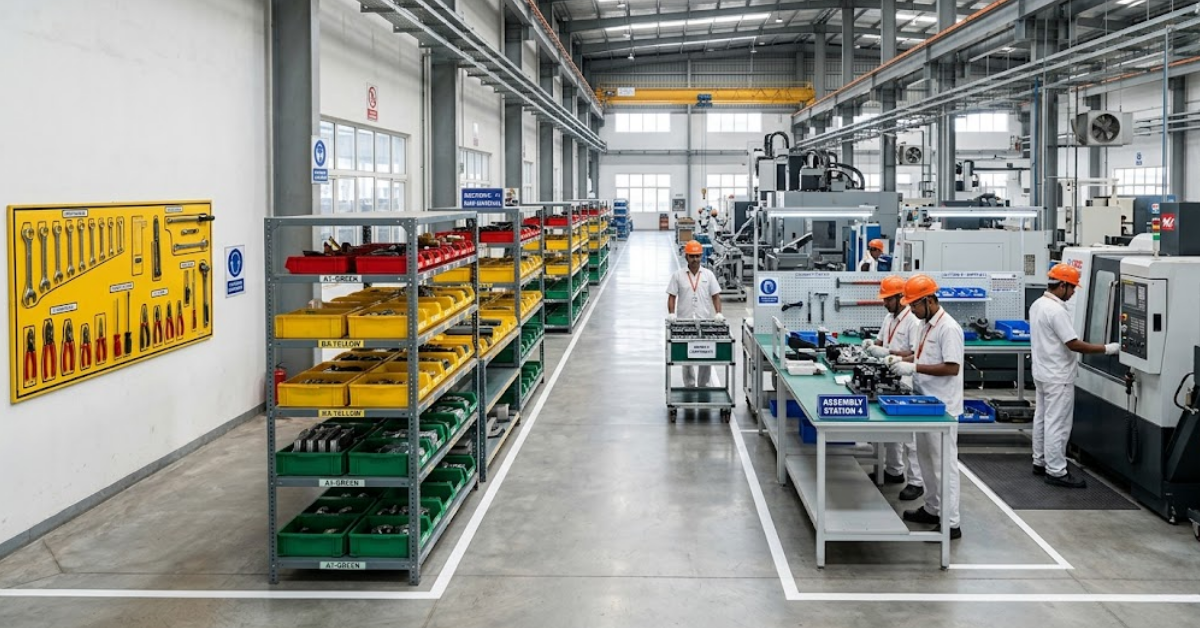
Operational waste is not always visible. It hides in excess motion, waiting time, rework, overproduction, and poor layout decisions. Over time, these inefficiencies silently reduce margins, slow growth, and impact business operations efficiency.
At Faber Infinite Consulting, we have worked across manufacturing, FMCG, logistics, and process industries, and one consistent pattern emerges: companies aiming to improve operational efficiency must systematically eliminate waste using structured frameworks like Lean Management and Six Sigma.
This blog explores how Lean & Six Sigma practices enable operational optimization, backed by real-world experience, research data, and actionable strategies.
What Is Operational Waste in Business Operations?
Operational waste refers to activities that consume resources but do not create value for customers.
The 8 Common Types of Waste (Lean Perspective)
| Waste Type | Operational Impact | Example in Manufacturing |
| Overproduction | Inventory carrying costs | Producing excess SKUs |
| Waiting | Idle labor & machines | Line stoppages |
| Transportation | Increased handling cost | Poor plant layout |
| Overprocessing | Higher cycle time | Duplicate quality checks |
| Inventory | Blocked working capital | Excess raw materials |
| Motion | Productivity loss | Inefficient workstation design |
| Defects | Rework & scrap cost | Quality failure |
| Underutilized Talent | Reduced organizational efficiency | Skill mismatch |
According to the McKinsey & Company, many factories operate at only 40–60% of their potential productivity due to hidden inefficiencies.
How Lean & Six Sigma Improve Operational Efficiency
Lean focuses on waste elimination. Six Sigma focuses on variation reduction. Together, they create structured process efficiency improvement.
Lean Management for Process Efficiency Improvement
Lean techniques emphasize:
- Value Stream Mapping
- Continuous Flow Design
- Pull Systems (Kanban)
- Kaizen methodology
- Standard Work Implementation
At Faber Infinite Consulting, we implemented lean techniques to increase operational efficiency in a mid-sized automotive plant. By redesigning the layout and improving material flow, the client reduced material travel distance by 32%, resulting in:
- 18% productivity improvement
- 21% reduction in WIP inventory
- Faster order fulfillment
This directly enhanced efficiency in operations without additional capital investment.
Six Sigma for Operational Optimization
Six Sigma uses DMAIC (Define, Measure, Analyze, Improve, Control) to reduce process variation.
| DMAIC Stage | Objective | Operational Benefit |
| Define | Identify key problem | Focused improvement |
| Measure | Data collection | Accurate baseline |
| Analyze | Root cause analysis | Eliminate defects |
| Improve | Implement solutions | Performance uplift |
| Control | Sustain gains | Long-term operational excellence |
The American Society for Quality (ASQ) notes that Six Sigma-driven organizations typically see defect reductions of up to 70% when properly implemented.
Data-Backed Impact of Lean & Six Sigma
Research from Boston Consulting Group shows that companies applying structured operational efficiency strategies achieve:
- 15–25% cost reduction
- 20–30% lead time reduction
- 10–20% inventory reduction
These gains directly improve cost efficiency and supply chain efficiency.
Real-World Experience: Manufacturing Transformation
In one of our operational excellence engagements, a process industry client struggled with inconsistent output and high rework rates.
Challenges Identified:
- Poor process standardization
- No real-time performance tracking
- High material movement
Intervention Approach:
- Time & Motion Study
- Layout redesign
- Statistical Process Control implementation
- Daily performance dashboards
Measurable Results (Within 6 Months):
- 27% productivity improvement
- 19% cost reduction
- 35% defect rate reduction
This case reinforces that business process optimization is not theoretical—it delivers tangible financial outcomes when executed with discipline.
Impact of Automation on Operational Performance
Automation amplifies Lean & Six Sigma benefits.
According to the World Economic Forum, smart manufacturing and automation can improve productivity by up to 30% when integrated with lean systems.
However, automation without process optimization often automates waste.
Operational efficiency strategies for manufacturing companies must follow this order:
- Stabilize process
- Standardize work
- Remove waste
- Then automate
How to Improve Operational Efficiency in a Business
Here is a structured roadmap:
| Step | Action | Outcome |
| 1 | Conduct operational audit | Identify hidden waste |
| 2 | Map value stream | Improve process visibility |
| 3 | Measure KPIs (OEE, cycle time, defects) | Establish baseline |
| 4 | Implement Kaizen projects | Continuous improvement |
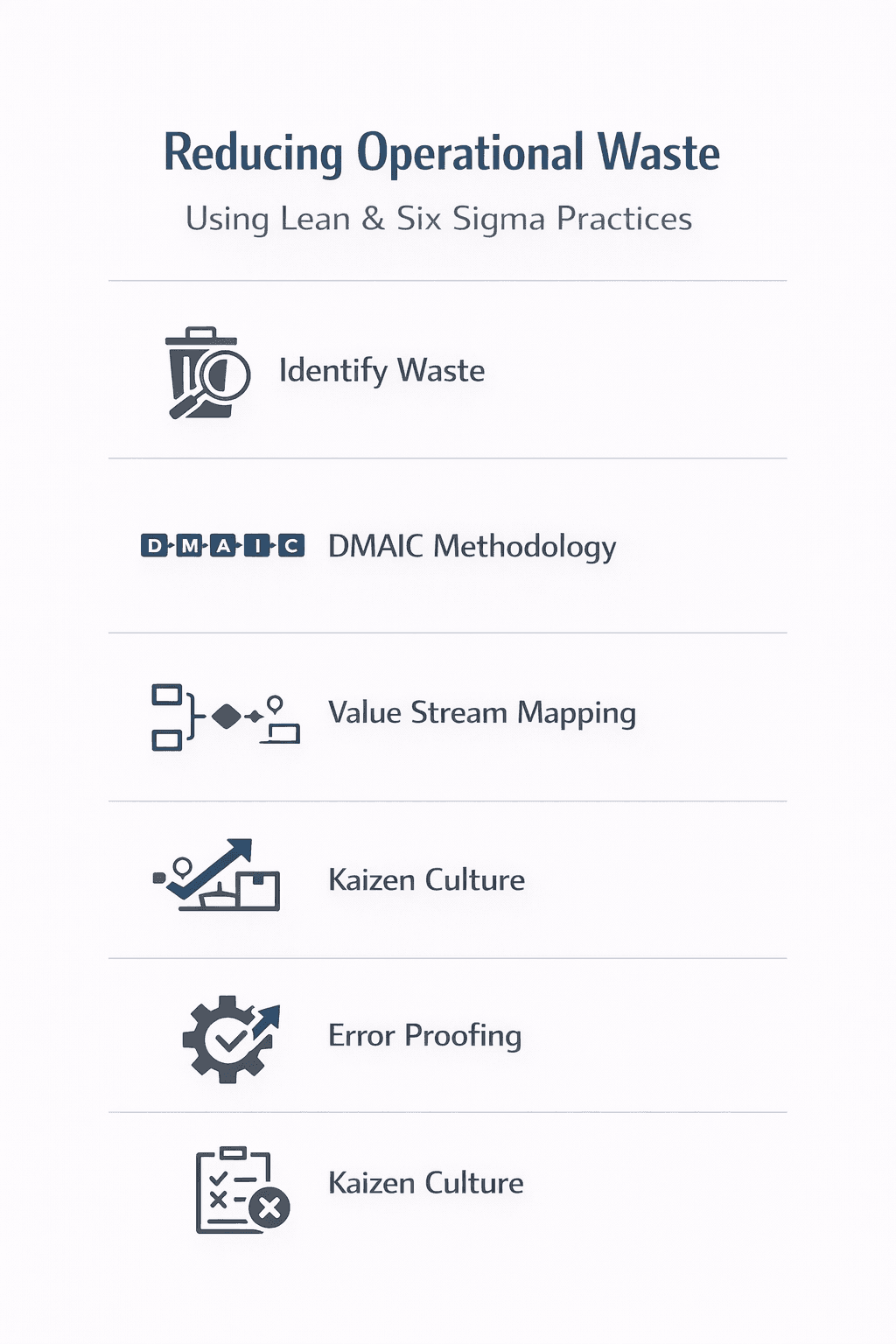
| 5 | Deploy DMAIC | Sustainable gains |
| 6 | Train teams | Organizational efficiency |
Operational excellence is not a one-time project. It is a cultural shift toward continuous improvement.
Why Lean & Six Sigma Strengthen Business Operations Efficiency
Lean & Six Sigma enable:
- Better decision-making using data
- Stronger cross-functional alignment
- Reduced cost through process improvement
- Faster response to market demand
- Sustainable operational optimization
Organizations that embed lean management principles experience higher resilience during market disruptions.
Conclusion: Turning Waste into Competitive Advantage
Operational waste is a silent margin killer. But with structured Lean and Six Sigma practices, businesses can:
- Improve operational efficiency
- Reduce cost without compromising quality
- Achieve sustainable operational excellence
- Strengthen supply chain efficiency
- Drive long-term productivity improvement
At Faber Infinite Consulting, we believe operational efficiency strategies must be data-driven, practical, and people-centric. The real transformation begins when leadership commits to systematic process improvement.
If you are exploring how to improve operational efficiency in your business, start with one value stream, measure it, and eliminate 20% of waste in the next 90 days.
Small improvements compound into exponential results.
FAQs
- How can Lean techniques increase operational efficiency?
Lean removes non-value-added activities, reduces lead time, improves flow, and enhances process efficiency improvement across operations.
- What is the difference between Lean and Six Sigma?
Lean focuses on waste elimination. Six Sigma focuses on variation reduction. Together, they deliver operational optimization.
- What industries benefit most from operational efficiency strategies?
Manufacturing, FMCG, logistics, healthcare, and service industries benefit significantly from business process optimization.
- How long does it take to see results from Lean & Six Sigma?
Most organizations see measurable productivity improvement within 3–6 months when properly executed.
- Can automation alone improve operational efficiency?
No. Automation must follow process stabilization and lean management implementation; otherwise, it amplifies inefficiencies.
Internal Link Suggestion:
Explore our Operational Excellence Consulting Services
External References:
- McKinsey & Company – Manufacturing Productivity Research
- American Society for Quality – Six Sigma Framework
- Boston Consulting Group – Cost Optimization Reports
- World Economic Forum – Future of Manufacturing