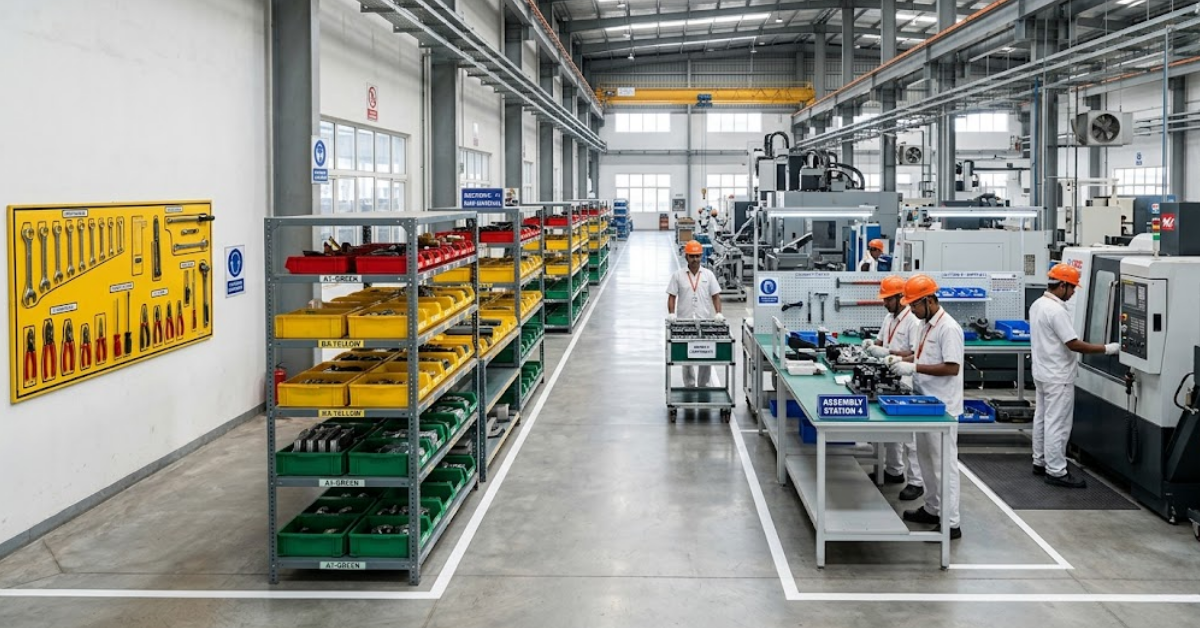
Walk into any manufacturing plant struggling with delays, excess inventory, or rising costs, and one issue quietly sits at the center: poor factory planning. Machines are placed where space was available—not where flow demanded it. Materials travel long distances. People wait, search, and adjust. Productivity suffers.
This is where factory planning consultants play a transformative role.
At Faber Infinite Consulting, we have seen first-hand how thoughtful factory planning and manufacturing plant layout design can turn operational chaos into structured, predictable performance. Factory planning is no longer just about drawing layouts—it is about building cost-effective, scalable, and future-ready manufacturing systems.
In this blog, we explore the role of factory planning consultants in manufacturing, how they deliver measurable impact, and why manufacturers across industries are investing in professional factory planning consulting services.
What Is Factory Planning in Manufacturing?
Factory planning is the structured process of designing or redesigning manufacturing facilities to optimize space, material flow, manpower, equipment placement, and future expansion. It integrates:
- Factory layout design
- Facility layout planning
- Process flow optimization
- Capacity planning
- Lean manufacturing principles
- Technology and Industry 4.0 readiness
According to the International Facility Management Association (IFMA), an optimized factory layout can improve plant efficiency by 20–30%, while poor layouts can increase operating costs by up to 15% annually.
This makes factory planning a strategic business decision—not just an engineering activity.
The Role of Factory Planning Consultants
1. Designing Flow-Based Factory Layouts
One of the core responsibilities of industrial factory planning consultants is creating layouts that support smooth, uninterrupted flow.
From our experience at Faber Infinite Consulting, most plants we assess suffer from:
- Excessive material movement
- Cross-traffic between people and forklifts
- Bottlenecks near shared machines
By applying lean manufacturing principles such as one-piece flow and cellular layouts, consultants redesign the manufacturing plant layout to:
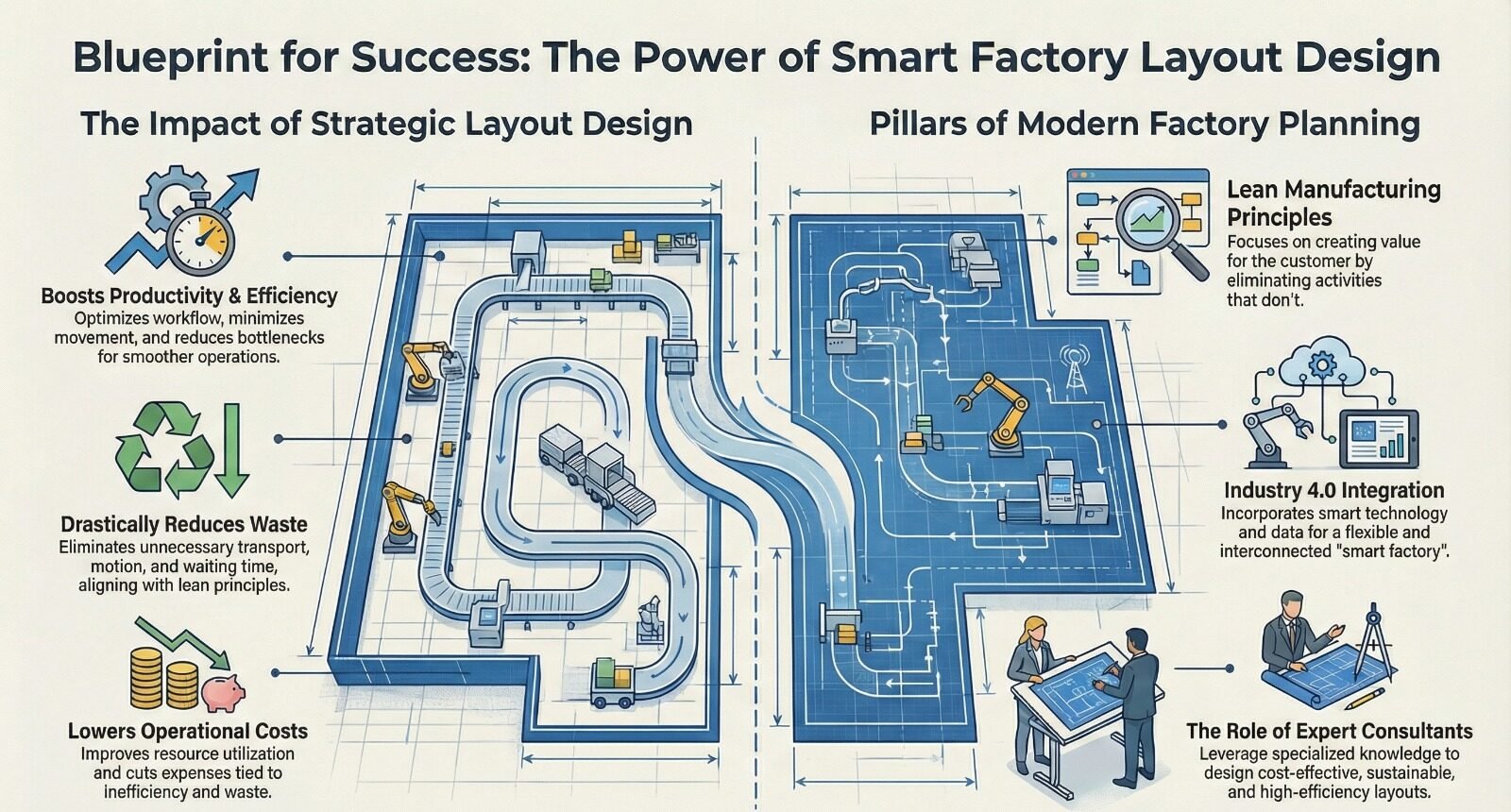
- Reduce travel distance by 30–50%
- Improve throughput
- Enhance operator safety
This is how factory layout design improves productivity in real-world environments.
2. Eliminating Waste Through Lean Factory Planning
Lean manufacturing is inseparable from effective factory planning.
Factory planning consultants identify and eliminate the seven wastes:
- Transportation
- Inventory
- Motion
- Waiting
- Overproduction
- Overprocessing
- Defects
In one FMCG plant supported by Faber Infinite Consulting, layout redesign combined with lean flow reduced internal material handling costs by 28% within six months.
This demonstrates how waste reduction and layout planning go hand in hand.
3. Improving Plant Efficiency and Space Utilization
Space is expensive. Yet many factories use only 60–70% of their available space effectively (source: McKinsey Operations).
Factory planning consultants use data-driven tools such as:
- Spaghetti diagrams
- Space utilization heat maps
- Simulation modeling
These tools help unlock hidden capacity without building new facilities. In multiple projects, Faber Infinite Consulting has helped clients defer capital expansion by 2–3 years through better factory layout design services.
Factory Planning for Industry 4.0 Manufacturing
4. Creating Smart Factory Layouts
Industry 4.0 is not only about automation—it depends heavily on layout readiness.
Factory planning consultants for Industry 4.0 manufacturing ensure that layouts support:
- Automated guided vehicles (AGVs)
- IoT-enabled machines
- Real-time data visibility
- Flexible production lines
A smart factory layout allows manufacturers to scale automation without frequent rework. According to Deloitte, factories designed with Industry 4.0 principles achieve 10–15% higher productivity than retrofitted plants.
5. Cost-Effective Planning for Long-Term Growth
Poor planning leads to frequent relocations, rework, and downtime. Factory planning consultants focus on cost-effective planning by:
- Designing for future capacity expansion
- Standardizing equipment footprints
- Avoiding short-term layout decisions
For small and mid-sized manufacturers, factory planning solutions for small manufacturing companies are especially critical. Smart planning enables growth without disrupting ongoing operations.
Avoiding Common Factory Planning Mistakes
6. Common Factory Planning Mistakes Manufacturers Should Avoid
Based on real project experience, these mistakes appear repeatedly:
- Designing layouts around machines instead of flow
- Ignoring future product mix changes
- Overlooking ergonomics and safety
- Failing to integrate maintenance access
- Treating layout as a one-time exercise
Industrial factory design must balance efficiency, safety, and flexibility. Factory planning consultants bring an external, unbiased view that helps manufacturers avoid these costly errors.
Sustainable and Responsible Factory Planning
7. Factory Planning Consultants for Sustainable Manufacturing
Sustainability is now a competitive requirement.
Factory planning consultants support sustainable manufacturing by:
- Reducing energy-intensive material movement
- Optimizing lighting and ventilation layouts
- Supporting low-carbon logistics flow
According to the World Economic Forum, layout-driven efficiency improvements can reduce manufacturing emissions by 5–10% without new technology investments.
At Faber Infinite Consulting, sustainability is embedded into every factory planning consulting service, aligning operational excellence with environmental responsibility.
Why Choose Professional Factory Planning Consultants?
8. Experience That Translates into Results
Unlike generic layout drafting, professional factory planning consultants bring:
- Cross-industry exposure
- Proven frameworks
- Implementation experience
At Faber Infinite Consulting, our teams combine hands-on shop-floor experience with global best practices, ensuring that every industrial factory planning consultant engagement delivers measurable impact.
9. Data-Driven and Standards-Based Approach
Authoritative factory planning follows recognized standards such as:
- ISO 9001 (Quality Management)
- ISO 14001 (Environmental Management)
- Lean and Six Sigma methodologies
We also reference industry benchmarks from organizations such as APICS, McKinsey, and Deloitte to ensure accuracy and credibility.
Conclusion: Factory Planning as a Competitive Advantage
Factory planning is no longer just about layout—it is about strategy, resilience, and growth.
Factory planning consultants help manufacturers:
- Improve plant efficiency
- Reduce manufacturing costs
- Enable Industry 4.0 readiness
- Build sustainable operations
Actionable Takeaways:
- Evaluate your current factory layout for flow inefficiencies
- Plan layouts with future expansion in mind
- Integrate lean manufacturing and Industry 4.0 early
- Partner with experienced factory planning consultants
At Faber Infinite Consulting, we help manufacturers transform spaces into performance-driven production systems.
Frequently Asked Questions (FAQs)
1. How does factory layout design improve productivity?
Efficient layouts reduce material movement, waiting time, and bottlenecks, leading to faster throughput and lower operating costs.
2. When should manufacturers hire factory planning consultants?
When setting up a new plant, expanding capacity, introducing new products, or facing persistent efficiency issues.
3. Are factory planning solutions suitable for small manufacturing companies?
Yes. Smart factory planning helps small manufacturers grow sustainably without unnecessary capital investment.
4. What is the role of Industry 4.0 in factory planning?
Industry 4.0 requires layouts that support automation, data flow, and flexible production systems.
5. How long does a factory planning project take?
Depending on complexity, projects typically range from 6 weeks to 6 months, including design and implementation support.
Contact us for Factory Planning Consultants