Manufacturers today are under relentless pressure — rising input costs, volatile demand, shorter product life cycles, and stricter quality expectations. Yet, according to the McKinsey & Company, many factories still operate at only 60% of their potential productivity due to inefficiencies in processes, equipment downtime, and fragmented data systems.
So the real question is not whether technology is changing manufacturing — it is whether your factory is ready to use it intelligently.
This is where Smart Factory and Industry 4.0 step in — not as buzzwords, but as structured frameworks for manufacturing productivity improvement.
At Faber Infinite Consulting, we have worked with diverse industries to transform traditional facilities into data-driven, performance-oriented operations. In this blog, we share practical insights, industry-backed knowledge, and actionable strategies to help you increase productivity in manufacturing sustainably.
What Is a Smart Factory in Industry 4.0?
A Smart Factory is an advanced manufacturing facility that uses connected systems, real-time data, automation, and intelligent analytics to improve manufacturing efficiency and production productivity.
Industry 4.0 refers to the fourth industrial revolution — integrating:
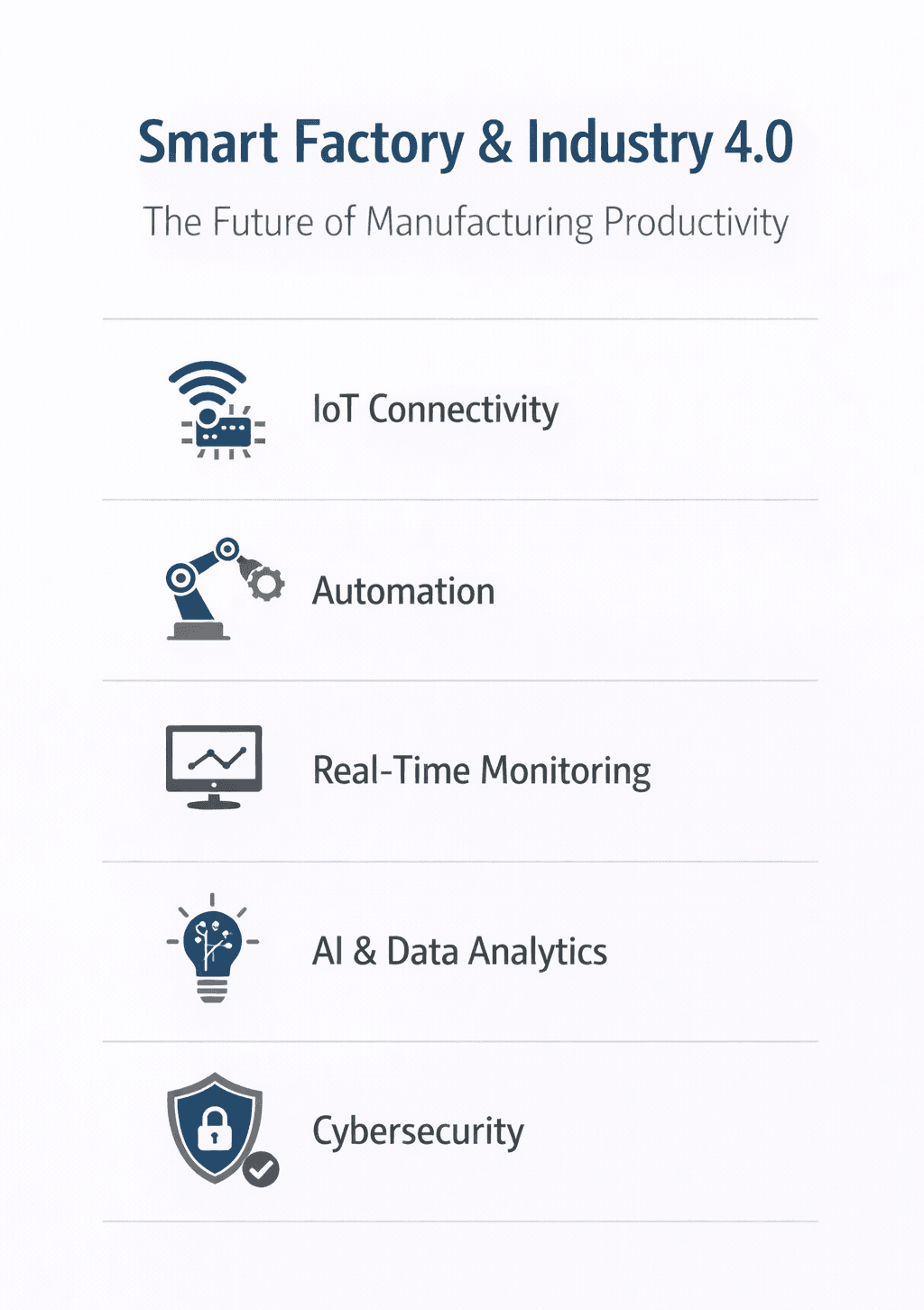
| Technology | Impact on Manufacturing Productivity |
| IoT Sensors | Real-time machine performance tracking |
| AI & Analytics | Predictive maintenance and quality improvement |
| Cloud Systems | Centralized production planning visibility |
| Robotics & Automation | Consistent output and waste reduction |
| Digital Twins | Simulation-based factory productivity improvement |
According to the World Economic Forum, “Lighthouse” smart factories have achieved:
- 30–50% productivity gains
- 20–50% reduction in machine downtime
- 10–20% reduction in energy consumption
These are not theoretical projections — they are real, documented performance shifts.
Why Manufacturing Productivity Still Lags
Despite technological advancement, many factories struggle because:
- Production planning is reactive, not predictive
- Maintenance is breakdown-based instead of preventive
- Data exists but is not actionable
- Lean manufacturing productivity principles are not digitally integrated
The International Federation of Robotics reports that while automation adoption is increasing globally, process inefficiency — not lack of automation — is the primary productivity bottleneck.
Technology without operational alignment does not improve productivity.
Real-World Experience: A Factory Transformation Case
At Faber Infinite Consulting, we partnered with a mid-sized engineering manufacturer facing:
- 18% machine downtime
- High WIP inventory
- Frequent quality rejections
- Poor cross-functional coordination
Step 1: Operational Baseline Assessment
We conducted:
- Time & Motion Study
- Value Stream Mapping
- OEE (Overall Equipment Effectiveness) evaluation
- Maintenance pattern analysis
Step 2: Smart Factory Integration
We implemented:
- IoT-enabled downtime tracking
- TPM framework integration
- Digital production planning dashboards
- Automated quality alerts
Results in 6 Months:
| Metric | Before | After | Impact |
| OEE | 58% | 74% | +16% |
| Downtime | 18% | 9% | -50% |
| Rejections | 7% | 3% | Improved quality |
| Throughput | +22% | Production productivity increase |
This was not just digital transformation Industry 4.0 — it was structured factory productivity improvement grounded in lean thinking.
How to Increase Productivity in Manufacturing Industries
Here is a practical breakdown:
- Combine Lean + Digital
Lean manufacturing productivity principles like:
- Waste reduction
- Continuous improvement
- Flow optimization
When digitally enabled, they deliver exponential gains.
Example:
Manual downtime recording → Often inaccurate
Sensor-based downtime tracking → Real-time corrective action
- Implement Total Productive Maintenance (TPM)
TPM improves machine efficiency by:
- Autonomous maintenance
- Planned maintenance
- Focused improvement
According to the Japan Institute of Plant Maintenance, TPM can improve equipment productivity by 15–25% when implemented systematically.
This directly supports how TPM improves productivity and machine efficiency.
- Smart Production Planning
Advanced production planning tools allow:
- Capacity simulation
- Demand forecasting
- Bottleneck prediction
Industry 4.0 solutions to increase manufacturing productivity rely heavily on predictive planning rather than reactive scheduling.
- Data-Driven Quality Improvement
Using AI for defect prediction:
- Reduces rework
- Improves first-pass yield
- Lowers material waste
Quality improvement is a critical driver of manufacturing efficiency.
- Digital Performance Dashboards
Smart factories use:
- Real-time KPI dashboards
- Automated alerts
- Threshold-based escalation
This ensures decision fatigue does not slow operational excellence.
Smart Factory vs Traditional Factory
| Parameter | Traditional Factory | Smart Factory |
| Maintenance | Breakdown-based | Predictive (TPM + AI) |
| Data | Manual entry | Real-time IoT data |
| Production Planning | Static | Dynamic & predictive |
| Quality Control | Post-production inspection | In-process monitoring |
| Decision Making | Experience-based | Data-backed |
The Role of Operational Excellence
Digital tools must align with structured operational excellence frameworks.
At Faber Infinite Consulting, we integrate:
- Lean manufacturing productivity
- Digital transformation Industry 4.0
- Total productive maintenance (TPM)
- Continuous improvement culture
The goal is not automation — it is sustainable productivity improvement in manufacturing.
Best Strategies to Increase Productivity in Manufacturing Facilities
Here is a crisp execution roadmap:
| Phase | Action | Outcome |
| Diagnose | Conduct OEE & VSM | Identify waste |
| Stabilize | Implement TPM | Reduce downtime |
| Digitize | Install IoT dashboards | Real-time visibility |
| Optimize | AI-based analytics | Predict failures |
| Scale | Continuous improvement loops | Sustainable growth |
Common Mistakes in Industry 4.0 Implementation
- Investing in technology before process stability
- Ignoring workforce training
- Lack of change management
- Treating digital transformation as an IT project
Smart Factory success requires cultural transformation.
The Future of Manufacturing Productivity
The Boston Consulting Group estimates that Industry 4.0 adoption can improve manufacturing productivity by up to 30% when aligned with lean systems.
The future factory will be:
- Self-monitoring
- Self-optimizing
- Data-intelligent
- Sustainability-focused
However, the foundation will always remain:
Lean thinking + structured execution + digital integration.
Actionable Takeaways
If you want factory productivity improvement:
- Measure OEE today — not assumptions.
- Implement TPM before automation expansion.
- Digitize production planning for predictive visibility.
- Train your workforce in data interpretation.
- Align digital transformation with operational excellence goals.
Smart Factory is not about buying machines — it is about redesigning how decisions are made.
FAQs
- How to increase productivity in manufacturing industries?
Start with waste reduction, implement TPM, integrate real-time data monitoring, and align lean manufacturing techniques with digital tools.
- What are Industry 4.0 solutions to increase manufacturing productivity?
IoT-based monitoring, AI-driven predictive maintenance, smart production planning systems, and digital dashboards.
- How does TPM improve productivity and machine efficiency?
TPM reduces breakdowns, improves OEE, increases equipment life, and stabilizes production productivity.
- What is the best strategy for factory productivity improvement?
Combine lean manufacturing productivity with digital transformation Industry 4.0 and structured continuous improvement programs.
- Is Smart Factory suitable for small manufacturers?
Yes. Even small facilities can adopt phased digital transformation focusing on data visibility and waste reduction first.
Contact us