In the competitive climate of 2026, manufacturing entities are under immense pressure to deliver high-quality products with shorter lead times and lower costs. Achieving this requires more than just hard work; it requires a surgical understanding of how value flows through a facility. Navigating this complexity is a significant challenge, which is why many organizations turn to specialized expertise to illuminate the path toward operational excellence.
Why is it Critical to Partner with Experienced Value Stream Mapping Consultants?
The journey toward a leaner operation begins with visibility. Many facility managers believe they understand their processes, yet they are often surprised by the sheer volume of “waste” uncovered during a formal value stream analysis. This is the primary reason why value stream mapping consultants are essential. They provide an objective, data-driven perspective that internal teams, often blinded by routine, might miss.
A consultant’s first task is to define the boundaries of the value stream. In a complex facility, attempting to map every single product at once is a recipe for confusion. Experts recommend selecting a “product family” based on shared processing steps. By focusing on a specific family, consultants can identify systemic issues that affect a broad range of outputs. Statistics from facility design research indicate that identifying a single bottleneck in a primary product family can lead to a 15% to 20% increase in overall plant capacity without adding a single new machine.
How Do VSM Consultants Construct an Accurate Current State Map of Your Facility?
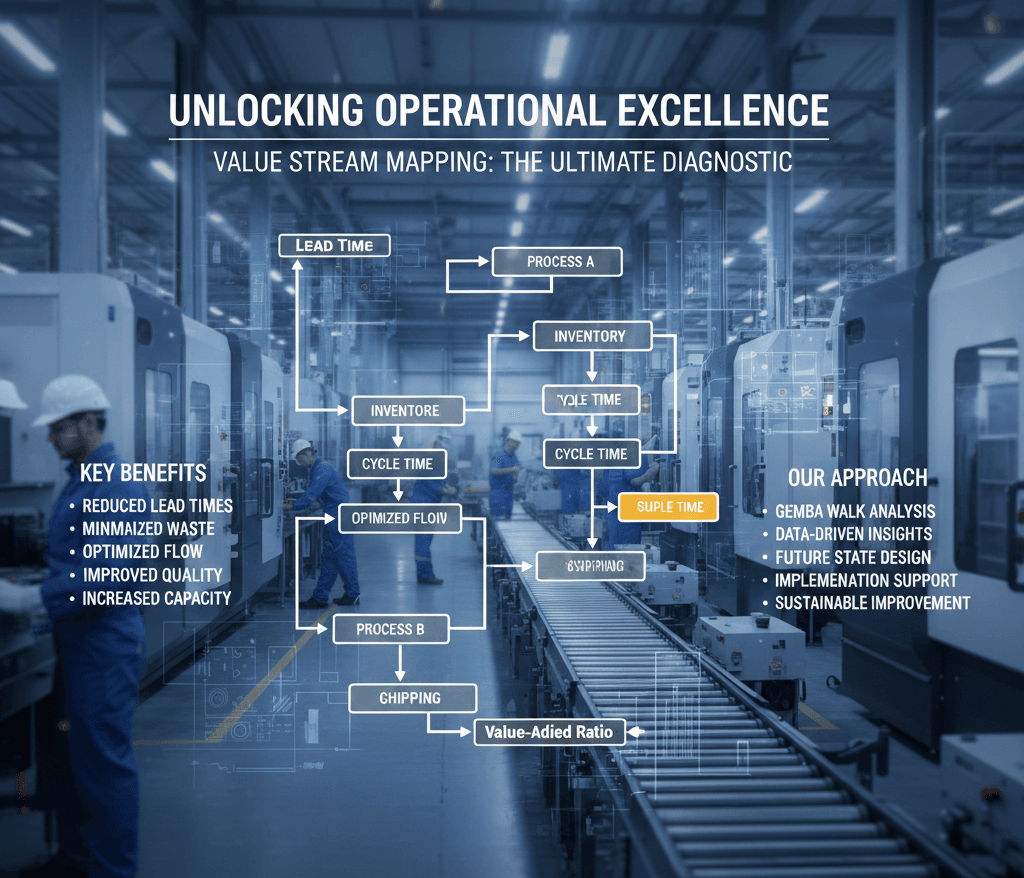
The “Current State Map” is a snapshot of reality, warts and all. VSM consultants spend a significant amount of time on the shop floor, performing a “Gemba walk.” They don’t rely on office-bound reports; they measure actual cycle times, setup times, and inventory levels between processes.
Using lean methodology, consultants document the flow of both materials and information. In many unoptimized facilities, the statistics are eye-opening. It is not uncommon to find that a product spends 90% of its time sitting in a bin as Work-in-Process (WIP) inventory, waiting for the next machine to become available. By documenting these “dwell times,” consultants highlight exactly where capital is being tied up.
During this phase, the use of VSM software tools allows for the digital capture of these data points, creating a baseline that includes:
- Cycle Time (C/T): The time it takes to complete one unit.
- Changeover Time (C/O): The time required to switch a machine from one product to another.
- Uptime: The percentage of time a machine is actually available to run.
- Pack Size: The number of items moved between stations.
What Specific Value Can Professional VSM Consulting Services Add to Your Strategy?
Once the current state is documented, the real transformation begins. VSM consulting services excel at identifying the gap between where a company is and where it needs to be. The ultimate goal is to design a “Future State Map” that eliminates as much non-value-added activity as possible.
One of the most impactful areas of manufacturing optimization is the reduction of travel distance. In documented facility redesigns, it was found that disorganized layouts caused materials to travel over 2,500 feet during production. Through strategic mapping and the implementation of a more logical flow, consultants reduced this distance to under 900 feet, a 64% reduction. This change directly translates to lower labor costs, fewer forklift requirements, and a significant reduction in the total time a product spends in the building.
Furthermore, these services help transition a facility from a “Push” system (producing based on a schedule) to a “Pull” system (producing based on actual customer demand). This shift is critical for productivity improvement, as it prevents the overproduction that clogs the shop floor and obscures quality issues.
How Do Tailored Value Stream Mapping Services Identify and Remove Process Waste?
The core of any value stream mapping services engagement is the relentless pursuit of waste elimination. Lean principles identify eight primary wastes, ranging from defects and over-processing to unused employee talent.
Consultants look for “islands of automation,” machines that run incredibly fast but create massive piles of inventory because the downstream process cannot keep up. By balancing the line to the “Takt time” (the rate of customer demand), consultants ensure a smooth, continuous flow. In one instance involving a facility layout overhaul, balancing the line allowed the organization to reduce its total lead time from 12 days to just 4.5 days.
This level of process improvement often involves physical changes to the shop floor, such as moving machines into a U-shaped cell. This layout allows a single operator to manage multiple machines, improving labor utilization by up to 30%. By reducing the physical footprint of the production line, the facility also gains valuable floor space that can be repurposed for new revenue-generating activities.
Why Should Your Organization Invest in Long-Term Lean VSM Consulting?
A one-time mapping exercise is helpful, but lean VSM consulting is most effective when it is viewed as a catalyst for a permanent culture shift. Operational excellence is a moving target; customer demands change, technologies evolve, and new wastes can creep back into a system over time.
A lean value stream mapping consultant works to train internal “Lean Champions.” By involving the workforce in the creation of the maps, the consultant ensures that the people on the front lines understand the “why” behind the changes. When an operator sees that a layout change reduces their daily walking distance by a mile, their buy-in is immediate.
Statistics show that organizations with a strong culture of continuous improvement see a 10% to 15% year-over-year improvement in productivity, even after the initial “low-hanging fruit” has been harvested. The consultant provides the framework, but the employees provide the momentum.
How Does a Lean Value Stream Mapping Consultant Bridge the Gap to Industry 4.0?
As we move further into 2026, the intersection of lean and digital technology is unavoidable. A lean value stream mapping consultant ensures that a company doesn’t make the mistake of “paving the cow path,” digitizing an inefficient process.
Instead, they use VSM to identify the most critical points for data collection. By integrating VSM with Industry 4.0 tools, such as automated tracking and real-time performance dashboards, the “Future State” becomes a living entity. Managers can see in real-time if a value stream is deviating from its target Takt time, allowing for instant correction rather than waiting for a weekly production meeting.
This synergy between traditional lean methodology and modern technology is the hallmark of a world-class manufacturing operation. It allows for a level of agility that was previously impossible, enabling the facility to pivot quickly in response to market volatility.
FAQs
What are the main benefits of hiring value stream mapping consultants?
The benefits of hiring value stream mapping consultants include gaining an unbiased view of operations, identifying hidden wastes, and significantly reducing lead times. Consultants bring specialized expertise in VSM software tools and lean methodology that helps companies achieve a higher ROI on their improvement initiatives.
Do you provide VSM consulting services for manufacturing industries specifically?
Yes, VSM consulting services for manufacturing industries focus on the unique challenges of the shop floor, such as machine downtime, high setup times, and complex material handling. These services are essential for manufacturing optimization and achieving a high level of operational excellence.
How do VSM consultants help reduce lead time and process waste?
When considering how VSM consultants help reduce lead time and process waste, they focus on eliminating non-value-added activities. By optimizing layouts and reducing travel distances, often by over 60%, they ensure products move through the facility faster, which directly lowers costs and improves customer satisfaction.
What are the primary VSM implementation steps for lean transformation?
The VSM implementation steps for lean transformation usually follow a structured path: selecting a product family, creating the Current State Map, identifying wastes, designing the Future State Map, and finally, executing a “Kaizen” plan to implement the changes.
How does lean VSM consulting for continuous improvement culture-building work?
Lean VSM consulting for continuous improvement culture building involves training and engaging employees at all levels. By making the flow of value visible, employees are empowered to identify and solve problems themselves, ensuring that process improvement becomes a daily habit rather than a one-time event.
How does VSM integration with Industry 4.0 for real-time insights improve efficiency?
VSM integration with Industry 4.0 for real-time insights allows for the creation of “digital twins” of the production process. This provides management with live data on cycle times and bottlenecks, enabling faster decision-making and a more responsive production environment.
Contact us