
As the Kingdom of Saudi Arabia accelerates its transition toward a diversified, non-oil-based economy, the pressure on local enterprises to optimize operations has never been higher. To compete on a global scale while meeting the ambitious targets of Vision 2030, businesses must look beyond simple cost-cutting and embrace systemic transformation. One of the most potent tools in this journey is a specialized diagnostic and planning method that visualizes the entire flow of value.
Why Should Organizations Partner with Value Stream Mapping Consultants for Growth?
In many high-growth environments, internal teams are often too close to the daily “firefighting” to notice the structural inefficiencies draining their resources. Value Stream Mapping Consultants provide an external, objective lens to identify where time, capital, and effort are being wasted. Unlike traditional consulting that might focus on a single department, these specialists look at the horizontal flow, from the initial customer order to the final delivery.
By working with Value Stream Mapping Consultants, companies can move away from “island optimization,” where one department improves at the expense of another. In a significant operational overhaul within a large-scale facility, it was discovered that while individual production stages were running at 90% efficiency, the total lead time remained high because of massive stagnation points between stations. The intervention of expert consultants helped reorganize these buffers, leading to a 28% improvement in overall throughput without adding a single new machine.
What Makes Value Stream Mapping the Definitive Tool for Modern Saudi Enterprises?
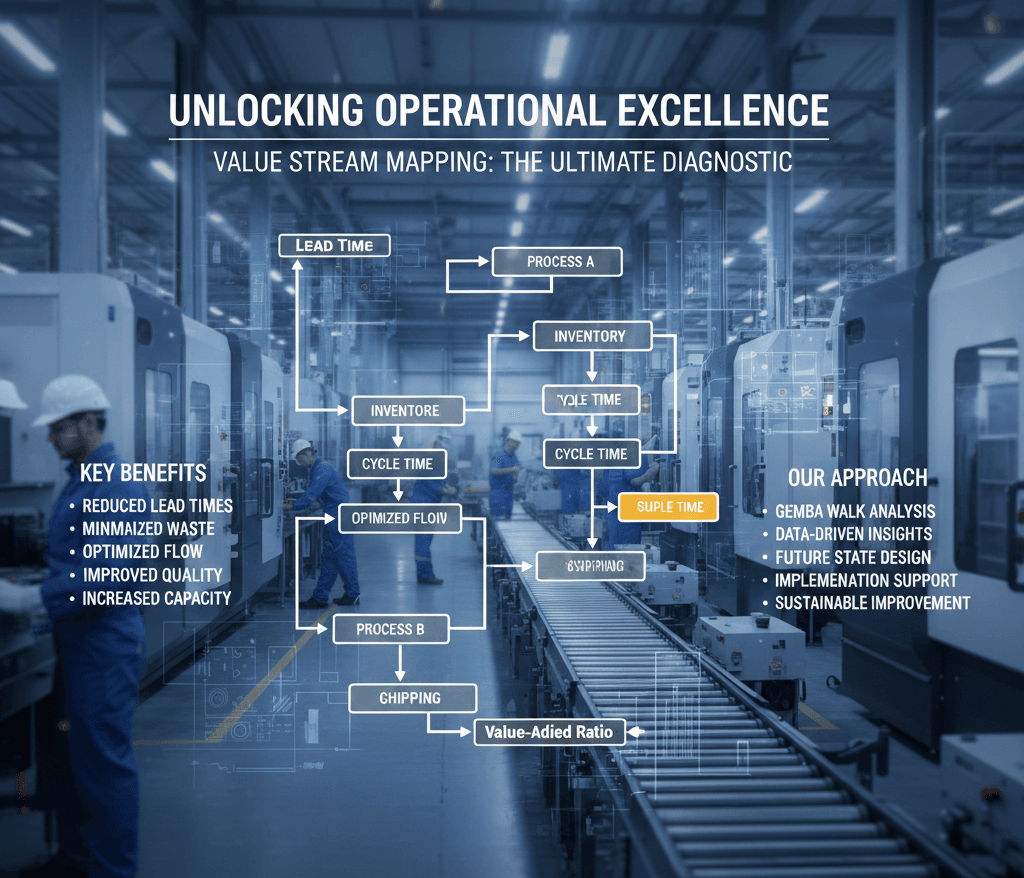
At its core, Value Stream Mapping is a visual language that allows leadership to see the “invisible” paths of information and material. In the context of the Saudi market, where supply chains are becoming increasingly complex due to regional expansion, having a clear map is essential. It serves as the foundation for lean management in Saudi Arabia, providing a data-driven baseline for all future improvements.
When a business utilizes Value Stream Mapping, it isn’t just creating a diagram; it is building a strategic roadmap. By documenting every step, including the wait times that usually go unrecorded, managers can pinpoint exactly where “value” is added and where “waste” accumulates. Statistics from local implementations indicate that firms focusing on this level of transparency often identify that up to 60% of their total lead time is comprised of non-value-added activities, such as excessive transport or redundant administrative approvals.
How Can an Integrated VSM Implementation Framework Standardize Your Local Operations?
Consistency is the hallmark of operational excellence. A robust VSM implementation framework ensures that the mapping process isn’t a one-off brainstorming session but a repeatable cycle of improvement. This framework typically involves three critical phases: the Current State, the Future State, and the Implementation Plan.
Adopting a standardized VSM implementation framework allows Saudi companies to align their internal language. Whether the facility is in Jubail, Jeddah, or Riyadh, the metrics used to measure performance, such as Takt time and changeover duration, remain consistent. This standardization is a core component of operational excellence consulting KSA, ensuring that as a company scales, its efficiency doesn’t dilute. In one regional project, the application of a structured framework allowed a facility to reduce its Work-in-Process (WIP) inventory by 40%, significantly freeing up cash flow that was previously tied up in stagnant materials.
Why Is Industrial Value Stream Mapping in Saudi Arabia Essential for Large-Scale Facilities?
For heavy industry and large-scale production, the stakes are incredibly high. Industrial Value Stream Mapping in Saudi Arabia focuses on the unique challenges of high-volume, high-complexity environments. In these settings, even a small bottleneck can result in millions of Riyals in delayed revenue.
Through Industrial Value Stream Mapping in Saudi Arabia, facilities can synchronize their production rates with actual market demand. This prevents the “overproduction” trap that often plagues local manufacturers. By shifting to a “pull” system, where production is triggered by actual consumption rather than forecasts, firms have achieved a 15% reduction in warehousing costs. This focus on continuous improvement in Saudi Arabia ensures that the industrial sector remains agile enough to respond to fluctuating global commodity prices and local demand shifts.
How Does Lean Value Stream Mapping KSA Facilitate Sustainable Waste Reduction?
Sustainability is no longer a buzzword; it is a requirement for the modern Saudi business. Lean Value Stream Mapping KSA is the primary vehicle for identifying and eliminating the “Eight Wastes” of Lean. While most managers recognize physical waste, Lean mapping uncovers intellectual and temporal waste, such as underutilized talent or excessive waiting for digital approvals.
By implementing Lean Value Stream Mapping KSA, organizations can apply targeted waste reduction strategies. For example, by mapping the flow of information in a procurement cycle, one company found that documents were being handled by six different people, most of whom provided no actual value to the process. Streamlining this flow through process improvement consulting in Saudi Arabia reduced the administrative cycle time by 55%, allowing the team to focus on higher-value strategic sourcing.
What Are the Key Stages of a Professional Value Stream Mapping Methodology?
A successful Value Stream Mapping methodology follows a logical progression that prioritizes data over opinions.
- Scope Definition: Identifying the specific “Product Family” to be mapped.
- Current State Documentation: Capturing real-time data from the shop floor or office. This includes measuring cycle times, uptime, and error rates.
- Analysis of Flow: Using value stream analysis to identify disconnects between material flow and information flow.
- Future State Design: Visualizing an ideal state where waste is removed, and flow is continuous.
- The Transformation Plan: Breaking down the Future State into manageable “Kaizen” (improvement) events.
This Value Stream Mapping methodology ensures that the changes made are sustainable. Organizations that jump straight to “solutions” without first mapping the “current state” often find that their improvements disappear within months because the underlying root causes were never addressed.
Can Value Stream Mapping Solutions in Saudi Arabia Bridge the Gap in Supply Chain Efficiency?
The logistics and supply chain sector in the Kingdom is currently undergoing a massive transformation. Value Stream Mapping Solutions in Saudi Arabia are vital for companies looking to enhance their supply chain efficiency in Saudi Arabia. Because VSM looks at the flow between organizations, it is the perfect tool for identifying delays at ports, customs, or third-party warehouses.
When applying Value Stream Mapping Solutions in Saudi Arabia, the focus shifts to the “Extended Value Stream.” By collaborating with suppliers and distributors to map the shared process, firms have been able to reduce total end-to-end lead times by 20% to 30%. This collaborative approach, often facilitated by business efficiency consulting in Saudi Arabia, ensures that the entire value chain is optimized for the end customer, leading to higher service levels and lower total costs.
FAQs
Why should we invest in Value Stream Mapping Consultants in Saudi Arabia specifically?
Local Value Stream Mapping Consultants in Saudi Arabia understand the specific regulatory, cultural, and logistical landscape of the Kingdom. They can tailor the Lean methodology to fit local labor laws and the unique geographic challenges of the Middle East, ensuring the VSM process mapping is realistic and actionable within the Saudi context.
How do Lean process improvement and VSM consultants for supply chain impact the bottom line?
These consultants focus on “Velocity.” By increasing the speed at which a product moves through the system, you reduce the capital tied up in inventory. Lean process improvement and VSM consultants for supply chain help businesses realize faster cash-to-cash cycles, which directly improve liquidity and profitability.
What is the ROI on value stream mapping training and consultancy services in Saudi Arabia?
While the initial investment in value stream mapping training and consultancy services in Saudi Arabia may seem significant, the ROI is usually realized within the first six months. By identifying wastes that lead to a 10-15% reduction in operating costs, the project typically pays for itself several times over within the first year of implementation.
How do Lean Six Sigma and Value Stream Mapping consulting services in KSA differ from basic mapping?
Basic mapping identifies where the waste is. Lean Six Sigma and Value Stream Mapping consulting services in KSA go a step further by using statistical tools to solve the root causes of that waste, particularly when the waste is caused by process variation or quality defects. This ensures a more permanent fix.
When should we hire an expert Value Stream Mapping consultant in the Middle East?
The best time to hire an expert Value Stream Mapping consultant in the Middle East is when you are planning a facility expansion, launching a new product line, or when you notice that your lead times are increasing despite adding more resources. It is a proactive step to ensure your growth is efficient.
Why are Value Stream Mapping consultants for Industrial Transformation in Saudi Arabia crucial for Vision 2030?
As industries modernize, they often adopt expensive technologies. Value Stream Mapping consultants for Industrial Transformation in Saudi Arabia ensure that you don’t just “automate your mess.” They help you lean out your processes first, so that your investment in automation and Industry 4.0 technology yields the maximum possible benefit.