
Rising input costs, global competition, and margin pressure are pushing Indian manufacturers to rethink how they operate. Cost-cutting is no longer about trimming expenses—it’s about building smarter, more efficient systems that sustain growth.
This is where strategic operational cost reduction comes in. Instead of reactive cuts, leading organizations are redesigning processes, improving flow, and leveraging expert guidance to reduce costs without compromising quality or output.
At Faber Infinite Consulting, real-world engagements across industries show that cost reduction, when done right, can improve productivity by 30–50%—without heavy capital investment.
What is Strategic Operational Cost Reduction?
Strategic cost reduction focuses on eliminating inefficiencies across operations while improving performance. It goes beyond short-term savings and builds long-term capability.
| Aspect | Traditional Cost Cutting | Strategic Cost Reduction |
| Approach | Reactive | Proactive |
| Focus | Expense reduction | Process optimization |
| Impact | Short-term | Sustainable |
| Risk | High (quality compromise) | Low (performance-driven) |
Why Indian Manufacturing Needs It Now
India’s manufacturing sector contributes nearly 17% to GDP (Source: Government of India) and is expected to grow rapidly. However, challenges remain:
- Rising labor and energy costs
- Inefficient plant layouts
- Underutilized capacity
- Poor demand-supply alignment
This creates a strong need for manufacturing consulting firms in India and industrial operational efficiency experts India to step in with structured solutions.
Key Strategies for Operational Cost Reduction
-
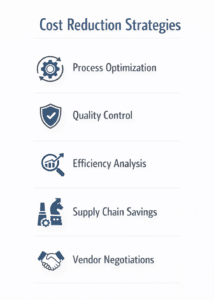
Process Optimization & Flow Improvement
Many factories operate with hidden inefficiencies—unnecessary movement, waiting time, and bottlenecks.
What experts do:
- Redesign plant layouts
- Optimize material flow
- Balance production lines
Impact:
- 20–40% reduction in cycle time
- Increased throughput without extra investment
This is where manufacturing process optimization consultants add immediate value.
-
Lean Manufacturing Implementation
Lean focuses on eliminating waste (muda) across processes.
Key areas:
- Overproduction
- Inventory excess
- Motion waste
- Defects
Best practices for operational efficiency in manufacturing:
- 5S implementation
- Value Stream Mapping
- Kaizen initiatives
Result:
- Reduced operational costs
- Improved workplace efficiency
This aligns with Lean Manufacturing Excellence India initiatives.
-
Smart Capacity Utilization
Underutilized machines and manpower directly increase cost per unit.
Approach:
- Identify idle capacity
- Improve scheduling
- Align production with demand
Outcome:
- Higher output per resource
- Better ROI on existing assets
-
Industrial Automation with ROI Focus
Automation is not about replacing people—it’s about improving consistency and reducing manual errors.
Industrial automation ROI strategies include:
- Targeted automation (not full-scale)
- ROI-based investment decisions
- Integration with existing systems
Example:
Automating a critical bottleneck process can increase output by 25% while reducing defects.
-
Quality Control & Assurance Optimization
Poor quality leads to rework, scrap, and customer dissatisfaction.
Quality control and assurance consulting focuses on:
- Root cause analysis
- Process standardization
- Error-proofing (Poka-Yoke)
Impact:
- Reduced rejection rates
- Lower cost of poor quality (COPQ)
Real-Life Case Insight (Experience)
A leading Indian manufacturing company faced rising operational costs and stagnant productivity.
Challenges:
- Inefficient layout
- High material movement
- Frequent delays
Intervention by Faber Infinite Consulting:
- Redesigned plant layout
- Implemented lean practices
- Improved line balancing
Results:
- 45% productivity improvement
- 30% reduction in operational costs
- Zero major capex investment
This demonstrates how manufacturing consulting firms drive efficiency through practical, on-ground solutions.
Role of Manufacturing Consulting Firms
Manufacturing consultants bring structured methodologies, external perspective, and execution capability.
Ways manufacturing consultants boost operational efficiency:
| Area | Consultant Contribution |
| Process Design | Data-driven optimization |
| Workforce Productivity | Skill alignment & training |
| Cost Reduction | Waste elimination |
| Technology Integration | Smart automation planning |
Engaging industrial operational efficiency experts India helps organizations move faster with lower risk.
Continuous Improvement: The Long-Term Advantage
Cost reduction is not a one-time activity. It requires a culture of continuous improvement.
Continuous improvement in manufacturing includes:
- Daily performance tracking
- Employee involvement
- Small, incremental improvements
Organizations that adopt this mindset consistently outperform competitors.
Data & Industry Backing
- According to research, lean transformations can reduce costs by 15–25%.
- Report says smart manufacturing improves productivity by up to 30%.
- Indian government initiatives like Make in India emphasize efficiency and competitiveness.
Common Mistakes to Avoid
- Focusing only on cost cutting, not efficiency
- Over-investing in automation without ROI clarity
- Ignoring workforce training
- Lack of execution discipline
Conclusion: Actionable Takeaways
Strategic operational cost reduction is not about doing less—it’s about doing things better.
What manufacturers should do next:
- Conduct a detailed operational assessment
- Identify high-impact improvement areas
- Implement lean and process optimization
- Invest in ROI-driven automation
- Partner with manufacturing consulting firms in India
With the right approach, cost reduction can become a growth driver—not a constraint.
FAQs
-
How do manufacturing consulting firms drive efficiency?
They analyze operations, identify inefficiencies, and implement structured improvements in processes, layout, and resource utilization.
-
What are the best practices for operational efficiency in manufacturing?
Lean implementation, process optimization, capacity utilization, and continuous improvement are key best practices.
-
How does automation impact operational costs?
When implemented strategically, automation reduces labor dependency, improves consistency, and lowers long-term costs.
-
What is the impact of manufacturing consulting on operational costs?
Consulting interventions can reduce operational costs by 20–30% while improving productivity and quality.
-
Why is continuous improvement important?
It ensures sustained efficiency gains and helps organizations adapt to changing market conditions.