
In India’s fast-evolving manufacturing landscape, efficiency is no longer optional—it’s a competitive necessity. Yet, many plants still struggle with unplanned downtime, inconsistent quality, and underutilized assets. This is where Total Productive Maintenance Consulting becomes a game changer.
By combining structured maintenance practices with workforce engagement and data-driven decision-making, TPM Consulting Services India are helping organizations significantly improve Overall Equipment Effectiveness (OEE). From automotive to FMCG, companies are seeing measurable gains in productivity, cost savings, and operational stability.
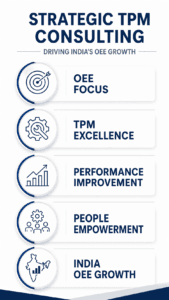
This blog breaks down how strategic TPM consulting drives OEE growth in India—through real insights, proven frameworks, and actionable strategies.
What is TPM and Why It Matters for OEE?
| Component | Explanation | Impact on OEE |
| Availability | Machine uptime vs downtime | Reduces breakdown losses |
| Performance | Speed vs ideal cycle time | Minimizes speed losses |
| Quality | Good output vs defects | Cuts rework and scrap |
Overall Equipment Effectiveness (OEE) is the gold standard for measuring manufacturing efficiency. TPM directly improves all three pillars through structured Industrial Maintenance Management.
The TPM Consulting Advantage in India
-
Structured TPM Implementation Framework
| Phase | Key Activities | Outcome |
| Assessment | Loss analysis, OEE baseline | Identify gaps |
| Planning | Roadmap, KPI setting | Clear direction |
| Execution | Autonomous & planned maintenance | Improved uptime |
| Sustainment | Audits, continuous improvement | Long-term gains |
A strong TPM implementation framework ensures consistency and scalability across plants.
-
Real-Life Insight: Manufacturing Case Example
A leading Indian manufacturing unit faced:
- 22% unplanned downtime
- Low OEE (~58%)
- Frequent minor stoppages
TPM Intervention:
- Autonomous maintenance training
- Planned maintenance scheduling
- Root cause analysis using Pareto
Results within 6 months:
| Metric | Before | After |
| OEE | 58% | 74% |
| Downtime | 22% | 10% |
| Productivity | Baseline | +18% |
This reflects how TPM Consulting Services India deliver measurable impact through structured execution.
Core Strategies Used by TPM Consultants
-
Autonomous Maintenance (Jishu Hozen)
| Action | Benefit |
| Operator-led cleaning & inspection | Early issue detection |
| Basic maintenance ownership | Reduced dependency on technicians |
-
Planned Maintenance
| Focus Area | Outcome |
| Preventive schedules | Reduced breakdowns |
| Predictive tools | Higher equipment reliability |
-
Focused Improvement (Kaizen)
| Tool | Use |
| Pareto Analysis | Identify major losses |
| Root Cause Analysis | Eliminate recurring issues |
-
Training & Skill Development
| Skill Type | Impact |
| Technical training | Better machine handling |
| Problem-solving | Faster issue resolution |
-
Safety, Quality, and Standardization
| Element | Result |
| Standard operating procedures | Consistency |
| Safety integration | Reduced accidents |
How TPM Improves Manufacturing OEE
Key OEE Losses Addressed
| Loss Type | TPM Solution |
| Breakdown losses | Preventive maintenance |
| Setup & adjustment | Standardization |
| Minor stoppages | Operator ownership |
| Speed losses | Process optimization |
| Defects | Quality maintenance |
Integrating Lean and TPM for Operational Excellence
Combining Operational Excellence Consulting with TPM amplifies results.
| Lean Tool | TPM Integration |
| 5S | Workplace organization for maintenance |
| Value Stream Mapping | Identifies maintenance bottlenecks |
| SMED | Reduces changeover losses |
This integration supports Manufacturing Excellence Strategies that are both efficient and sustainable.
Role of Management in TPM Success
| Leadership Action | Impact |
| Setting clear KPIs | Aligns teams |
| Resource allocation | Ensures execution |
| Cultural shift | Drives ownership |
Without strong leadership, even the best TPM Consultants cannot sustain results.
Manufacturing Productivity Tools Used in TPM
| Tool | Purpose |
| OEE dashboards | Real-time monitoring |
| CMMS systems | Maintenance tracking |
| IoT sensors | Predictive insights |
These tools enable data-driven Manufacturing Process Optimization.
Benefits of Total Productive Maintenance in India
| Benefit | Business Impact |
| Reduced downtime | Higher output |
| Improved quality | Lower rework costs |
| Increased asset life | Better ROI |
| Workforce engagement | Stronger culture |
Challenges in TPM Implementation (and Solutions)
| Challenge | Solution |
| Resistance to change | Training & involvement |
| Lack of data | Digital tools |
| Inconsistent execution | Regular audits |
External Insights & Industry Alignment
- According to global benchmarks, world-class OEE is 85%+, while many Indian plants operate between 50–65%.
- Industry standards from organizations like JIPM (Japan Institute of Plant Maintenance) emphasize TPM as a foundation for manufacturing excellence.
- Studies show TPM can reduce breakdowns by 30–50% and improve productivity by 15–25%.
Conclusion: Turning TPM into a Growth Engine
TPM is not just a maintenance tool—it’s a strategic lever for growth. When implemented correctly, it transforms how machines, people, and processes work together.
Actionable Takeaways
- Start with a clear OEE baseline
- Focus on high-impact losses first
- Train operators for ownership
- Integrate Lean with TPM
- Use data for continuous improvement
For Indian manufacturers, TPM Consulting Services India offer a structured path to achieve higher OEE, better productivity, and long-term operational excellence.
FAQs
-
What is Total Productive Maintenance Consulting?
It is a structured approach where experts help implement TPM practices to improve equipment efficiency, reduce downtime, and enhance productivity.
-
How TPM Consulting improves manufacturing OEE?
By addressing availability, performance, and quality losses through preventive maintenance, operator involvement, and continuous improvement.
-
What industries benefit most from TPM in India?
Automotive, FMCG, pharmaceuticals, textiles, and heavy engineering industries benefit significantly from TPM implementation.
-
How long does TPM implementation take?
Typically, 6–18 months depending on plant size, complexity, and readiness.
-
Is TPM suitable for small manufacturing units?
Yes, TPM can be scaled and customized, making it effective even for small and mid-sized manufacturing setups.