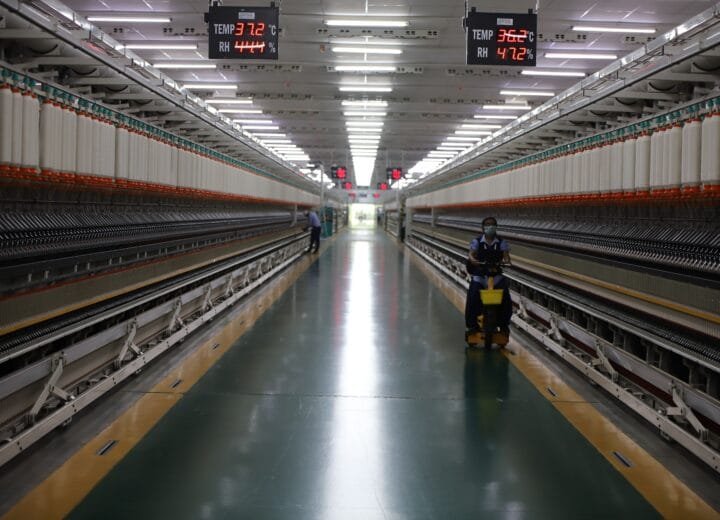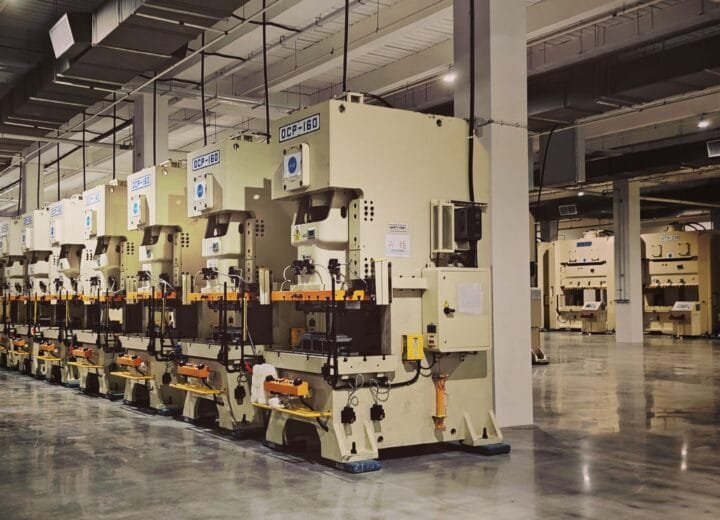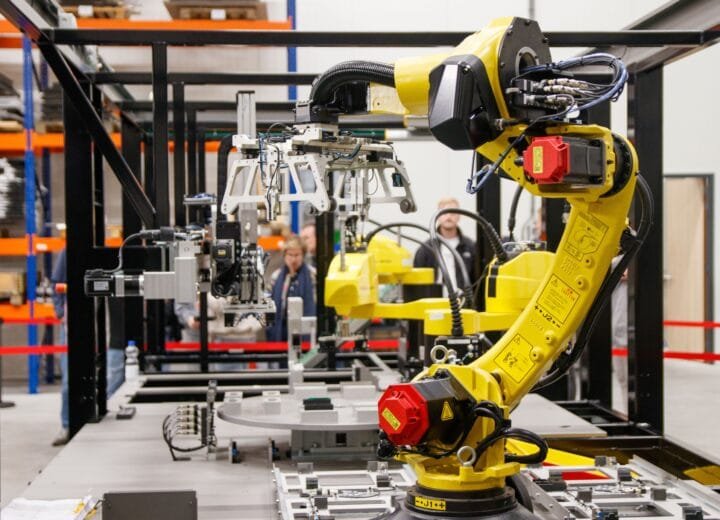
Cost pressure in the manufacturing industry is increasing globally due to rising energy prices, supply chain instability, labor inefficiencies, and intensifying competition.
In response, many organizations adopt short-term cost-cutting measures such as reducing workforce, delaying maintenance, or lowering material quality. While these actions may show immediate savings, they often weaken production systems and reduce long-term competitiveness.
Sustainable cost reduction in the manufacturing industry is fundamentally different. It focuses on improving the system that generates costs, rather than simply reducing expenses within the system.
Instead of asking “Where can we cut costs?”, sustainable manufacturing asks:
“How can we design operations so that waste is continuously eliminated and efficiency improves over time?”
What Is Sustainable Cost Reduction in Manufacturing?
Sustainable cost reduction in manufacturing refers to long-term operational strategies that reduce production costs by improving efficiency, eliminating waste, optimizing processes, and strengthening system reliability, without compromising quality or output.
Unlike reactive cost cutting, which often creates operational instability, sustainable cost reduction is embedded into daily operations and system design.
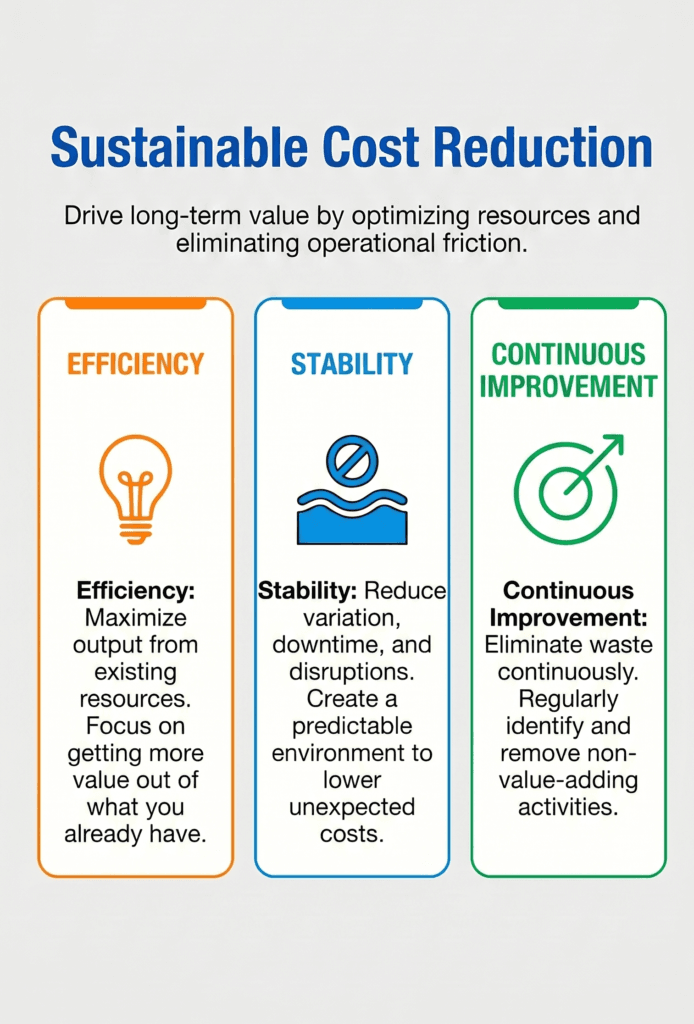
It is built on three core principles:
- Efficiency: Maximizing output from existing resources
- Stability: Ensuring consistent and predictable production performance
- Continuous Improvement: Ongoing identification and elimination of waste
This makes cost reduction a system outcome rather than a financial action.
Why Traditional Cost Cutting Fails in Manufacturing
Many cost reduction initiatives fail because they target visible expenses instead of hidden inefficiencies within production systems.
Common mistakes include:
- Reducing headcount without redesigning workflows
- Cutting maintenance budgets to reduce short-term spending
- Switching to cheaper materials without quality evaluation
- Delaying equipment upgrades beyond optimal lifecycle
These approaches often lead to:
- Increased unplanned downtime
- Higher defect and rework rates
- Lower production stability
- Greater long-term operational costs
In manufacturing systems, inefficiency is often shifted rather than eliminated when cost cutting is poorly designed.
Why Sustainable Cost Reduction Requires Operational Excellence
Sustainable cost reduction is not achieved through isolated initiatives. It requires operational excellence in manufacturing, where processes, systems, and performance management are aligned toward continuous improvement.
When manufacturing systems are stable and standardized, cost reduction becomes a natural outcome rather than a forced action.
At Faber Infinite, operational excellence is viewed as the foundation of sustainable manufacturing performance. Improvements in productivity, quality, maintenance, and supply chain systems directly translate into cost efficiency.
Lean Manufacturing Waste Reduction
One of the most effective frameworks for manufacturing cost optimization is lean manufacturing.
Lean is based on a simple principle:
Any activity that does not add value to the customer is waste.
The 8 Types of Manufacturing Waste:
- Overproduction
- Waiting time
- Transportation inefficiencies
- Overprocessing
- Inventory waste
- Motion waste
- Defects and rework
- Underutilized talent
Each of these wastes contributes directly to increased production costs without increasing value output.
Lean manufacturing waste reduction improves cost efficiency by redesigning production flow rather than reducing budgets.
Industrial Process Improvement and Cost Efficiency
Industrial process improvement focuses on optimizing workflows at a system level.
It targets inefficiencies such as:
- Unnecessary production steps
- Poor machine utilization
- Inefficient sequencing of operations
- Inconsistent production standards
Better process design reduces cost per unit without reducing output quality.
This is one of the most reliable long-term cost reduction methods in manufacturing environments.
Preventive Maintenance as a Cost-Control System
Equipment failure is one of the most expensive hidden cost drivers in manufacturing.
Unplanned downtime impacts:
- Production output
- Labor efficiency
- Delivery timelines
- Emergency repair costs
Preventive maintenance strategies reduce these risks by shifting maintenance from reactive repair to structured planning.
Benefits include:
- Improved machine uptime
- Reduced emergency repair costs
- Extended equipment lifespan
- More stable production scheduling
Preventive maintenance is not a support function; it is a cost-control system.
Factory Energy Saving Techniques
Energy is one of the fastest-growing cost components in manufacturing.
Effective factory energy saving techniques include:
- Optimizing machine runtime schedules
- Reducing idle machine consumption
- Upgrading inefficient equipment
- Monitoring peak energy usage patterns
Even small improvements in energy efficiency can produce significant annual cost reductions in large-scale manufacturing environments.
Supply Chain Cost Management in Manufacturing
Manufacturing costs are heavily influenced by supply chain efficiency.
Key optimization strategies include:
- Supplier consolidation to reduce variability
- Demand forecasting to reduce overproduction
- Inventory optimization to reduce holding costs
- Local sourcing to reduce logistics delays
A well-optimized supply chain improves both cost efficiency and operational stability.
Quality Standards and Cost Reduction
Quality-related costs remain one of the most underestimated expenses in manufacturing.
Defects, rework, and warranty claims significantly impact profitability.
However, these changes deliver the greatest value when supported by stable processes and internationally recognized quality standards such as ISO 9001, which provides a structured framework for consistency and continuous improvement.
Digital transformation is becoming a key driver of sustainable cost reduction in manufacturing. Real-time production monitoring, predictive maintenance, and industrial automation help manufacturers reduce downtime, improve resource utilization, and strengthen operational efficiency.
How Manufacturing Consulting Supports Sustainable Cost Reduction
Sustainable cost reduction requires more than identifying inefficiencies; it requires redesigning the systems that create them.
Manufacturing consulting helps organizations:
- Identify operational bottlenecks
- Improve process stability
- Strengthen maintenance systems
- Optimize supply chain performance
- Implement lean manufacturing principles
- Build continuous improvement systems
At Faber Infinite, the focus is on enabling organizations to build long-term operational capability that naturally drives cost efficiency.
Conclusion
Sustainable cost reduction in the manufacturing industry is not achieved through aggressive cost-cutting, but through system-level optimization and continuous improvement.
Manufacturers that implement lean manufacturing, preventive maintenance, process improvement, and supply chain optimization build long-term resilience against cost pressure.
In modern manufacturing environments, the most competitive companies are not those that spend the least, but those that operate the most efficiently at scale.
FAQs
How to implement cost reduction in the manufacturing industry?
By focusing on operational excellence, lean systems, maintenance optimization, and process improvement rather than short-term cost cuts.
What are the best practices for cost reduction in the manufacturing industry?
Lean manufacturing, preventive maintenance, supply chain optimization, and continuous improvement systems.
What is the difference between cost cutting and sustainable cost reduction?
Cost cutting reduces expenses; sustainable cost reduction improves the system that generates costs.
How does operational excellence reduce manufacturing costs?
By improving efficiency, reducing waste, and stabilizing production systems.
What role does preventive maintenance play in cost reduction?
It reduces downtime, repair costs, and improves equipment reliability.