For manufacturing companies in Kenya, keeping production lines running efficiently remains a constant challenge. Many industrial facilities still operate with reactive maintenance practices, where equipment receives attention only after a failure occurs. This approach often leads to production disruptions, higher operating costs, and reduced equipment reliability.
Total Productive Maintenance (TPM) offers a different approach. Rather than treating maintenance as a standalone technical function, TPM creates a structured framework for improving equipment performance, reducing operational losses, and supporting long-term manufacturing excellence.
What is Total Productive Maintenance (TPM)?
Total Productive Maintenance (TPM) is a manufacturing methodology that improves equipment reliability, reduces downtime, and increases Overall Equipment Effectiveness (OEE) through proactive maintenance and employee involvement. TPM helps manufacturers improve productivity, reduce equipment-related losses, and support manufacturing excellence initiatives.
Unlike traditional maintenance systems that rely primarily on engineering teams, TPM encourages shared responsibility across the organization. Operators, supervisors, maintenance personnel, and leadership teams all play a role in improving equipment performance and operational stability.
When implemented effectively, TPM helps create a more predictable manufacturing environment where equipment reliability supports quality, productivity, and delivery performance.
Alignment with Global Best Practices
TPM is widely recognized as a key component of manufacturing excellence programs and aligns with internationally recognized frameworks such as methodologies developed by the Japan Institute of Plant Maintenance (JIPM), ISO 55000 Asset Management principles, lean management systems, and continuous improvement methodologies.
Why TPM Matters for Manufacturers in Kenya
Manufacturers in Kenya face increasing pressure to improve productivity, control costs, and maintain consistent quality standards. These organizations must navigate specific operational bottlenecks that traditional, run-to-failure maintenance practices cannot resolve:
- Dependency on Imported Spare Parts: Many Kenyan production facilities rely heavily on foreign-manufactured machinery and specialized replacement components. When critical equipment breaks down, long shipping timelines, clearing delays, and regional supply chain bottlenecks can turn a minor fault into weeks of idle capacity.
- Aging Manufacturing Assets: Capital-intensive industrial equipment is often expected to operate for many years. Extending the lifecycle and peak operating capacity of existing legacy machinery becomes essential for protecting capital expenditure (CAPEX) budgets.
- Rising Operational Costs: Increasing industrial electricity tariffs, fluctuating raw material prices, and stiff market competition leave zero room for avoidable waste, process inconsistency, and equipment-driven production delays.
TPM helps manufacturers move from reactive maintenance to a more proactive approach to equipment reliability and asset management.
The 8 Pillars of TPM
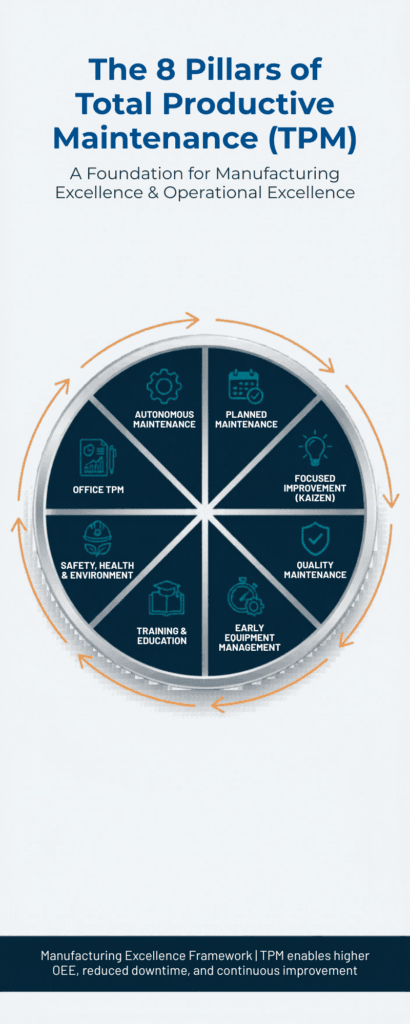
The TPM framework is built around eight interconnected pillars that help organizations improve equipment reliability, reduce losses, and strengthen operational performance. Together, these pillars create a structured approach to proactive maintenance, workforce engagement, and continuous improvement.
| TPM Pillar | Strategic Purpose | Operational Impact |
| Autonomous Maintenance (Jishu Hozen) | Operators perform routine inspection, cleaning, lubrication, and basic equipment care. | Supports early fault detection and stronger equipment ownership. |
| Planned Maintenance | Maintenance activities are scheduled using condition, risk, and performance data. | Helps reduce breakdowns and extend equipment life. |
| Focused Improvement (Kaizen) | Cross-functional teams identify and eliminate recurring equipment and process losses. | Supports continuous improvement and productivity gains. |
| Quality Maintenance | Equipment is maintained to consistently meet and validate quality requirements. | Helps reduce defects and improve product consistency. |
| Early Equipment Management | Operational learning and practical experience are applied to equipment design and installation. | Supports improved lifecycle performance and faster equipment commissioning. |
| Training and Education | Employees develop technical, analytical, and problem-solving capabilities. | Strengthens workforce capability and operational resilience. |
| Safety, Health & Environment | Maintenance and operational activities support safe, zero-accident, and compliant operations. | Helps improve workplace safety and regulatory compliance. |
| Office TPM | TPM principles are applied to administrative, procurement, and support processes. | Improves coordination, logistics, and decision-making efficiency. |
Key takeaway: While each pillar addresses a different aspect of performance, they work together to improve equipment reliability, operational stability, and manufacturing excellence.
Strategic Implementation: Moving Beyond the Tools
A common challenge in TPM deployment is treating it as a maintenance initiative rather than a broader operational improvement system.
Successful TPM implementation requires the complete integration of people, processes, leadership, and daily performance management practices.
Building the Foundation with Workplace Organization (6S)
TPM cannot thrive in a disorganized environment. An effective deployment begins with building solid workplace organization. Implementing 6S (5S + Safety) establishes the strict visual control and structural discipline needed to make equipment abnormalities instantly visible.
Once workplace standards are established, Daily Work Management (DWM) practices help teams identify, escalate, and resolve equipment issues before they affect production performance.
Eliminating Equipment-Related Losses (The 6 Big Losses)
To maximize OEE, Kenyan manufacturers must focus on systematically identifying and eliminating the 6 Big Losses that drive equipment inefficiency:
- Availability Losses:
- Unplanned Downtime (Equipment breakdowns and component failures)
- Setup and Adjustments (Changeovers and tooling adjustments)
- Performance Losses:
- Minor Stoppages (Idling and minor misfeeds that clear quickly)
- Reduced Speed (Equipment operating slower than its designed nameplate speed)
- Quality Losses:
- Process Defects (Scrap and rework generated during steady-state production)
- Reduced Yield (Startup and warm-up losses generated before stable production is reached)
Root Cause Analysis and Structured Problem Solving
When an anomaly or failure occurs, patching up the superficial symptom guarantees a repeat failure. Teams must utilize structured engineering tools, such as the 5 Whys Methodology and Fishbone Analysis, to drill down into the systemic cause. For example, if a component fails due to inadequate lubrication, teams should investigate why the maintenance standard was not followed and implement corrective actions to prevent recurrence.
Business Benefits of TPM
Organizations that successfully integrate TPM into their operational excellence efforts often experience benefits such as:
- Improved equipment availability
- Reduced downtime
- Better asset utilization
- Improved product quality
- Lower maintenance costs
- Stronger operator ownership
- More stable production planning
- Enhanced workforce capability
The specific results achieved will depend on factors such as equipment maturity, leadership commitment, workforce engagement, and implementation discipline.
Frequently Asked Questions
What is TPM in manufacturing?
TPM is a proactive maintenance methodology that improves equipment reliability, productivity, and OEE through employee involvement and continuous improvement.
How does TPM improve OEE?
TPM improves equipment availability, performance, and quality, the three components of Overall Equipment Effectiveness.
What are the 8 pillars of TPM?
The eight pillars are Autonomous Maintenance, Planned Maintenance, Focused Improvement, Quality Maintenance, Early Equipment Management, Training and Education, Safety Health and Environment, and Office TPM.
What is the difference between TPM and preventive maintenance?
Preventive maintenance is one component of TPM. TPM is a broader management system that involves operators, maintenance teams, and leadership in improving equipment performance and operational effectiveness.
How does TPM support lean management?
Lean management focuses on reducing process waste, while TPM focuses on reducing equipment-related losses. Together they help improve operational performance.
Why is TPM important for manufacturers in Kenya?
TPM helps manufacturers improve equipment reliability, reduce downtime, increase productivity, and support manufacturing excellence initiatives.
How long does TPM implementation take?
Organizations often begin seeing measurable improvements within a few months, while long-term TPM maturity is achieved through sustained continuous improvement efforts.
Conclusion
Total Productive Maintenance is more than a maintenance methodology. It is a structured approach to improving equipment reliability, operational stability, and manufacturing performance.
For manufacturers in Kenya, TPM provides a practical framework for reducing equipment-related losses, improving OEE, and supporting broader manufacturing excellence initiatives.
When integrated with lean management, continuous improvement, and operational excellence practices, TPM can help organizations build more reliable, efficient, and competitive manufacturing operations over the long term.