
In the rapidly evolving industrial landscape of the Kingdom, the physical configuration of a production floor is no longer viewed as a static arrangement of equipment. Instead, factory layout design in Saudi Arabia has become a dynamic strategic tool. As the nation pivots toward a diverse, non-oil-based economy, manufacturers are discovering that the architecture of their operations dictates their market agility. A poorly planned floor can act as a bottleneck, while a scientifically designed layout functions as a catalyst for growth.
The primary objective of plant layout planning is to harmonize the relationship between workers, machinery, and material movement. In the Saudi context, where large-scale industrial cities like Yanbu and Jubail house massive operations, even minor inefficiencies in travel distance can escalate into significant financial drains. By focusing on the logical flow of goods, from the receiving dock to the shipping bay, organizations can achieve a level of manufacturing efficiency that provides a distinct competitive advantage.
Integrating global standards into local operations isn’t just about aesthetics; it’s about cost reduction. When a facility is designed with flow in mind, it minimizes the “hidden” wastes that often plague traditional setups: excessive material handling, idle time between processes, and the physical fatigue of the workforce. By reducing the complexity of the environment, a business can focus on its core mission: delivering high-quality products to the market at the lowest possible cost.
How Does a Professional Industrial Layout Design in KSA Transform Operational Flow?
The transition from a traditional setup to a world-class facility requires a deep dive into industrial layout design in KSA. At its core, an optimized layout seeks to reduce the complexity of the production environment. Every movement of a component that does not add value to the final product is a waste of resources.
Statistical analysis of facility transformations reveals that a strategic redesign can lead to a 65.8% reduction in total material travel distance. In high-output environments, this translates to thousands of man-hours saved annually. Furthermore, a professional layout ensures that safety protocols are “built-in.” By clearly demarcating pedestrian zones from forklift lanes and ensuring hazardous processes are appropriately isolated, operational excellence is achieved not through manual policing, but through the very design of the workspace.
For many local firms, productivity improvement begins with visualizing the current state. When manufacturers map out their existing paths, they often find “back-tracking” or “cross-traffic” that causes delays. Addressing these through a revised manufacturing plant layout, KSA allows for a more “rhythmic” production schedule, where parts move predictably and reliably through each stage of the lifecycle. This structural clarity often results in a 13.2% reclamation of previously wasted floor space, providing room for growth without the need for physical building expansion.
Which Configuration Wins: Process vs Product Layout for Saudi Factories?
One of the most frequent debates in industrial engineering centers on the choice between different structural flows. The “correct” answer depends entirely on the product mix and the volume of output required by the market.
The Process-Oriented Approach
A process layout groups similar functions together. For example, all machining units are in one zone, and all quality testing benches are in another.
- Application: Best suited for custom manufacturing where different products follow unique, non-linear paths.
- Key Advantage: If one machine fails, the entire plant doesn’t stop, offering high functional flexibility.
- Efficiency Metric: While flexible, it often results in higher work-in-process (WIP) levels, as parts sit idle between departments.
The Product-Oriented Approach
In a product layout, machines are arranged in the exact sequence required by the product. It is a linear or U-shaped flow where a component moves from step A to step B with zero deviation.
- Application: Ideal for mass production with standardized designs.
- Key Advantage: It dramatically shortens the production cycle and simplifies management.
- Efficiency Metric: Factories utilizing this layout often see a 40% improvement in throughput time due to the elimination of transit delays.
For those involved in factory layout design for new manufacturing plants in Saudi Arabia, the trend is leaning toward a “Cellular” hybrid. This involves creating “mini-factories” within the plant that handle specific families of parts, combining the flexibility of the process layout with the high-speed efficiency of the product layout. This hybrid approach has been shown to increase revenue per square meter by as much as 62%.
Can a Lean Factory Layout in Saudi Arabia Dramatically Minimize Production Waste?
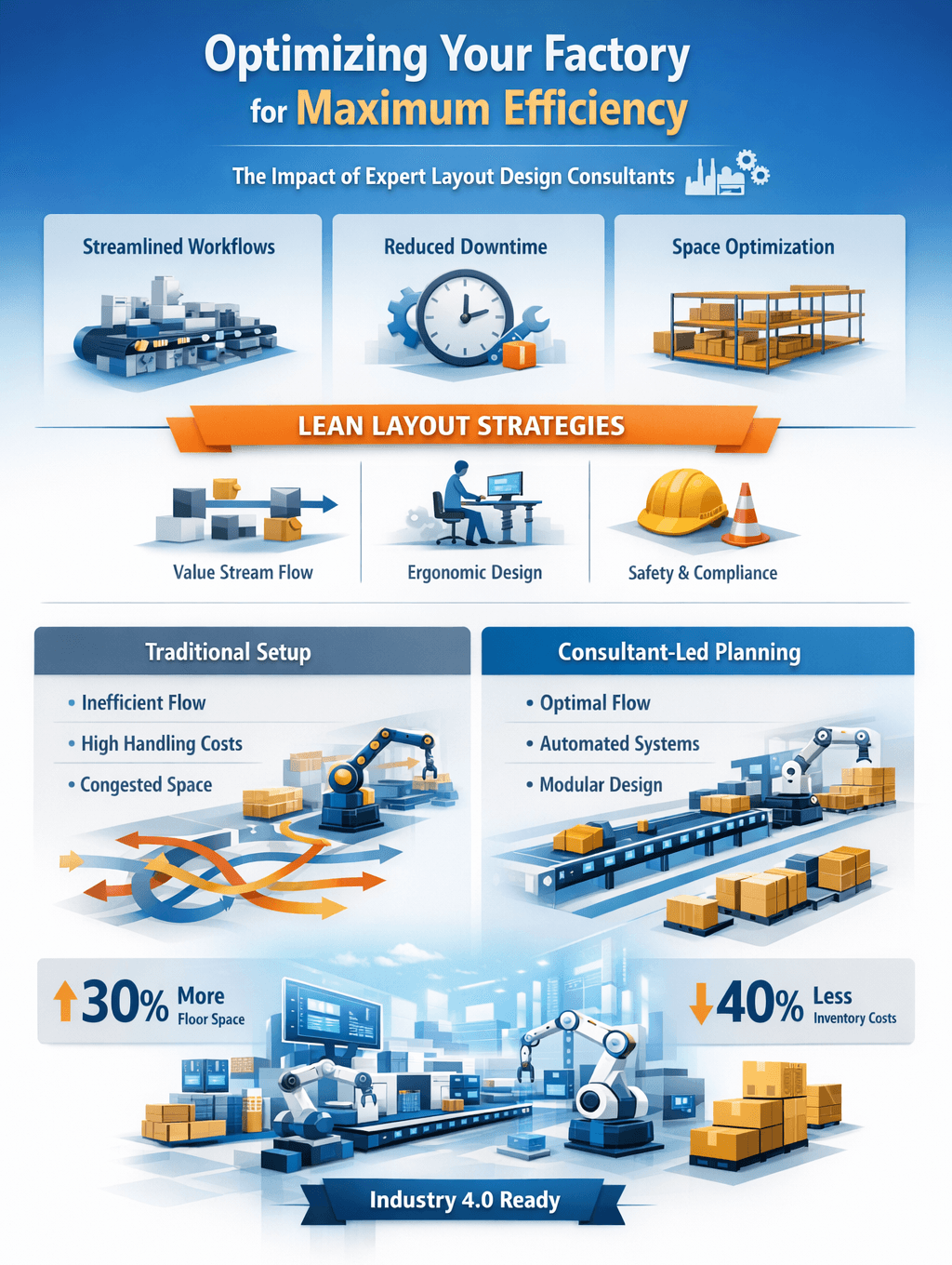
The implementation of a lean factory layout in Saudi Arabia is perhaps the most effective way to address the “hidden” costs of manufacturing. Lean is not just a philosophy; it is a spatial science. By applying specific facility design principles, manufacturers can identify and remove the “Seven Wastes” that are physically baked into their floor plans.
How Lean Layouts Reduce Waste in KSA Factories
The physical environment is the greatest influencer of behavior. A lean layout encourages a “One-Piece Flow” mentality. Key benefits observed in regional implementations include:
- Reduced Inventory Footprint: By placing sequential processes adjacent to one another, the need for large “buffer zones” or staging areas is eliminated. This can lead to a 50% reduction in working capital tied up in idle inventory.
- Point-of-Use Storage: Instead of a massive central warehouse, tools and materials are stored exactly where they are consumed. This strategy can reduce dedicated storage footprints by 30%, allowing that space to be repurposed for value-added activities.
- Visual Management: Lean layouts are designed to be “self-explanatory.” One can walk onto the floor and immediately see the status of production, enhancing operational excellence.
In many optimization projects, the shift to a lean-aligned configuration allowed for a 17% enhancement in total production capacity using the exact same workforce and machinery.
FAQs
How does factory layout design improve productivity in Saudi factories?
By aligning the physical placement of machinery with the actual production sequence, a layout eliminates non-value-added time. When an operator has everything they need within arm’s reach and the product moves in a direct path, the output per labor hour increases. Data shows that such optimizations can lead to a 62% increase in revenue generated per square meter of floor space.
What are the best plant relayout strategies for Saudi manufacturing facilities?
A successful relayout involves moving away from “functional silos” toward “flow-based cells.” Key strategies include performing a material flow audit to identify bottlenecks and then reconfiguring equipment to minimize travel. Successful strategies have been known to reduce material travel by over 65%, effectively cutting production cycles from months to weeks.
How does factory layout impact manufacturing efficiency in KSA?
The impact is felt most acutely in the “Total Cost of Ownership” of the facility. An efficient layout reduces the energy required for material handling, lowers maintenance costs on transport equipment, and maximizes the utility of every square meter. In many cases, it allows a facility to increase its output by 17% without requiring additional land or building square footage.
Why use lean factory layout design for new manufacturing plants in Saudi Arabia?
Building “Lean from Day One” ensures that waste is never given the chance to take root. It allows for a 30% reduction in storage space and a 40% faster throughput time compared to traditional plant designs, providing a significant competitive edge in the local and global market.
Conclusion
The evolution of the Saudi industrial sector demands a more sophisticated approach to the physical workspace. By understanding the nuances of factory layout design in Saudi Arabia, manufacturers can transform their facilities from simple shells into high-performance engines of production. Whether it is through the adoption of a lean factory layout in Saudi Arabia or a rigorous assessment of process vs product layout for Saudi factories, the path to operational excellence is paved with smart spatial planning.
The integration of these best practices ensures that the Kingdom’s manufacturing sector remains robust, efficient, and ready to meet the demands of a global market. Productivity is not just about how fast a machine runs; it is about how effectively the entire factory breathes.