
By 2030, Indian businesses will operate in an environment defined by automation, ESG mandates, digital ecosystems, and evolving workforce expectations. According to McKinsey & Company, nearly 70% of transformation initiatives fail due to poor organizational change management—not because of strategy, but because of execution and culture gaps.
For Indian companies, the importance of organizational change has shifted from survival to sustainable growth. Whether in manufacturing, FMCG, infrastructure, logistics, or services, the ability to manage change strategically is now directly linked to ROI.
At Faber Infinite Consulting, we have seen firsthand that change done structurally improves productivity by 15–35% within 12–18 months when aligned with a strong organizational change strategy.
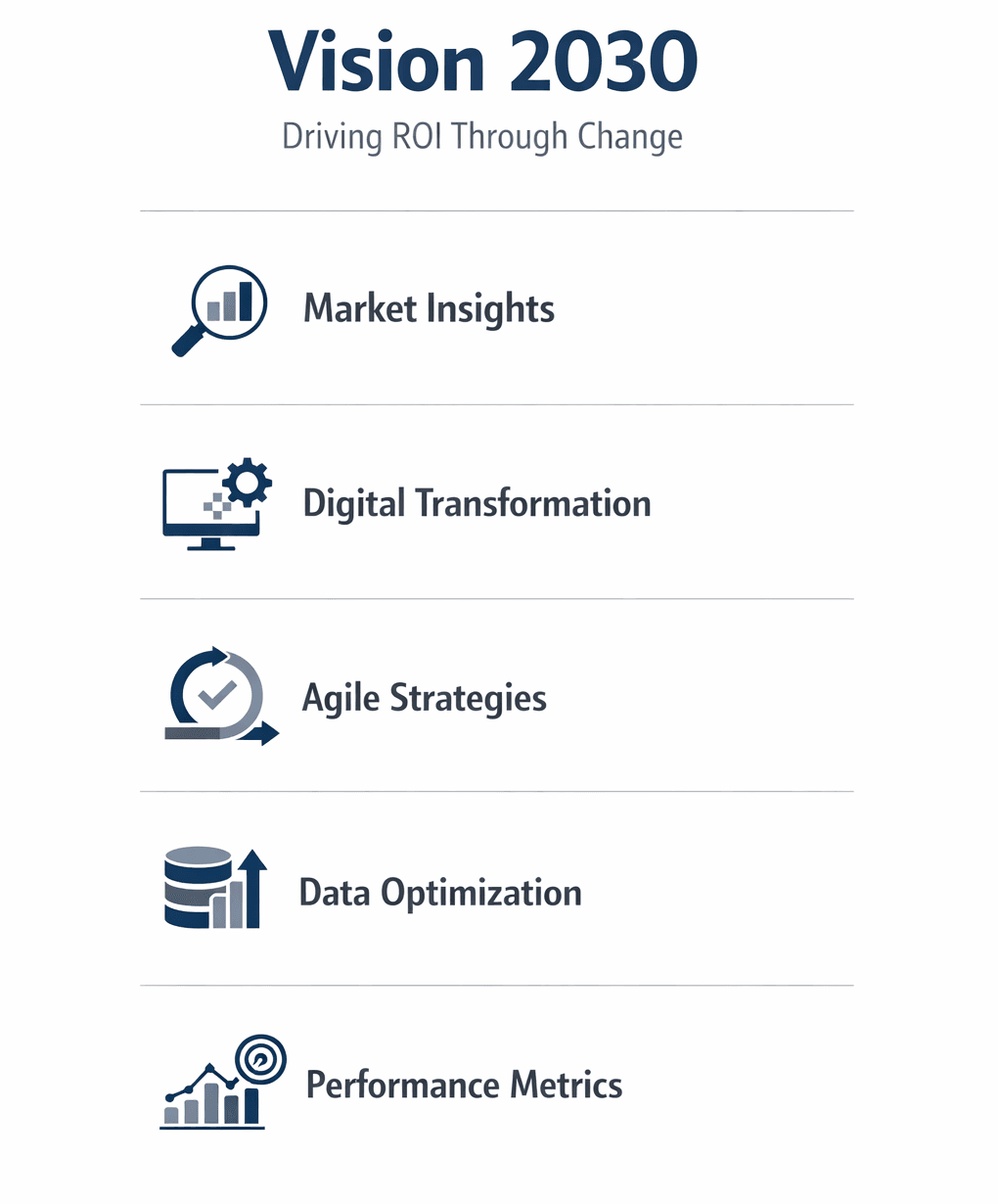
This blog explains how Vision 2030 can translate into measurable returns through structured organizational change in India.
Why Organizational Change Matters in India (Vision 2030 Lens)
The Indian Business Context
India is projected to become the third-largest economy by 2030 (as estimated by International Monetary Fund). This growth demands:
- Leaner operations
- Digitally enabled processes
- Higher productivity per employee
- Cultural agility
- Data-driven leadership
Yet many organizations still operate with legacy systems, hierarchical bottlenecks, and reactive decision-making.
Importance of Organizational Change in Indian Companies
| Business Pressure | Impact Without Change | ROI With Strategic Change |
| Digital disruption | Loss of market share | Faster innovation cycles |
| Rising labor costs | Margin erosion | Productivity-led cost control |
| ESG & compliance | Regulatory risk | Competitive differentiation |
| Global competition | Price wars | Operational efficiency |
| Workforce expectations | Attrition | Engagement & retention |
Organizational change in India is not about cosmetic restructuring. It is about redesigning systems, processes, culture, and leadership accountability.
Understanding Organizational Change Management
What Is Organizational Change Management?
Organizational change management (OCM) is the structured approach to transitioning individuals, teams, and organizations from a current state to a desired future state.
According to Prosci, projects with excellent change management are 6 times more likely to meet objectives than those with poor change management.
Core Elements of an Effective Change Management Process
| Element | Purpose | Business Outcome |
| Leadership alignment | Unified direction | Faster decisions |
| Stakeholder mapping | Identify resistance | Smoother transitions |
| Communication strategy | Reduce uncertainty | Higher engagement |
| Capability building | Skill transformation | Sustained performance |
| Performance tracking | Measure impact | ROI validation |
This structured approach is critical for change management in Indian organizations, where cultural sensitivity and hierarchy influence adoption rates.
Real-World Experience: Organizational Change in India
Case Example 1: Manufacturing Turnaround
An Indian mid-sized manufacturing company faced:
- 22% productivity loss
- High manpower inefficiencies
- Delayed order fulfillment
Instead of investing immediately in new machinery, the leadership adopted a phased organizational change strategy:
- Time & motion study
- Layout redesign
- Role clarity restructuring
- Performance dashboards
- Incentive alignment
Within 14 months:
- Productivity improved by 28%
- Labor cost per unit reduced by 18%
- Lead time reduced by 21%
The ROI was achieved without major capital expenditure. This demonstrates the importance of change management in India, especially in operational sectors.
Case Example 2: Cultural Change in a Service Organization
A services firm struggled with decision fatigue and slow approvals.
Change intervention included:
- Decision-rights redesign
- Accountability matrix (RACI)
- Leadership workshops
- KPI-linked performance review
Outcome after 9 months:
- Decision turnaround time reduced by 35%
- Employee engagement score improved by 22%
- Revenue growth accelerated by 12% YoY
Cultural change in organizations is often underestimated, but it is central to business transformation in India.
Organizational Change Strategy for Vision 2030
A Vision 2030 transformation requires structured phases.
Phase 1: Diagnostic and Baseline
| Action | Tools | KPI Focus |
| Current state mapping | Process audits | Efficiency gaps |
| Financial benchmarking | Cost analysis | ROI baseline |
| Workforce assessment | Skill matrix | Capability gaps |
Phase 2: Strategic Realignment
| Action | Objective | Expected Impact |
| Org structure redesign | Reduce hierarchy | Faster execution |
| KPI cascading | Align goals | Clear accountability |
| Process standardization | Eliminate waste | Performance improvement |
Phase 3: Cultural and Behavioral Shift
| Action | Goal | Business Benefit |
| Leadership coaching | Strategic clarity | Strong governance |
| Change champions network | Peer influence | Faster adoption |
| Transparent communication | Trust building | Reduced resistance |
Phase 4: Measurement & ROI Validation
According to Boston Consulting Group, companies that rigorously track transformation KPIs generate 1.5x higher shareholder returns than peers.
Key ROI indicators:
- EBITDA margin improvement
- Productivity per employee
- Revenue per square foot
- Decision cycle time
- Attrition rate
Organizational Change Challenges in India
| Challenge | Why It Happens | Solution Approach |
| Hierarchical resistance | Legacy leadership style | Leadership buy-in workshops |
| Fear of job loss | Automation anxiety | Transparent communication |
| Silo mentality | Functional fragmentation | Cross-functional KPIs |
| Inconsistent execution | Weak governance | PMO-driven tracking |
Understanding these challenges helps Indian organizations design more realistic transformation plans.
Why Change Management in Indian Organizations Fails
Research from Harvard Business Review highlights that most transformations fail due to:
- Lack of leadership alignment
- Poor communication
- Absence of measurable KPIs
- Ignoring cultural factors
Indian businesses often focus on strategy decks rather than structured implementation.
That is why organizational change management in India must integrate:
- Process redesign
- Cultural recalibration
- Performance tracking
- Governance mechanisms
The ROI Equation of Organizational Change
We simplify ROI from organizational development as:
ROI = (Performance Gain – Change Investment) / Change Investment
Where performance gain includes:
- Increased output
- Reduced waste
- Higher revenue per employee
- Reduced rework
- Lower attrition
When aligned strategically, business transformation in India can yield ROI within 12–24 months.
Actionable Takeaways for Vision 2030
| Step | Immediate Action | Expected Outcome |
| 1 | Conduct organizational diagnostic | Identify performance gaps |
| 2 | Define clear transformation KPIs | Align teams |
| 3 | Establish change governance | Improve accountability |
| 4 | Invest in leadership capability | Drive cultural change |
| 5 | Track ROI monthly | Validate impact |
The importance of organizational change lies not in change itself—but in measurable improvement.
Conclusion: Change as a Strategic Asset
Vision 2030 is not about ambition—it is about structured execution.
Indian organizations that treat organizational change strategy as a board-level priority will lead their sectors. Those that delay will experience gradual erosion of competitiveness.
At Faber Infinite Consulting, our experience across industries shows that when change is:
- Structured
- Measured
- Culturally aligned
- Leadership-driven
It consistently delivers ROI.
The future will not reward the biggest organizations. It will reward the most adaptable.
FAQs
- What is the importance of organizational change in Indian companies?
Organizational change helps Indian businesses improve productivity, remain competitive globally, and adapt to digital and regulatory shifts.
- Why is change management important for Indian organizations?
Change management ensures smooth implementation, reduces resistance, aligns leadership, and improves ROI from transformation initiatives.
- What are common organizational change challenges in India?
Hierarchy resistance, cultural inertia, skill gaps, and lack of structured governance are major challenges.
- How long does organizational change management take?
Typically 12–24 months for measurable ROI, depending on complexity and industry.
- What is the difference between organizational development and change management?
Organizational development focuses on long-term growth and capability building, while change management focuses on managing specific transitions.
SEO Optimization Checklist
Primary Keywords Used:
Importance of organizational change, Organizational change in India, Organizational change management, Change management in Indian organizations, Organizational change strategy
Supporting Keywords Used:
Business transformation in India, Organizational development, Cultural change in organizations, Change management process, Performance improvement
Suggested Internal Links:
- Operational Excellence Services
- Lean Manufacturing Consulting
- Time & Motion Study Framework
Suggested External References:
- McKinsey transformation studies
- BCG performance reports
- Prosci change management research
- IMF India growth projections
If your organization is planning Vision 2030 transformation, the right question is not “Should we change?”
It is: “Are we managing change strategically enough to generate ROI?”