Lean Transformation in Egypt Using Value Stream Mapping
Egypt’s industrial sector is undergoing a profound transformation. As global supply chain pressures mount, the need for operational efficiency has moved from the boardroom to the shop floor. In this environment, value stream mapping consultants in Egypt have become essential architects of change, providing manufacturers with a visual and data-driven roadmap to eliminate waste and synchronize operations.
By analyzing the flow of materials and information from the moment an order is placed to the point it reaches the customer, these specialists help local plants unlock hidden capacity and improve production efficiency without the need for massive capital investment.
Why are value stream mapping consultants in Egypt essential for sustainable growth?
The Egyptian manufacturing landscape is characterized by a mix of high-volume production and complex logistics. Often, facilities operate with layouts and schedules that have grown organically over decades, leading to significant “non-value-added” time. VSM consultants Egypt serve as objective guides who can look past daily fires to see the systemic issues.
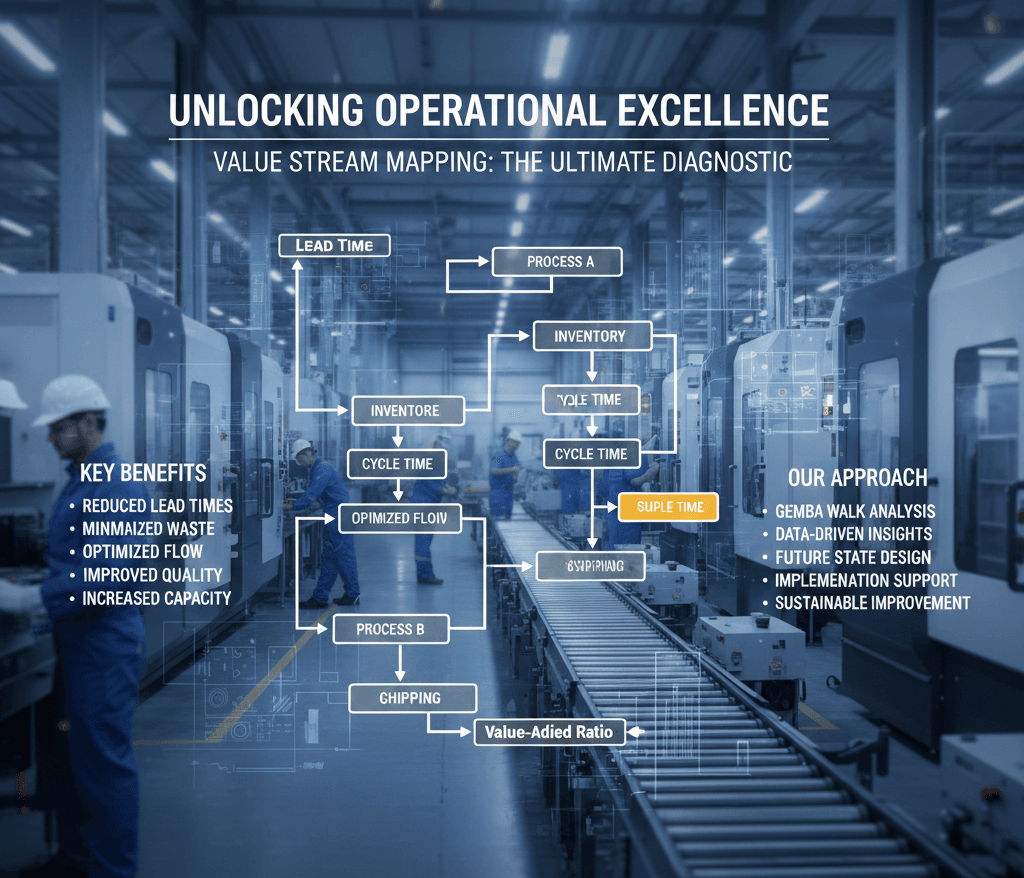
The core role of a consultant is to help leadership “see the flow.” In many cases, a factory might feel efficient because the machines are always running. However, value stream mapping Egypt often reveals that these machines are overproducing, creating inventory that sits in a warehouse rather than being shipped. Consultants use standardized symbols and data boxes to document cycle times, changeover durations, and uptime, providing a factual basis for every proposed process improvement.
How can value stream mapping revolutionize your production line?
For a facility in the 10th of Ramadan or 6th of October City, the primary enemy is lead time. When lead times are long, the factory is less responsive to the market. VSM in manufacturing in Egypt focuses on reducing the total time a product spends in the system.
Visualizing the Timeline
A key output of any VSM engagement is the “Lead Time Ladder.” This visual compares the value-added time (the minutes spent actually making the product) against the non-value-added time (the days the product spends waiting).
By utilizing VSM lean manufacturing techniques, consultants help plants:
- Identify the “Pacemaker”: The single point in the production chain that controls the rhythm of the entire plant.
- Reduce Material Handling: By redesigning the layout based on the map, factories can often reduce the distance parts travel by up to 35%, directly impacting operational efficiency.
- Synchronize Information: Ensuring that the office doesn’t release orders faster than the floor can produce them, which prevents the buildup of expensive Work-In-Process (WIP).
What specific results do value stream mapping of industrial plants in Egypt deliver?
Implementing lean facility design principles through VSM produces measurable results that directly impact the bottom line. Based on documented lean transformations, the application of value stream mapping in industrial plants in Egypt yields significant performance metrics.
Quantitative Improvements in Factory Performance
Drawing from established lean data, the following statistics represent typical gains seen when a facility transitions from a traditional “Push” system to a lean “Pull” system:
- Increase in Throughput: By balancing the line and removing bottlenecks identified on the map, plants have achieved an increase in equivalent unit output of 25% to 30%.
- WIP Reduction: Transitioning to continuous flow often results in a 40% reduction in work-in-process inventory, freeing up valuable cash flow.
- Space Optimization: Strategic factory optimization can reclaim 15% to 20% of total floor space by eliminating “islands” of inventory and unnecessary equipment.
- Quality Gains: Shortening the lead time reduces the “feedback loop.” If an error occurs, it is caught at the next station in minutes rather than being discovered in a batch of 500 units a week later.
Do VSM consultants in Egypt’s industrial zones provide localized expertise?
The industrial zones along the Suez Canal and near Cairo have specific infrastructure and labor dynamics. VSM consultants in Egypt’s industrial zones understand these local nuances, such as the impact of electricity costs or the availability of specialized logistics.
Strategic Implementation for Regional Hubs
When working with value stream mapping consultants for industrial zones in Egypt, the focus is on creating a “Future State Map” that is both ambitious and achievable. This involves:
- Improvising productivity using value stream mapping in Egypt: Focusing on high-impact areas like packaging or assembly, where labor density is highest.
- VSM for lean manufacturing implementation in Egypt: Training local teams to maintain the map. A VSM shouldn’t be a one-time poster; it should be the foundation of a continuous improvement culture.
- Value stream mapping to reduce waste in Egypt: Specifically targeting the “Seven Wastes,” such as excess motion and waiting, which are common in large, sprawling facilities.
These consultants ensure that the benefits of VSM for factories in Egypt are sustained long after the initial workshop ends by establishing “visual management” systems that make flow, or its absence, obvious to everyone on the shop floor.
Why is VSM lean manufacturing in Egypt a superior strategy for factory optimization?
Unlike traditional “cost-cutting,” which often hurts morale and quality, lean manufacturing focuses on removing the things that don’t add value. When you use VSM lean manufacturing in Egypt, you are essentially cleaning the pipes of your production system.
The Holistic View of Value
Most efficiency tools focus on a single machine or a single person. VSM is unique because it looks at the Value Stream, the interconnected chain of events.
- Takt Time Alignment: Consultants help you calculate exactly how fast you need to produce to meet customer demand, no faster and no slower.
- Flow over Force: Instead of forcing more work onto the floor, VSM helps you create a “Pull” system where the customer’s order pulls the product through the factory.
- Empowered Workforce: Because the map is visual and simple, it allows operators to participate in process improvement, often leading to a 10% to 15% increase in labor productivity through better ergonomics and standardized work.
FAQs
What is the difference between VSM and a regular flowchart?
A regular flowchart only shows the sequence of steps. Value stream mapping Egypt includes critical metrics like inventory levels, machine uptime, the number of operators, and the time between steps. It also maps the Information Flow (schedules, faxes, emails), which is often where the real delays happen.
How do VSM consultants in Egypt prioritize which processes to map?
Consultants typically start by creating a “Product Family Matrix.” This identifies which products share similar processing steps. We map the product family that has the highest volume or the highest level of customer complaints, ensuring the biggest “bang for the buck” in factory optimization.
Can VSM help with rising material costs in Egypt?
Yes. By reducing waste, specifically scrap and overproduction, value stream mapping to reduce waste in Egypt ensures that every kilogram of raw material is turned into a saleable product as efficiently as possible.
How long does it take to see the benefits of VSM?
While the mapping process takes 3 to 5 days, the implementation of “Kaizen bursts” (rapid improvement projects) identified on the map can show results in as little as 30 days. Most factories see a full ROI on their consultancy within 6 to 9 months.
Is VSM for lean manufacturing implementation in Egypt suitable for small plants?
Absolutely. In fact, smaller plants often see faster results because there is less bureaucracy to navigate when changing the layout or the production schedule.
Transform Your Operation with Data-Driven Clarity
In the modern industrial age, you cannot manage what you cannot see. Value stream mapping turns the invisible “waste” in your factory into a visible target for improvement. By partnering with experienced consultants, you can ensure that your facility is not just working harder, but working smarter.