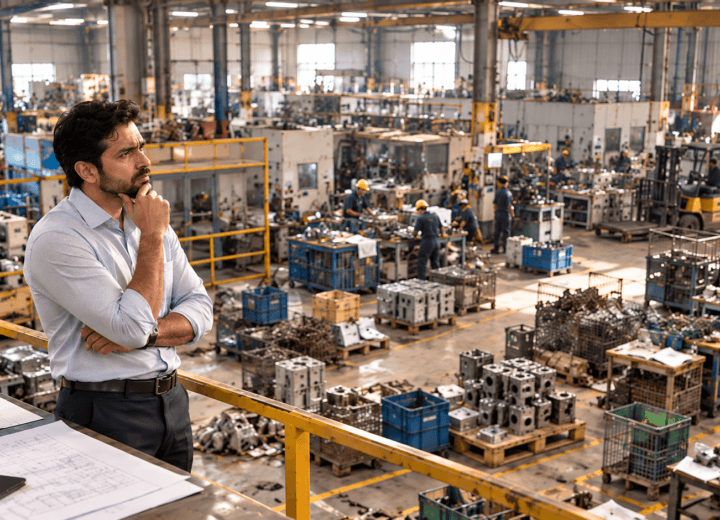
Last month, I watched a production manager stare at his shift report and mutter something I’ve heard a hundred times: “We ran all day. Where did the time go?”
His machines ran fine. His crew showed up. But he still missed target by 18%.
The problem wasn’t what was moving. It was what was waiting.
Your Real Bottleneck Isn’t Where You Think
Most executives assume throughput issues come from old equipment or understaffing. So they budget for a new line or approval for three more hires. Then they wait six months while the problem gets worse.
But here’s what actually happens on your floor: operators finish a batch and spend 12 minutes finding the next work order. A machine sits idle for 20 minutes because the material handler is across the building. Changeovers that should take 8 minutes take 35 because nobody wrote down the steps. Quality holds up an entire shift over paperwork that could’ve been done in parallel.
Walk your line during second shift sometime. Count how many people are standing around waiting for something—a signature, a forklift, a decision, clarification on a spec. That’s your missing 20%.
Three Things You Can Fix This Quarter
Forget the theory. If you want measurable improvement without touching your capex budget, focus here:
Optimize material flow with cellular layouts. Most plants have materials zigzagging across the floor like a pinball machine. Raw materials travel 200 feet to get cut, then back 150 feet to get welded, then forward again to finishing. Every move adds time and burns labor.
The solution: map your current flow state and redesign your layout into work cells. Group machines by product family, not by function. Position equipment so parts move in a U-shape or straight line through sequential operations. Use a spaghetti diagram to track actual movement, then physically relocate equipment to minimize transport distance. One automotive supplier cut their floor-to-floor travel by 65% just by rearranging their press, welding, and assembly stations into adjacent cells. The cost was a weekend of downtime and some new floor markings. Their cycle time dropped 28% the following week.
Implement visual management and 5S systems. Your people spend half their day looking for stuff—tools, paperwork, materials, their supervisor. One plant I worked with put shadow boards in every cell and cut their setup time by 40%. Not because they worked faster. Because they stopped wandering around looking for a torque wrench.
Here’s how to fix it: Start with 5S in your highest-volume work areas. Shadow boards for every tool with clearly outlined shapes. Color-code tools by station—red tools stay at Station 1, blue at Station 2. Create kanban cards for materials with visual min/max levels so replenishment happens automatically. Put work instructions on laminated sheets mounted at eye level at each station, not in a binder in the supervisor’s office. Add andon boards that show real-time status—green for running, yellow for minor issues, red for stoppage. When your team can locate any tool in 10 seconds and see production status at a glance, you’ve eliminated the coordination tax that kills throughput.
Create standard work documents for repetitive processes. Every plant has jobs that run weekly or daily. And every time, someone’s figuring it out from scratch. When a medical device manufacturer finally documented their top 10 changeovers, their average setup dropped from 47 minutes to 19. Same people. Same machines. They just stopped reinventing it every time.
The implementation: Identify your 20% of processes that represent 80% of your volume. For each one, create a one-page standard work sheet showing the exact sequence, machine settings, quality checkpoints, and tools needed. Include photos. Time each step and note the target. Have your best operator validate it, then train everyone else to that standard. Use a SMED approach to convert internal setup steps to external ones—do as much as possible while the machine is still running. Review and update the standards quarterly based on operator feedback. This isn’t about micromanaging—it’s about capturing tribal knowledge before your best people retire or leave.
What This Actually Gets You
A 25% throughput improvement means different things depending on your business. Maybe it’s fulfilling orders two days faster. Maybe it’s absorbing a new contract without hiring. Maybe it’s finally getting your Saturdays back because you’re not running emergency weekend shifts.
But here’s what it always means: you stop leaving money on the table.
Your competition isn’t investing in some magic technology you don’t have. They’re just running tighter. The plants winning right now aren’t the ones with the fanciest equipment. They’re the ones that eliminated the stupid stuff slowing everyone else down.
You’ve already got the capacity. It’s just tied up in a thousand small inefficiencies that nobody’s bothered to fix. Start fixing them, and you’ll wonder why you ever thought you needed new equipment in the first place.