How Can Expert Layout Design Consultants Drive Measurable Growth Through Proven Case Studies?
In the competitive landscape of Indian manufacturing, space is often equated with cost. However, for a forward-thinking facility owner, space is actually a canvas for efficiency. Many manufacturers operating in industrial hubs like Chakan, Oragadam, or Pune find themselves trapped in a cycle of diminishing returns, believing that the only way to increase output is to expand the physical building. This “expansion-first” mindset is a costly misconception. The reality, as demonstrated by the rigorous application of lean layout design, is that most factories have a massive amount of “hidden capacity” trapped within their existing walls.
The key to unlocking this capacity lies in the hands of layout design consultants. By moving away from subjective machine placement and toward data-driven industrial engineering layout principles, these experts transform stagnant floors into high-velocity production engines. This blog explores the “Before and After” reality of facilities that leveraged professional facility layout design services to achieve world-class results.
Why is Partnering with a Plant Layout Design Consultant a Strategic Investment?
The primary challenge in Indian manufacturing is the “evolutionary” layout. Over the years of operation, new machines are often squeezed into whatever gap is available, leading to a “spaghetti flow” where materials, people, and tools crisscross paths inefficiently. A plant layout design consultant steps in to break this cycle. They don’t just move equipment; they engineer a synchronized flow that treats every inch of floor space as a revenue-generating asset.
The Hidden Benefits of Hiring Layout Design Consultants for Manufacturing Facilities
When you engage an expert, you aren’t just paying for a CAD drawing. You are investing in:
- Reduced Material Handling: Minimizing the distance a product travels reduces labor costs and the risk of damage.
- Enhanced Space Utilization: Reclaiming floor area that was previously wasted on cluttered WIP (Work-in-Progress) or poorly planned aisles.
- Improved Throughput: Shortening the time it takes for raw material to become a finished product, which directly impacts cash flow.
- Safety and Compliance: Ensuring that your industrial space planning meets the latest Indian safety standards and ergonomic requirements.
Case Study 1: Reclaiming 13% Of Factory Space in the Nets and Ropes Industry
One of the most compelling examples of factory layout optimization comes from a specialized Nets and Ropes manufacturing unit. This facility was suffering from severe congestion, with heavy material coils being moved back and forth across the plant floor, creating significant safety hazards and delays.
The “Before” Scenario
The original layout was functional, meaning machines were grouped by type. This required materials to travel nearly 500 meters during the various stages of extrusion, twisting, and winding. The “back-tracking” was so severe that forklifts were constantly waiting for each other to clear narrow aisles.
The “After” Transformation
By hiring a factory layout consultant, the company implemented a “U-shaped” flow. This lean layout design placed sequential processes in immediate physical proximity.
- Material Travel Reduction: The total travel distance was slashed by a staggering 65.8%.
- Space Reclaimed: The redesign freed up 13.2% of the total factory floor area.
- The Result: The reclaimed space allowed the company to install two additional production lines without the need for any civil construction or building expansion.
Case Study 2: A 62% Increase in Revenue Per Square Meter for Aerospace Engineering
Precision is the hallmark of the aerospace sector, yet many facilities in the Pune industrial belt struggle with the “logistics of precision.” An aerospace engineering firm was meeting its quality targets but failing its lead-time goals due to a fragmented industrial layout design.
The “Before” Scenario
Components for aerospace engines had to move through multiple departments: machining, deburring, heat treatment, and inspection, each located in different corners of the facility. This resulted in high WIP levels and a lack of visual transparency; supervisors never knew exactly where a part was in the process.
The “After” Transformation
The manufacturing layout design was completely overhauled to create “Product-Focused Cells.” Instead of departments, the factory was organized into mini-factories (cells) that handled a part from start to finish.
- Lead Time Impact: Lead times dropped by 45% as the “waiting time” between departments was eliminated.
- Financial Performance: The most significant metric was a 62% increase in revenue per square meter.
- The Result: This transformation proved how layout design consultants improve space utilization and productivity by aligning the physical environment with the value stream.
Case Study 3: Squeezing 17% More Capacity into Automated Parking Systems Manufacturing
When a manufacturer of Automated Parking Systems saw a sudden spike in market demand, they were faced with a dilemma: turn down orders or build a new shed. They chose a third option, factory layout optimization for lean manufacturing.
The “Before” Scenario
The facility was operating 6 production lines. The floor was cluttered with large batches of steel components, and the production layout planning didn’t account for the increased volume. It was a “wall-to-wall” operation with no room to breathe.
The “After” Transformation
Through professional facility layout planning, industrial engineers identified that 25% of the floor space was being used for “temporary storage” that wasn’t actually necessary. By shifting to a “Just-in-Time” material delivery system within the plant, they cleared the clutter.
- Line Density: The consultants reconfigured the assembly stations to be more compact and ergonomic.
- The Result: The plant successfully integrated 8 production lines into the same footprint that previously held only 6. This resulted in a 17% production capacity enhancement with zero additional real estate costs.
The Vital Role of a Warehouse Layout Consultant in Giga-Factories
In the modern era of Solar Giga-Factories and massive battery plants, the warehouse is no longer a separate entity; it is the heart of the facility. A warehouse layout consultant is essential to ensure that the massive influx of raw materials doesn’t paralyze the production lines.
Giga-Factory Transformation Data
By utilizing advanced facility layout design services, these massive plants have achieved:
- Storage Footprint Reduction: A 25-30% decrease in the space required for inventory.
- Working Capital Efficiency: A 50% reduction in tied-up working capital because materials move through the warehouse twice as fast.
- Dock Productivity: Optimized dock-door assignments that reduce the time trucks spend on-site by 35%.
FAQ: Understanding The ROI Of Professional Layout Consulting
How do layout design consultants improve space utilization and productivity?
They use “Micro-Layout” and “Macro-Layout” strategies. Macro-layout focuses on the overall flow of the building, while micro-layout looks at the ergonomics of a single workstation. By eliminating the need for workers to walk, reach, or bend excessively, and by shrinking the footprint of each cell, they create a high-density, high-output environment.
How does proper layout design reduce lead time and material handling cost?
Material handling is a “non-value-added” activity. Every time a part is moved, it costs money but adds no value to the customer. By placing sequential steps adjacent to each other, layout design consultants reduce “transit time” to zero. In Cryogenic Tank manufacturing, this logic helped reduce a 9-month production cycle to just 5 months, a 40% reduction in lead time.
What are the main benefits of hiring layout design consultants for manufacturing facilities?
Beyond the immediate data (like the 65% travel reduction in the Nets and Ropes case), consultants provide “Flexibility.” A lean layout is modular. It allows you to pivot your product mix or introduce new technology with minimal disruption. It also provides a massive boost to employee morale by creating a clean, organized, and safe workplace.
Can you share case studies on factory layout redesign and performance improvement?
Certainly. Aside from the Aerospace 62% revenue gain and the Nets and Ropes 13% space reclamation, we have seen Automated Parking plants increase capacity by 17% and Solar Giga-Factories cut working capital by 50%. These aren’t just marginal gains; they are transformative shifts in business performance
Conclusion: Turning Your Floor into a Competitive Weapon
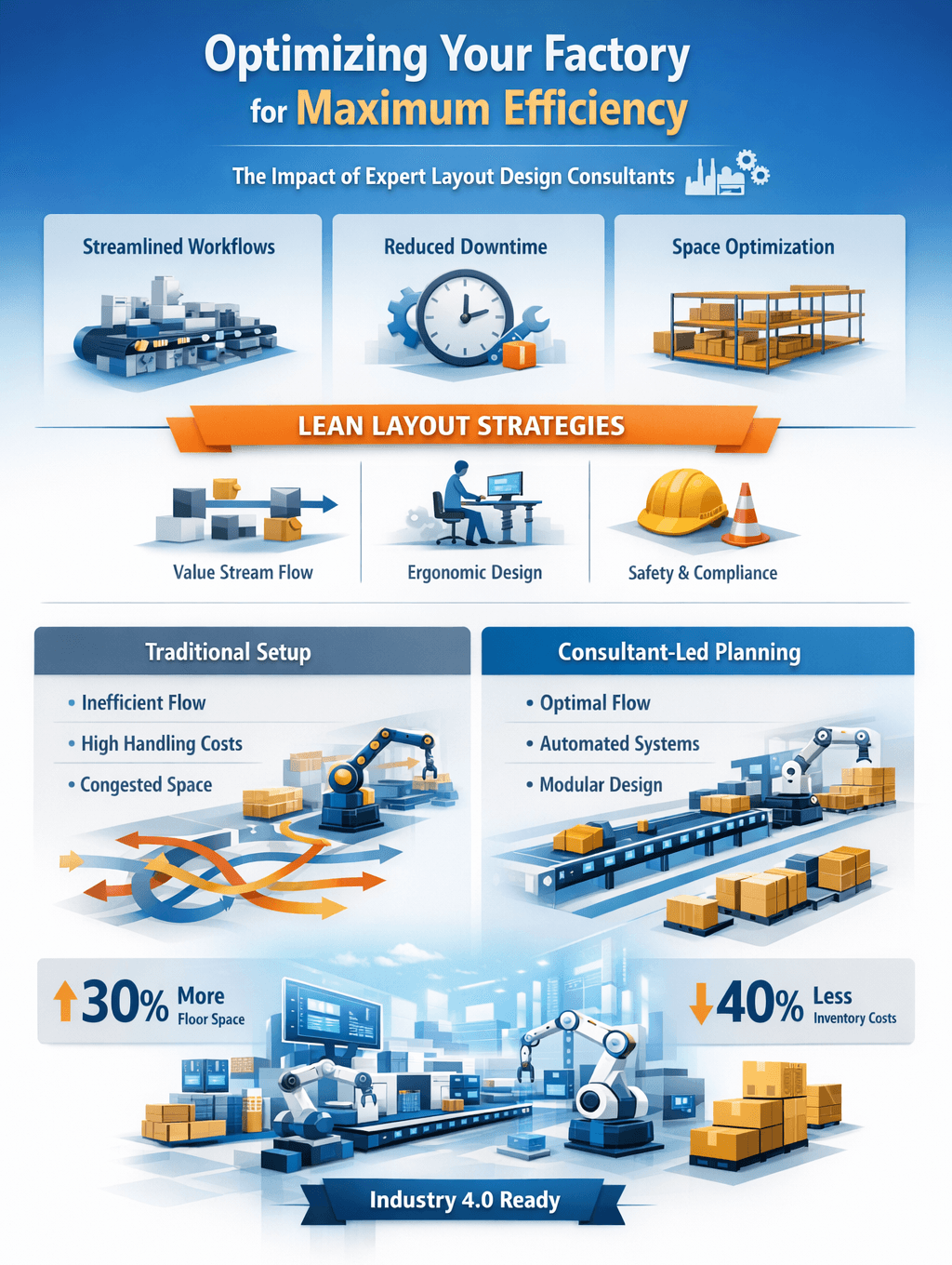
The evidence from these case studies is clear: the physical layout of your plant is the single biggest factor in your operational lead time and cost structure. Whether you are seeking a warehouse layout consultant to fix a bottlenecked supply chain or a plant layout design consultant to re-engineer your assembly flow, the expertise provided by facility layout design services is the most cost-effective way to scale your business.
Contact us