
Selecting an operational consulting partner is a pivotal strategic decision for expanding enterprises. In an evolving economic climate where operational efficiency directly impacts organizational resilience, business leaders need partners who deliver tangible financial gains rather than theoretical advisory reports.
Navigating the market to find qualified productivity consultants in Egypt requires a clear evaluation framework. Organizations must assess potential partners based on proven methodologies, hands on shop floor execution capabilities, and a demonstrated ability to build sustainable internal continuous improvement culture.
The Landscape of Operational Consulting in Egypt
As market dynamics shift, Egyptian enterprises increasingly seek specialized external support to optimize capacity, lower operating costs, and streamline complex workflows. However, consulting firms vary widely in their approach, focus, and delivery models.
When evaluating business productivity consultants in Egypt, leadership teams generally encounter two primary operational transformation models:
- Strategy Only Advisory Firms: These organizations focus primarily on high level management diagnostics, financial analysis, and strategic presentation decks. While valuable for corporate restructuring, they rarely assist with floor level execution, supervisor coaching, or frontline behavioral change.
- Implementation Focused Transformation Partners: These specialists work directly at the real place of execution, often called the Gemba. They collaborate shoulder to shoulder with operational teams to implement tools, redesign physical workflows, streamline material movement, and establish continuous daily management controls.
For companies aiming to eliminate operational bottlenecks, optimize equipment performance, and build high performing workforces, implementation focused partners deliver superior long term return on investment.
Core Criteria for Evaluating Productivity Consultants
To ensure a successful partnership, decision makers should systematically evaluate potential corporate productivity consultants in Egypt against four essential pillars.
1. Commitment to On Ground Gemba Execution
Operational improvements cannot be designed or sustained from an executive boardroom. The right consulting partner conducts exhaustive Gemba diagnostics, observing material flow, physical operator movements, workstation layouts, and information handoffs directly at the workplace.
Leading operational productivity consultants in Egypt spend significant time on the shop floor, coaching supervisors, conducting Time and Motion studies based on International Labour Organization (ILO) standards, and optimizing workstation ergonomics in real time.
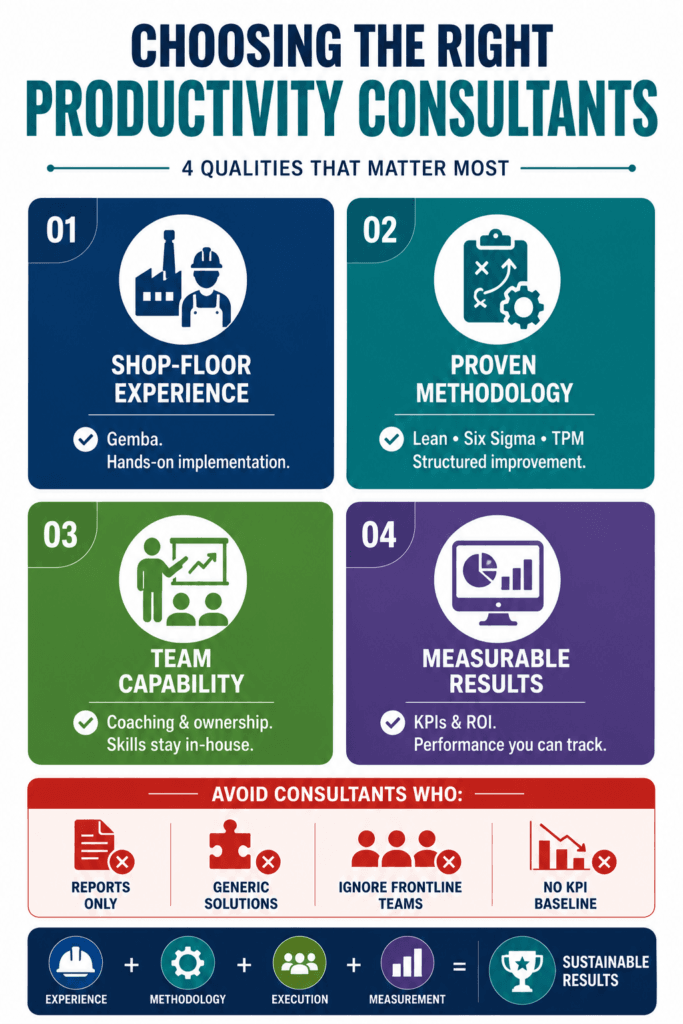
2. Standardized Frameworks and Analytical Depth
Unstructured or purely intuitive consulting leads to unpredictable operational results. Reputable firms deploy structured, proprietary transformation engines, such as comprehensive operational frameworks, to systematically diagnose and eliminate operational waste.
Evaluating prospective partners requires looking for deep expertise in globally validated operational methodologies:
- Lean Management and Six Sigma: For process flow optimization, lead time reduction, defect elimination, and process variation reduction.
- Total Productive Maintenance (TPM): To optimize Overall Equipment Effectiveness (OEE), eliminate micro stoppages, and prevent unplanned machinery downtime.
- 6S Frameworks (5S plus Safety): For establishing physical workspace organization, visual management, standardized work routines, and workplace safety protocols.
3. Capability Building and Upskilling Focus
A successful operational consulting project should make the client organization self reliant. If operational performance drops after consultants complete their engagement, the implementation lacks foundational stability.
Top productivity improvement consultants in Egypt prioritize human capability development. They design custom training modules, establish Daily Work Management (DWM) systems, and train internal transformation champions who continue driving continuous improvement routines independently over time.
4. Measurable Return on Investment and Audit Governance
Clear diagnostic metrics must precede any operational project. High quality firms define concrete Key Performance Indicators (KPIs) during initial discovery, tracking parameters such as unit throughput, defect rates, cycle time reduction, setup times, and worker utilization.
Furthermore, leading partners establish tiered governance structures and regular audit cadences to prevent process regression and ensure long term operational stability across changing business cycles.
The Strategic Importance of Cultural Transformation and Ownership
Beyond process redesign and tool implementation, long term business efficiency depends heavily on organizational culture. Operational workflows frequently deteriorate after external advisors leave because the underlying behavioral habits of the workforce remain unchanged.
High capability workplace productivity improvement strategies address this challenge by embedding a mindset of continuous improvement across all organizational levels. Consultants foster bottom up problem solving by encouraging operators and line supervisors to participate actively in Kaizen events and root cause analysis sessions.
When employees actively contribute to workflow redesigns, operational ownership shifts from external advisors to internal teams. This cultural realignment ensures that efficiency tools remain active components of daily management rather than forgotten initiatives.
Red Flags to Avoid During the Selection Process
To protect organizational resources and avoid project failure, business leaders should watch for specific warning signs when interviewing prospective consultants:
- Over Reliance on Theoretical Recommendations: Be cautious of consultants who deliver static reports without offering floor level implementation support or supervisor coaching.
- One-Size-Fits-All Solutions: Operational processes vary significantly. Avoid providers who apply rigid, off the shelf templates without conducting deep diagnostic assessments of your unique operational realities.
- Lack of Supervisory Coaching: Systems fail when front line leaders are not aligned. Firms that ignore middle management upskilling rarely achieve long term operational shifts.
- Absence of Baseline Data: Partners who propose solutions without establishing baseline performance data or utilizing standard measurement protocols often fail to deliver verifiable operational ROI.
Key Questions to Ask Prospective Consulting Partners
Before signing an operational consulting contract, executive teams should ask prospective partners the following key questions:
- What proportion of your project time is spent on floor level execution versus off site analysis?
- How do your consultants help establish Daily Work Management routines among our front line supervisors?
- What specific analytical tools do you use for Time and Motion studies and line balancing?
- How do you ensure our teams retain capability and sustain operational gains after project completion?
- What governance frameworks do you deploy to monitor continuous improvement routines after phase delivery?
Key Operational Insight: Choosing the right operational consultant is not about buying advisory hours; it is about establishing a long term transformation partnership that embeds operational discipline, elevates workforce capability, and drives scalable profit expansion.
Strategic Value of Specialized Efficiency Services
Partnering with qualified business efficiency consulting services provides enterprise leadership with clear operational clarity. By combining expert diagnostic tools with hands-on implementation, specialized consultants enable businesses to maximize asset capacity, improve customer delivery metrics, streamline material handling, and protect operating margins without requiring unnecessary capital expenditure.
Frequently Asked Questions
How do productivity consultants help Egyptian businesses?
Productivity consultants analyze physical and administrative workflows, remove operational bottlenecks, conduct Time and Motion studies, and implement continuous improvement methodologies like Lean and Six Sigma. They help companies optimize workforce productivity, reduce waste, lower operating costs, and establish daily visual management systems.
Why should companies hire productivity consultants in Egypt?
External productivity consultants bring objective analysis, specialized methodologies, and implementation experience across diverse operating environments. They help organizations execute structural operational changes rapidly without pulling internal managers away from daily execution priorities.
What services do productivity consultants offer in Egypt?
Productivity consultants offer operational diagnostic audits, line balancing, workstation ergonomic redesign, Time and Motion studies, Daily Work Management (DWM) implementation, Total Productive Maintenance (TPM), process layout optimization, and workforce capability building.
When do businesses need productivity consultants in Egypt?
Businesses should engage productivity consultants when encountering capacity bottlenecks, high overtime costs, inconsistent output quality across shifts, excessive lead times, low labor productivity, or when scaling operations requires structured execution models.