In today’s fast-evolving industrial landscape, Kenyan businesses are under increasing pressure to deliver more with less—less time, less cost, and fewer resources. Whether it’s manufacturing, logistics, or service delivery, the difference between stagnation and growth often lies in one critical factor: how efficiently work gets done.
This is where a time and motion study in Kenya becomes a game-changer. Far beyond stopwatches and observation sheets, modern time and motion study in Kenya are data-driven, technology-enabled, and deeply aligned with Lean Manufacturing principles.
At Faber Infinite Consulting, we have seen firsthand how structured time and motion analysis transforms operations—unlocking hidden productivity, reducing waste, and creating sustainable growth for Kenyan industries.
What is a Time and Motion Study?
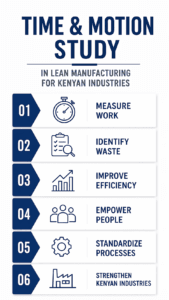
A time and motion study is a systematic method of analyzing work processes to determine the most efficient way to perform tasks. It involves:
- Time Study: Measuring how long each task takes
- Motion Study: Evaluating movements to eliminate unnecessary actions
Together, they form the backbone of lean time and motion study in Kenya, helping organizations identify inefficiencies and redesign workflows.
Why It Matters in Kenya
Kenyan industries, especially in manufacturing and logistics, often face challenges such as:
- High labor dependency
- Process variability
- Limited standardization
- Rising operational costs
A well-executed time and motion study in Kenya directly addresses these challenges by bringing clarity, consistency, and control to operations.
The Lean Connection: Beyond Measurement
Time and motion studies are not standalone tools—they are integral to Lean Manufacturing Consulting in Kenya.
Core Lean Principles Applied:
- Elimination of waste (Muda)
- Standardization of work
- Continuous improvement (Kaizen)
- Respect for people
By combining these principles with data-driven time and motion analysis in Kenya, organizations can move from reactive problem-solving to proactive optimization.
Real Experience: Transforming Kenyan Shop Floors
At Faber Infinite Consulting, we worked with a mid-sized packaging manufacturer in East Africa facing low productivity and high overtime costs.
Initial Challenges:
- Inconsistent cycle times across shifts
- Excessive operator movement
- Bottlenecks in material handling
Our Approach:
- Conducted a detailed time and motion study in Kenya across production lines
- Mapped operator movements using motion analysis tools
- Identified non-value-added activities
Key Findings:
- 28% of operator time was spent on unnecessary movement
- Material flow inefficiencies caused 15% downtime
- Lack of standard work instructions led to variability
Results Achieved:
- 20% increase in labor productivity
- 18% reduction in cycle time
- Significant drop in overtime costs
This is how time and motion study in Kenya improves productivity when expertly applied when applied with the right expertise.
Step-by-Step Process of a Time and Motion Study
-
Define Objectives
Clearly identify goals such as:
- Productivity improvement
- Cost reduction
- Workflow optimization
-
Data Collection
Using tools like:
- Stopwatch studies
- Video analysis
- Digital tracking systems
This forms the base for data-driven time and motion analysis in Kenya.
-
Process Mapping
Break down tasks into:
- Value-added activities
- Non-value-added activities
-
Motion Analysis
Evaluate:
- Operator movements
- Equipment layout
- Ergonomics
-
Time Measurement
Establish:
- Standard cycle times
- Benchmark performance
-
Improvement Design
Implement:
- Layout changes
- Standard operating procedures
- Work balancing
-
Continuous Monitoring
Ensure sustainability through:
- KPIs
- Regular audits
- Feedback loops
Applications Across Kenyan Industries
-
Manufacturing
- Assembly line balancing
- Machine utilization improvement
- Reduction in idle time
-
Logistics & Supply Chain
- Warehouse optimization
- Route efficiency
- Faster loading/unloading
This directly supports improving logistics productivity through time and motion study in Kenya.
-
Service Industry
- Customer service efficiency
- Process turnaround time
- Workforce optimization
Making time and motion study service industry Kenya increasingly relevant.
Key Benefits of Time and Motion Study
-
Productivity Improvement
Organizations typically see 15–30% productivity gains.
-
Cost Reduction
- Lower labor costs
- Reduced overtime
- Optimized resource utilization
-
Standardization
Creates consistent processes across teams and shifts.
-
Better Decision-Making
Data replaces assumptions, enabling how to measure work efficiency using time study in Kenya effectively.
-
Employee Engagement
Clear processes reduce confusion and improve morale.
Expertise Matters: Why Choose Professional Consultants
While internal teams can attempt studies, the real impact comes from experienced time and motion consultants in Kenya.
What Experts Bring:
- Structured methodology
- Industry benchmarks
- Advanced tools
- Objective analysis
At Faber Infinite Consulting, our approach combines:
- Lean expertise
- Digital analytics
- Hands-on implementation
This ensures measurable and sustainable outcomes.
Industry Standards and Best Practices
Time and motion studies are grounded in globally recognized methodologies:
- Frederick Taylor’s Scientific Management
- Frank & Lillian Gilbreth’s Motion Study Principles
- Lean Manufacturing frameworks (Toyota Production System)
Supporting Data:
- According to industry research, lean implementation can reduce waste by up to 40%
- Productivity improvements of 20–25% are common with structured time studies
These benchmarks reinforce the importance of lean manufacturing consulting Kenya.
Common Challenges and How to Overcome Them
-
Employee Resistance
Solution: Involve teams and communicate benefits clearly
-
Inaccurate Data
Solution: Use digital tools and multiple observations
-
Lack of Follow-Through
Solution: Establish continuous improvement systems
The Future: Digital Time and Motion Studies
Modern studies are evolving with:
- AI-driven analytics
- IoT-enabled tracking
- Real-time dashboards
This shift is making data-driven time and motion analysis in Kenya more precise and scalable than ever before.
Conclusion: From Observation to Transformation
A time and motion study in Kenya is no longer optional—it’s essential for businesses aiming to stay competitive. When combined with Lean principles, it becomes a powerful tool for:
- Driving productivity improvement
- Achieving cost reduction
- Building a culture of continuous improvement
Actionable Takeaways:
- Start with a pilot study in one process area
- Focus on data, not assumptions
- Engage employees throughout the process
- Partner with experienced consultants
- Track improvements consistently
At Faber Infinite Consulting, we help Kenyan industries turn insights into measurable results—because efficiency isn’t just about working faster, it’s about working smarter.
FAQs
-
What is the main goal of a time and motion study?
The primary goal is to improve efficiency by analyzing task duration and eliminating unnecessary movements, leading to higher productivity and reduced costs.
-
How time and motion study improves productivity in Kenya?
By identifying inefficiencies, standardizing processes, and optimizing workflows, businesses can achieve significant gains in labor productivity and operational performance.
-
Which industries benefit most from time and motion studies in Kenya?
Manufacturing, logistics, warehousing, and service industries benefit the most due to their process-driven nature.
-
How to measure work efficiency using time study in Kenya?
Efficiency is measured by comparing actual task time against standard time, identifying gaps, and implementing improvements to close those gaps.
-
Why hire time and motion study consultants in Kenya?
Professional consultants bring expertise, tools, and proven methodologies that ensure accurate analysis and sustainable improvements.