Many manufacturing companies in Kenya face a recurring challenge: production systems that appear active, but consistently fail to deliver expected output levels.
Improve Low Manufacturing Productivity in Kenya by recognizing that, in many cases, machines are running, workers are present, and raw materials are available; yet overall productivity remains below potential.
This gap between activity and output is what defines low manufacturing productivity.
It is rarely caused by a single issue. Instead, it results from multiple small inefficiencies across processes, workflows, planning systems, and resource utilization.
While identifying the causes is important, the real value lies in understanding how manufacturers can begin improving productivity in a structured and practical way.
This article explores foundational actions that help manufacturing businesses in Kenya start improving low productivity without requiring large-scale investment or complex transformation programs.
1. Stabilize Core Production Processes
One of the most important steps in improving productivity is ensuring that production processes are stable and repeatable.
In many factories, the same task is performed differently depending on the operator or shift. This leads to inconsistent output quality and variable production speed.
When processes are not standardized:
- Output fluctuates from shift to shift
- Quality becomes inconsistent
- Production time varies unnecessarily
Over time, this variability reduces overall productivity because the system cannot operate predictably.
Stabilizing processes involves clearly defining how work should be done and ensuring that all operators follow the same method consistently.
Even small improvements in process consistency can significantly improve output stability.
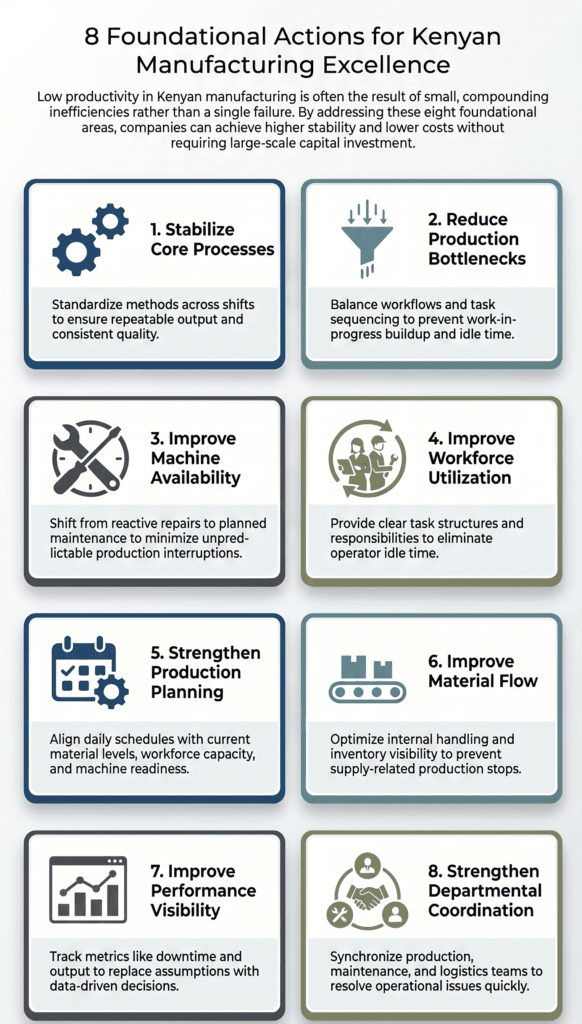
2. Reduce Production Bottlenecks
Bottlenecks are one of the most visible and impactful causes of low productivity in manufacturing environments.
A bottleneck occurs when one stage of production slows down the entire workflow.
For example, if one machine or process is slower than others, it creates a buildup of work upstream and idle time downstream.
Common signs of bottlenecks include:
- Work-in-progress (WIP) piling up between stages
- Certain machines constantly overloaded
- Other machines remaining idle
In many Kenyan factories, bottlenecks are not always caused by equipment limitations; they are often caused by unbalanced workflows or poor sequencing of tasks.
Improving productivity requires identifying where work slows down and redistributing load more evenly across the system.
3. Improve Machine Availability and Uptime
Machine performance has a direct impact on production output. Even small interruptions in machine availability can significantly reduce daily productivity.
Low machine availability is often caused by:
- Unplanned breakdowns during production
- Delayed maintenance response times
- Long setup or changeover periods
In many factories, maintenance is reactive rather than planned, meaning machines are only repaired after failure occurs.
This creates unpredictable production interruptions and reduces total output capacity.
Improving machine availability requires ensuring that equipment is consistently ready for production and that downtime is minimized across shifts.
4. Improve Workforce Utilization and Task Clarity
Human resources play a central role in manufacturing productivity, but they are often underutilized due to unclear task structures.
In many production environments:
- Workers wait for instructions instead of following defined workflows
- Tasks are not evenly distributed across teams
- Productivity varies widely between operators
This leads to idle time, inconsistent output, and inefficiencies in production flow.
Improving workforce utilization involves ensuring that every operator has clear responsibilities and is consistently engaged in productive tasks during their shift.
When workforce roles are well-defined, productivity becomes more stable and predictable.
5. Strengthen Production Planning and Scheduling
Production planning plays a critical role in determining how smoothly manufacturing operations run.
Poor planning often leads to:
- Production delays due to missing materials
- Machines waiting for inputs
- Frequent changes in production schedules
In many cases, production does not fail on the shop floor; it fails in coordination between planning, procurement, and execution.
When planning is weak, even well-functioning machines and skilled workers cannot operate at full capacity.
Improving planning involves ensuring that production schedules align with material availability, workforce capacity, and machine readiness.
6. Improve Material Flow and Availability
Manufacturing productivity depends heavily on how smoothly materials move through the production system.
When materials are not available at the right time, production is forced to stop or slow down.
Common material-related issues include:
- Delayed delivery of raw materials
- Poor inventory visibility
- Inefficient storage and retrieval systems
In some factories, materials exist within the system but are not accessible when needed, creating unnecessary waiting time.
Improving material flow ensures that production continues without interruptions caused by supply delays or internal handling inefficiencies.
7. Improve Visibility of Production Performance
Many manufacturing environments operate without clear visibility into performance metrics.
Without structured tracking of:
- Output per shift
- Machine downtime
- Production cycle times
- Defect rates
It becomes difficult to understand where productivity losses are occurring.
In such environments, decisions are often based on assumptions rather than actual production data.
Even basic visibility into production performance can significantly improve decision-making and help identify inefficiencies that would otherwise go unnoticed.
8. Strengthen Coordination Between Departments
Manufacturing productivity is not only determined on the production floor; it also depends on how well different departments work together.
Production, maintenance, procurement, and logistics must operate in coordination for the system to function efficiently.
When coordination is weak:
- Issues take longer to resolve
- Production interruptions spread across departments
- Decision-making becomes reactive instead of structured
Improving coordination ensures that operational issues are communicated quickly and resolved before they affect output significantly.
The Compounding Nature of Productivity Loss
Low productivity is rarely caused by one major issue. Instead, it results from multiple small inefficiencies interacting across the production system.
For example:
- A minor machine delay creates a small bottleneck
- The bottleneck causes material buildup
- Material buildup leads to idle time in another section
Over time, these small disruptions compound and significantly reduce overall output.
This is why productivity improvement requires attention across multiple areas of the system rather than isolated fixes.
Why This Matters for Kenyan Manufacturing
Improving manufacturing productivity is essential for competitiveness in Kenya’s industrial environment.
Factories with higher productivity benefit from:
- Lower cost per unit
- Higher output without additional capital investment
- Improved ability to compete with imports and regional producers
- Greater operational stability
In a market where margins are often tight and input costs are rising, productivity directly determines long-term sustainability.
Once foundational productivity improvements are in place, manufacturers can begin exploring structured operational improvement approaches that focus on system optimization, process redesign, and long-term efficiency gains.
This forms the basis of more advanced manufacturing transformation strategies.
Conclusion
Low manufacturing productivity in Kenya is not caused by a lack of effort or demand. It is the result of multiple small inefficiencies across processes, workflows, machines, materials, and coordination systems.
By addressing these foundational areas, manufacturers can begin improving output stability and overall production performance.
Faber Infinite supports organizations in developing structured operational thinking and improving manufacturing performance through systems-based approaches.
FAQs
What causes low manufacturing productivity in Kenya?
It is mainly caused by inefficient processes, machine downtime, poor planning, and weak coordination between production systems.
How does machine downtime affect productivity?
Machine downtime reduces available production time, which directly lowers total output.
Why is production planning important?
It ensures that materials, labor, and machines are aligned to avoid interruptions and delays.
Can small improvements increase productivity?
Yes. Small improvements across multiple areas often create significant overall productivity gains due to compounding effects.
What is the biggest hidden cause of low productivity?
The most common hidden cause is lack of system coordination between processes, departments, and workflows.