Modern industrial facilities operate in an environment where Operational Excellence dictates market survival. Across Egypt, manufacturing facilities face the dual pressure of optimizing production costs while meeting heightened environmental and quality benchmarks. Transitioning toward world-class manufacturing requires moving beyond basic adjustments and adopting proven industry standards. Implementing structured manufacturing industry waste reduction frameworks allows plants in Egypt to achieve operational stability, minimize resource consumption, and build long-term resilience.
While individual improvement methods play an important role, long-term success depends on establishing repeatable practices that become part of daily operations. Organizations that embed waste reduction into their operational culture are better equipped to improve quality, reduce unnecessary resource consumption, and support continuous improvement over time. True transformation happens when plants stop viewing waste as an inevitable cost of doing business and start treating every scrap, idle minute, and excess inventory buffer as a solvable operational defect.
The Foundation of Industrial Best Practices in Waste Reduction
Best practices in waste reduction are not isolated operational tricks; they represent an integrated philosophy of continuous improvement. Successful industrial leaders in Egypt understand that sustainable efficiency originates from standardizing daily routines and fostering a culture of accountability.
By focusing on root-cause problem solving rather than treating surface-level symptoms, plants can permanently eliminate recurring operational losses. This foundational mindset requires continuous training, transparent performance metrics, and a commitment to empowering employees at every level of the production hierarchy to suggest and implement workflow improvements. When leadership establishes psychological safety on the shop floor, operators feel encouraged to highlight hidden inefficiencies before they escalate into major production bottlenecks.
Key Best Practices for Sustainable Manufacturing in Egypt
Deploying high-impact operational practices ensures that factories maximize output while systematically cutting waste across the entire value chain. Integrating these practices requires discipline, cross-departmental collaboration, and ongoing measurement.
1. Value Stream Mapping (VSM) for Visualizing Waste
Before implementing changes, plant managers must visualize the entire production flow from raw material intake to final customer delivery. Value Stream Mapping acts as a diagnostic tool that highlights process bottlenecks, excessive inventory buffers, and unnecessary material transport. By analyzing current-state maps, engineering teams can design future-state workflows that drastically shorten lead times, reduce work-in-progress (WIP) inventory, and eliminate non-value-adding steps. This visual clarity ensures that capital and human resources are deployed where they generate the highest operational return.
2. Implementing Rigorous Root Cause Analysis (RCA)
When defects, machine stoppages, or material losses occur, addressing only the immediate failure guarantees recurrence. Industry leaders utilize structured problem-solving methodologies, such as the Five Whys and fishbone diagrams, to uncover the underlying systemic causes of inefficiency. Fixing the root cause permanently protects the process against future waste generation, ensuring high first-pass quality and minimizing costly scrap generation. Over time, disciplined root cause analysis shifts maintenance and engineering teams from a reactive firefighting mode to a proactive reliability culture.
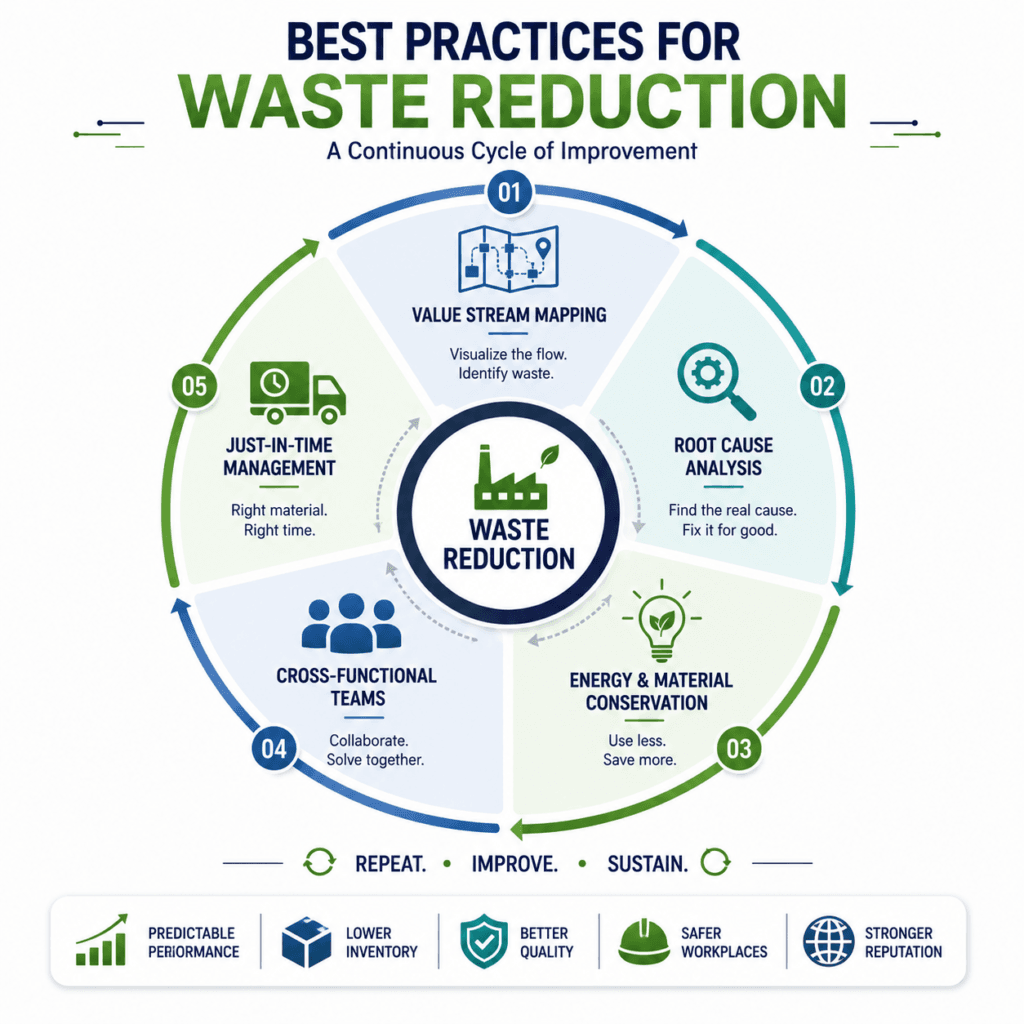
3. Energy and Material Conservation Integration
Sustainable manufacturing requires a holistic view of resource inputs. Best-in-class operations continuously monitor power consumption, compressed air leakage, and raw material utilization rates. Integrating industrial waste reduction service guidelines in Egypt helps facilities optimize material cutting patterns, recycle scrap streams internally, and significantly lower overall utility overhead. Conserving energy and raw materials protects margins against price volatility while aligning operations with environmental stewardship and modern resource regulations.
4. Cross-Functional Continuous Improvement Teams
Siloed departments hinder operational progress. Best practices dictate the creation of cross-functional teams comprising shop-floor operators, quality controllers, and plant engineers. Empowering frontline workers to identify daily friction points and propose practical solutions fosters a powerful culture of ownership, accelerates problem resolution, and ensures that process changes are practical and sustainable. When production operators collaborate directly with design and quality engineers, solutions are implemented faster and adopted more willingly across shifts.
5. Just-in-Time (JIT) Material Management
Holding excessive raw material or finished goods inventory ties up vital working capital and hides underlying production defects. Adopting Just-in-Time principles ensures that materials arrive precisely when needed in the production sequence. This discipline minimizes storage costs, reduces the risk of material degradation, and forces production teams to resolve equipment or quality bottlenecks immediately rather than relying on inventory buffers to mask disruptions.
Developing an Operational Waste Reduction Framework for Egypt
Long-term industrial success depends on establishing a structured operational waste reduction framework that guides improvement efforts across the entire organization. An effective framework typically includes:
- Leadership Support: Plant leaders establish priorities, allocate resources, and reinforce the importance of continuous improvement throughout the organization, ensuring alignment from top management to frontline operators.
- Clearly Defined Processes: Documented standard operating procedures (SOPs) provide consistency while creating a foundation for future process enhancements and safe operational execution.
- Performance Monitoring: Organizations should monitor key operational indicators that reflect process efficiency, quality performance, and resource utilization in real-time.
- Continuous Learning: Lessons learned from daily improvement initiatives should be documented, shared across shifts, and incorporated into future operational planning.
Strategic Value of Adopting Industry Standards in Egypt
Embracing structured manufacturing waste reduction methodologies with the help of experts in Egypt delivers measurable strategic advantages that compound over time:
- Predictable Operational Performance: Standardized processes minimize variability, ensuring consistent product quality, predictable delivery timelines, and higher customer satisfaction.
- Optimized Working Capital: Reducing work-in-progress (WIP) inventory and eliminating material waste frees up valuable financial liquidity for business growth and technology investment.
- Elevated Brand Reputation: Adopting efficient, eco-conscious manufacturing practices positions regional brands as trusted, reliable partners for both local and international markets.
- Enhanced Safety and Ergonomics: Eliminating physical clutter and streamlining workstation design creates a safer, more comfortable environment for plant operators, lowering absenteeism and injury rates.
Frequently Asked Questions
What are the best practices for waste reduction in the manufacturing industry?
Leading best practices include process standardization, Value Stream Mapping, continuous improvement, preventive maintenance, employee engagement, performance monitoring, and Lean manufacturing principles.
Why is waste reduction in the manufacturing industry important in Egypt?
With shifting economic parameters and rising input costs, waste reduction provides a reliable blueprint for industrial facilities to protect profit margins, optimize resource utilization, and secure sustainable long-term operations.
How do Lean manufacturing waste reduction methods support operational efficiency?
Lean manufacturing waste reduction methods help organizations identify non-value-adding activities, simplify workflows, improve workplace organization, and encourage continuous improvement across manufacturing operations.
What is an operational waste reduction framework?
An operational waste reduction framework is a structured system that combines leadership support, standardized processes, employee participation, performance monitoring, and continuous improvement to reduce operational waste.
How can organizations sustain waste reduction efforts over time?
Organizations can sustain waste reduction by embedding continuous improvement into daily operations, regularly reviewing processes, engaging employees, monitoring performance, and adapting improvement initiatives as operational needs change.