Manufacturing companies in Kenya are increasingly focused on improving efficiency and productivity as they face rising production costs, competitive regional markets, and pressure to deliver consistent output.
While many factories understand the need for improvement, the real challenge is identifying what actually works in day-to-day production environments.
In practice, manufacturing efficiency is not improved through theory alone. It is achieved through specific operational changes that affect how work flows, how resources are used, and how consistently production systems perform.
This article explores practical, real-world ways manufacturers in Kenya improve efficiency and productivity based on common operational improvements seen in functioning production environments.
1. Improving Flow Between Production Stages
One of the most effective ways factories improve performance is by improving how work moves through the production system.
In many manufacturing environments, production is not slowed down by individual processes, but by delays between processes.
These delays often appear as:
- Waiting time between production steps
- Work piling up between departments
- Uneven production speeds across stages
When flow is improved, materials and work move more smoothly from one stage to another, reducing idle time and increasing total output.
Even without adding new equipment or labor, improving flow often results in immediate productivity gains.
2. Reducing Idle Time in Machines and Workers
A common inefficiency in manufacturing systems is underutilization of available capacity.
Machines may be operational, but not actively producing. Workers may be present, but not continuously engaged in productive tasks.
Idle time is often caused by:
- Poor coordination between production stages
- Waiting for materials or instructions
- Unbalanced workloads across shifts
Improving efficiency involves ensuring that both machines and workers remain consistently engaged in value-producing activities during production cycles.
Reducing idle time directly increases output without requiring additional resources.
3. Standardizing How Work Is Done
Consistency in production processes is one of the most important drivers of manufacturing performance.
When work is performed differently across shifts or operators, factories experience:
- Variation in output quality
- Inconsistent production speeds
- Unpredictable results
Standardization ensures that tasks are performed in the same way regardless of who is operating the system.
This creates stability in production performance and reduces unnecessary variation in output.
4. Improving Machine Readiness and Availability
Machine performance is a major factor in overall productivity.
Even when equipment is capable of high output, performance drops when machines are frequently unavailable.
Common issues affecting machine readiness include:
- Unplanned breakdowns
- Delayed maintenance response
- Long setup times between production runs
Improving machine availability ensures that equipment is ready when needed and capable of running at expected capacity during production.
This has a direct impact on total output levels.
5. Strengthening Material Availability and Flow
Production efficiency depends heavily on the availability of materials at the right time.
When materials are delayed or poorly managed, production slows down or stops completely.
Common material-related inefficiencies include:
- Delayed delivery of raw inputs
- Poor inventory visibility
- Inefficient storage and retrieval systems
Improving material flow ensures that production continues without interruptions caused by missing or inaccessible inputs.
This is one of the most overlooked but impactful areas of manufacturing improvement.
6. Balancing Workloads Across Production Lines
Uneven distribution of work across production stages leads to inefficiencies that reduce overall output.
In many factories:
- Some stages are overloaded
- Others remain underutilized
- Bottlenecks form at specific points in the process
Balancing workloads ensures that all parts of the production system operate at a consistent pace.
This improves flow efficiency and reduces unnecessary waiting time between processes.
7. Improving Communication Between Production Functions
Manufacturing performance depends on coordination between multiple functions, including production, maintenance, procurement, and logistics.
When communication is weak:
- Issues take longer to resolve
- Delays spread across departments
- Production becomes reactive rather than planned
Improving communication ensures that operational issues are identified and addressed quickly, preventing small disruptions from affecting overall output.
8. Increasing Visibility of Production Performance
Many manufacturing environments operate without clear visibility into actual production performance.
Without structured tracking of:
- Output per shift
- Machine downtime
- Production cycle times
- Defect rates
It becomes difficult to identify where inefficiencies are occurring.
Improving visibility allows managers and operators to understand performance in real time and make informed operational decisions.
Even basic tracking systems can significantly improve production discipline and consistency.
9. Reducing Unnecessary Movement and Handling
In many factories, inefficiencies are created by unnecessary movement of materials and workers.
This includes:
- Excess transport between storage and production areas
- Repeated handling of materials
- Poor layout of production spaces
Reducing unnecessary movement improves efficiency by minimizing time wasted on non-productive activities.
This also improves overall flow and reduces fatigue in production environments.
The Compounding Effect of Small Improvements
Manufacturing productivity does not usually improve because of one major change.
Instead, it improves through multiple small improvements that work together across the system.
For example:
- A small reduction in machine downtime
- Slight improvement in material availability
- Better balance of workloads
Individually, these may seem minor. Together, they significantly improve total production output.
This compounding effect is what makes structured improvement approaches so effective in manufacturing environments.
Improve Efficiency and Productivity in Kenyan Manufacturing
Improving manufacturing efficiency and productivity is critical for competitiveness in Kenya’s industrial sector.
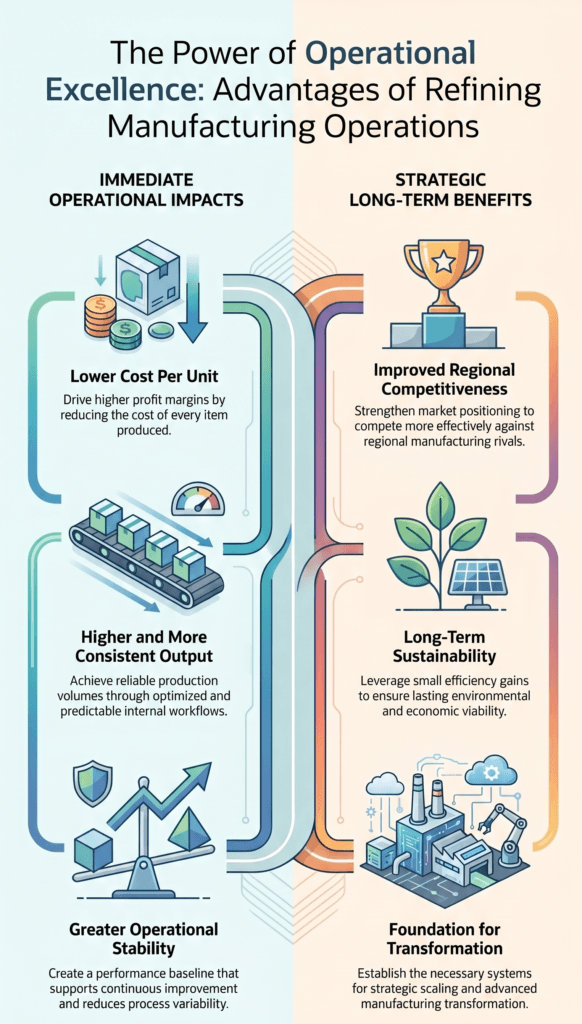
Factories that successfully improve internal operations benefit from:
- Lower cost per unit
- Higher and more consistent output
- Improved ability to compete regionally
- Greater operational stability
In a cost-sensitive and competitive environment, even small improvements in efficiency can have a significant impact on long-term sustainability.
Once these practical improvements are in place, manufacturers can move toward more structured operational systems that focus on long-term performance stability, continuous improvement, and strategic scaling of production capability.
This forms the foundation for advanced manufacturing transformation approaches.
Conclusion
Manufacturing efficiency and productivity in Kenya improve when factories focus on practical operational changes such as improving flow, reducing idle time, standardizing work, and strengthening material and machine availability.
These improvements create more stable, predictable, and efficient production systems that enhance overall competitiveness.
In manufacturing environments, consistent small improvements often deliver greater impact than isolated large-scale changes.
Faber Infinite supports organizations in strengthening operational thinking and improving manufacturing performance through structured, systems-based approaches.
FAQs
What is the fastest way to improve manufacturing efficiency?
Improving flow between production stages and reducing idle time often delivers the quickest gains.
Why is idle time a problem in manufacturing?
Idle time reduces the productive use of machines and labor, lowering overall output.
How does standardization improve productivity?
It ensures that work is performed consistently, reducing variation and improving output stability.
Why is material availability important?
Production stops or slows when required materials are not available at the right time.
Can small improvements really increase factory output?
Yes. Small improvements across multiple areas create a compounding effect that significantly increases total productivity.