Improve efficiency and productivity in Kenya is becoming more competitive in 2026, with increasing pressure to improve output, reduce operational costs, and maintain consistent production performance.
While most factories already understand that efficiency and productivity need to improve, the real challenge is not awareness; it is structure and execution.
Many improvement efforts fail because they focus on isolated actions instead of a coordinated strategy that connects daily operations to long-term performance goals.
This article explains how manufacturers can build practical improvement strategies in 2026, and what actually separates successful factories from those that struggle to sustain performance gains.
What a Manufacturing Strategy Really Means in 2026
A manufacturing strategy is not a document, presentation, or consulting report.
In real factory environments, it simply means:
- Deciding what to improve first
- Understanding where output is being lost
- Linking improvements to measurable performance outcomes
- Ensuring improvements are sustained over time
Without this structure, improvement efforts become reactive and fragmented, and results rarely last.
A strong strategy ensures that operational improvements are not random, but coordinated across the entire production system.
What Successful Factories Actually Focus On in 2026
Factories that consistently improve performance tend to focus on a small number of core operational areas rather than trying to fix everything at once.
These include:
- Reducing time lost during production (downtime and delays)
- Improving how smoothly work moves through production stages
- Making better use of machines and labour during shifts
- Ensuring work is performed consistently across teams
- Improving coordination between departments like production, maintenance, and logistics
These areas matter because they directly affect output, cost per unit, and delivery reliability.
When these fundamentals improve, overall factory performance improves naturally.
What a Strong Improvement Strategy Looks Like in Practice
In real manufacturing environments, strategy is not created all at once; it is built in stages.
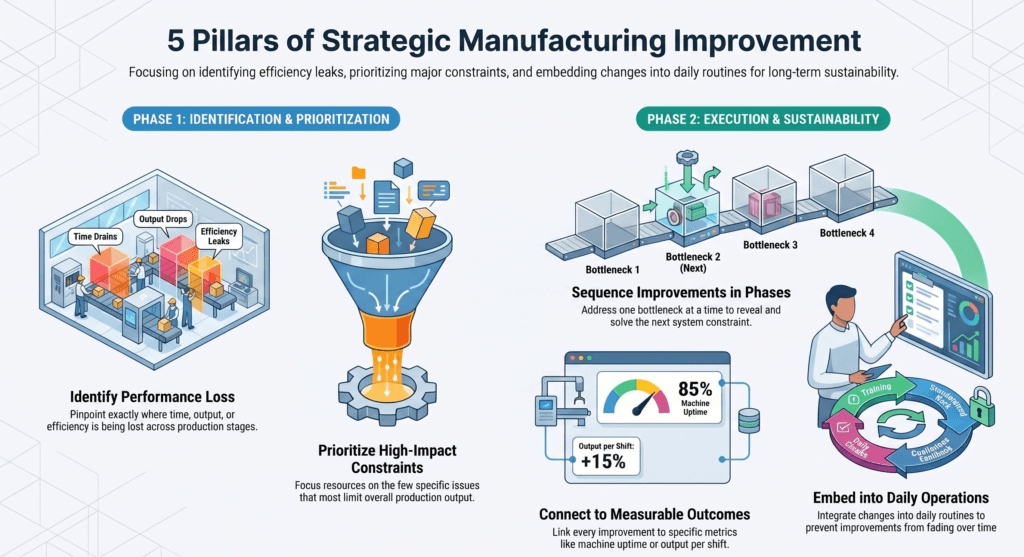
1. Understanding Where Production Performance Is Being Lost
Factories first need to identify where time, output, or efficiency is being lost. This could be downtime, slow processes, or poor coordination between stages.
2. Focusing on High-Impact Constraints First
Not all problems have equal impact. Strong strategies prioritize the few issues that are limiting overall production output the most.
3. Sequencing Improvements Instead of Doing Everything at Once
Improvement is more effective when done in phases. Fixing one constraint often reveals the next bottleneck in the system.
4. Connecting Improvements to Measurable Outcomes
Every improvement should be linked to something measurable such as output per shift, machine uptime, or production consistency.
5. Embedding Improvements Into Daily Operations
Without integration into daily routines, improvements fade over time. Sustainable strategies ensure that changes become part of how work is done every day.
What “Good Performance” Actually Means in Manufacturing Strategy
A strong strategy is not measured by the number of changes implemented, but by measurable improvements in production performance.
Key indicators usually include:
- Higher output per shift
- Reduced unplanned downtime
- More consistent production cycles
- Fewer interruptions in material flow
- Improved delivery reliability
When strategy is working, these improvements appear gradually but consistently across the system.
How Consultants Support Manufacturing Strategy Development
In many manufacturing environments, consultants are used not to “fix operations directly” but to help structure improvement efforts.
Their role often includes:
- Identifying where performance losses are happening in the system
- Helping prioritize improvements based on impact
- Designing structured improvement roadmaps
- Introducing measurement systems for tracking performance
- Ensuring improvements are aligned across departments
The main value of consulting support is clarity; helping factories move from scattered improvement efforts to a structured, measurable system of change.
Why Most Manufacturing Strategies Fail to Deliver Results
Many factories attempt to improve efficiency and productivity but do not achieve lasting results.
This usually happens because:
- Improvements are implemented in isolation
- There is no clear sequencing of actions
- Performance is not tracked consistently
- Changes are not reinforced in daily operations
Without structure and follow-through, improvements tend to fade, and factories return to previous performance levels.
How Strategy Directly Improves Efficiency and Productivity
A well-structured strategy improves manufacturing performance in three main ways:
1. It Reduces Wasted Time in the System
By focusing on downtime, delays, and bottlenecks, factories recover lost production time.
2. It Improves Stability in Production Output
Consistent processes and coordination lead to more predictable results.
3. It Increases Effective Use of Existing Capacity
Factories produce more output without necessarily adding machines or labour.
Together, these improvements lead to higher efficiency and productivity without major capital investment.
Why This Matters for Manufacturing in Kenya
Manufacturers in Kenya operate in an environment where operational costs are rising and competition is increasing from both local and regional producers.
In this environment, efficiency directly impacts:
- Cost per unit
- Ability to meet delivery timelines
- Competitiveness in regional markets
- Long-term profitability
Factories that adopt structured improvement strategies are better positioned to remain stable and competitive in 2026 and beyond.
Once a structured strategy is in place, factories can move into deeper transformation work that focuses on system-wide Operational Excellence, continuous improvement, and long-term scalability.
This is where manufacturing performance becomes not just improved, but consistently optimized.
Faber Infinite supports organizations in building structured, systems-based approaches to improving manufacturing efficiency and productivity.
Conclusion
Improving efficiency and productivity in 2026 is not about isolated fixes or short-term actions.
It is about building a clear strategy that connects operational priorities to measurable outcomes and ensures improvements are sustained over time.
Factories that succeed are those that understand where performance is being lost, focus on the right constraints, and build systems that support continuous improvement.
In manufacturing, strategy is what turns improvement into a repeatable capability rather than a one-time effort.
FAQs
What is a manufacturing improvement strategy?
It is a structured approach that identifies priorities, focuses on key constraints, and links improvements to measurable outcomes.
Why do manufacturing strategies fail?
They fail when improvements are not structured, not sequenced properly, or not tracked consistently over time.
What makes a good manufacturing strategy?
A good strategy focuses on high-impact areas, is implemented in phases, and is tied to measurable production results.
How do consultants help in manufacturing strategy?
They help identify performance gaps, prioritize improvements, and design structured execution systems.
What is the biggest driver of productivity improvement?
Reducing wasted time in production systems, especially downtime and process delays.