
As businesses in Kenya grow, one of the first operational areas to experience strain is inventory management.
Systems that worked during early-stage operations such as spreadsheets, manual tracking, and informal procurement routines quickly become insufficient when order volumes increase, supply chains expand, and customer expectations become more demanding.
At this stage, many companies begin looking for inventory management consultants who can help structure their systems, improve visibility, and align inventory operations with business growth.
However, growth-stage inventory challenges are not simple “stock problems.” They are system scaling problems.
This means the solution is not just better tracking; it is better design of how inventory flows through the entire business.
This article explains how inventory management consultants support growing Kenyan firms, what typically breaks during growth, and what businesses should look for when scaling operations.
Why Inventory Systems Break When Businesses Start Growing
Growth exposes weaknesses that were previously hidden.
In early-stage businesses, small inefficiencies are manageable. But as operations expand, those inefficiencies multiply.
Common breakdown points include:
- Inventory records becoming inconsistent across locations
- Procurement decisions being made without accurate demand data
- Warehouse teams operating without standardized processes
- Increasing delays in replenishment cycles
- Rising levels of excess or obsolete stock
These problems are not caused by growth itself, but by systems that were never designed to handle scale. As complexity increases, informal systems stop working effectively.
Why Inventory Becomes a Scaling Bottleneck
Inventory is one of the few business functions that touches almost every operational area:
- Sales depend on stock availability
- Procurement depends on demand visibility
- Finance depends on inventory valuation and cash flow impact
- Operations depend on material or product flow
When inventory systems are weak, all of these areas are affected simultaneously.
This is why many growing firms experience a situation where: sales are increasing, but profitability and cash flow feel tighter.
The cause is often not revenue; it is inventory inefficiency.
When Growing Firms Typically Realize They Need Consulting Support
Most businesses do not seek inventory consulting early. They usually recognize the need when operational friction becomes visible.
Common triggers include:
- Frequent stock discrepancies between system and physical counts
- Difficulty tracking inventory across multiple locations or branches
- Increasing emergency procurement due to stockouts
- Slow-moving inventory accumulating without control
- Inability to forecast demand reliably
- Delays in fulfilling customer orders despite having “stock somewhere”
These signals indicate that the inventory system is no longer aligned with operational scale.
At this stage, incremental fixes are usually not enough.
What Inventory Management Consultants Actually Do for Growing Companies
Inventory consulting is not just about fixing stock issues.
For growing businesses, consulting focuses on rebuilding the structure of inventory operations so the operations can scale effectively.
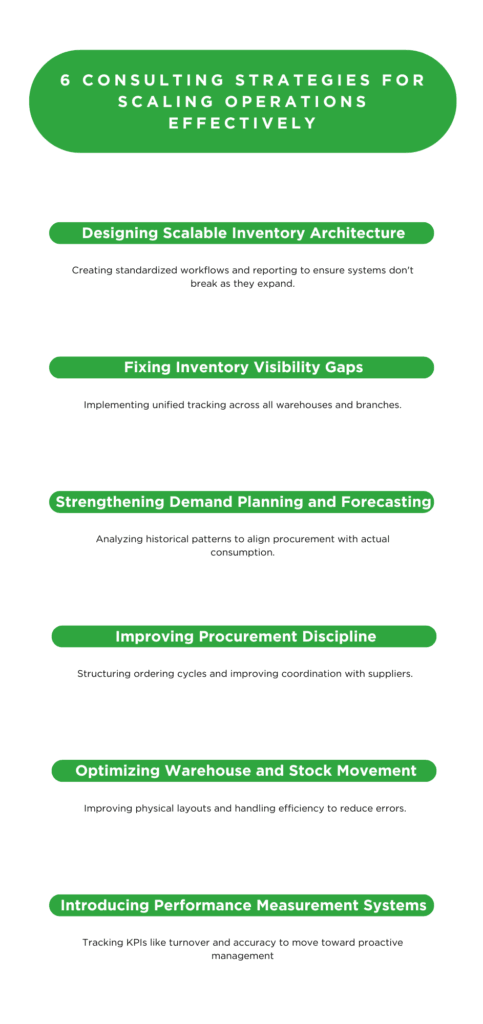
1. Designing Scalable Inventory Architecture
Growing firms need systems that can expand without breaking.
Consultants help design:
- Standardized inventory workflows across locations
- Structured stock movement processes
- Consistent receiving and issuing procedures
- Unified reporting systems
This ensures that as operation scale grows, inventory processes remain stable and predictable.
Without this, each new branch or warehouse adds more confusion instead of capacity.
2. Fixing Inventory Visibility Gaps
One of the most common challenges growing Kenyan companies face is lack of visibility.
Inventory may exist, but it is not clearly tracked across:
- Warehouses
- Branches
- Production units
- Distribution points
Consultants improve visibility by:
- Creating unified tracking systems
- Improving stock reconciliation processes
- Reducing delays in data updates
- Standardizing reporting formats
This allows decision-makers to see inventory in real time rather than relying on fragmented reports.
3. Strengthening Demand Planning and Forecasting Systems
As businesses grow, demand becomes more complex and less predictable.
Consultants help firms:
- Analyze historical demand behavior
- Identify patterns in seasonal fluctuations
- Separate stable demand from volatile demand
- Align procurement planning with actual consumption trends
This reduces overstocking while preventing stockouts.
In growing firms, forecasting is often the difference between controlled growth and chaotic expansion.
4. Improving Procurement Discipline and Supplier Coordination
Procurement becomes more complex as order volumes increase.
Without structure, companies experience:
- Delayed replenishment cycles
- Inconsistent supplier performance
- Emergency purchasing at higher costs
Consultants help improve procurement by:
- Structuring ordering cycles
- Improving supplier lead time planning
- Introducing procurement controls
- Aligning purchasing with demand forecasts
This stabilizes supply and reduces operational disruptions.
5. Optimizing Warehouse and Internal Stock Movement
As inventory grows, inefficiencies in physical handling become more expensive.
Consultants typically improve:
- Warehouse layout and zoning
- Picking and packing efficiency
- Stock placement strategies (fast vs slow moving items)
- Internal movement flow
Even small improvements in warehouse design can significantly reduce delays and errors.
6. Introducing Performance Measurement Systems
Growing firms often lack structured inventory performance tracking.
Consultants introduce systems such as:
- Inventory turnover tracking
- Stock aging reports
- Demand vs supply analysis
- Stock accuracy KPIs
These metrics help businesses move from reactive problem-solving to proactive management.
What Separates Strong Consultants From Basic Service Providers
Not all consultants are equipped to support growth-stage complexity.
Basic providers typically focus on:
- Short-term stock corrections
- Software implementation
- Surface-level inventory adjustments
Stronger consultants focus on:
- System redesign and scalability
- Process standardization across the organization
- Cross-functional alignment (procurement, sales, operations, finance)
- Long-term operational stability
For growing firms, this difference determines whether improvements last or collapse under scale.
Why Many Growing Firms Struggle Even After Implementing Systems
A common issue is implementing tools without fixing underlying processes.
For example:
- Software is installed but data entry remains inconsistent
- Warehouses are reorganized but processes remain unclear
- Procurement systems exist but forecasting is weak
This leads to a situation where systems exist, but performance does not improve.
Consultants address this gap by aligning systems with real operational behavior.
Why Inventory Consulting Matters for Growing Kenyan Firms
Kenyan businesses often function in environments characterized by:
- Fluctuating demand conditions
- Supply chain delays
- Cash flow constraints
- Uneven infrastructure and logistics systems
In such conditions, scaling without structure leads to operational instability.
Inventory consulting helps businesses:
- Maintain control during expansion
- Reduce operational inefficiencies
- Improve financial stability
- Support sustainable growth
It turns inventory from a constraint into a structured growth enabler.
Conclusion
For growing Kenyan firms, inventory management becomes increasingly complex as operations expand.
The challenge is not just tracking stock; it is designing systems that can scale without breaking.
Inventory management consultants help businesses build this structure by improving visibility, strengthening forecasting, standardizing processes, and aligning operations across departments.
When done correctly, inventory management becomes a foundation for controlled, sustainable business growth.
FAQs
When should a growing firm hire an inventory consultant?
When inventory tracking becomes inconsistent or operations become difficult to manage across locations.
Why do inventory systems break during growth?
Because informal systems do not scale with increased operational complexity.
How do consultants help scaling businesses?
They design structured systems for inventory flow, forecasting, and procurement.
Do inventory systems improve cash flow?
Yes, by reducing excess stock and improving working capital efficiency.
What is the biggest inventory challenge in growing firms?
Lack of visibility and inconsistent processes across expanding operations.
Contact us