
Kenya’s business landscape is undergoing a structural shift driven by digital adoption, regional trade integration, and rising pressure for operational efficiency. As companies scale across East Africa, traditional logistics models are giving way to more agile, data-driven supply chain systems.
This shift has significantly increased demand for supply chain consulting in Kenya, where organizations are working with experts to redesign operations, improve visibility, and build resilience across increasingly complex networks.
Rather than focusing only on cost efficiency, modern supply chain transformation is now centered on intelligence, speed, and adaptability. Consulting firms are being increasingly sought to help organizations transition from fragmented systems to integrated digital ecosystems that connect planning, procurement, logistics, and distribution.
This article explores the key digital supply chain consulting trends shaping Kenya’s markets and how businesses can use them to build competitive advantage.
1. Data Is Redefining Supply Chain Decision-Making
One of the most significant shifts in supply chain management in Kenya is the move toward real-time, data-driven decision-making.
Organizations are increasingly adopting analytics dashboards, predictive forecasting tools, and AI-supported planning systems to manage procurement and inventory more effectively. Instead of relying on historical assumptions, decisions are now based on live operational data.
Supply chain consultants play a critical role in integrating Enterprise Resource Planning (ERP) systems, warehouse management platforms, and logistics tracking tools into a unified digital environment. This creates visibility across the entire value chain; from sourcing to delivery.
In sectors like FMCG and retail, predictive demand modeling is already reducing both stockouts and excess inventory, improving service levels while lowering working capital pressure.
2. End-To-End Digital Transformation Is Becoming the Standard
Businesses are increasingly moving away from siloed systems toward end-to-end supply chain transformation in Kenya.
This means digitizing the full lifecycle of operations, including procurement, production planning, warehousing, and last-mile delivery, within a single connected ecosystem.
Instead of isolated improvements, companies are now focusing on system-wide optimization where every node in the supply chain communicates in real time.
The role of consulting here is not just technical but strategic; aligning digital systems with business objectives such as faster turnaround times, reduced operational friction, and improved supplier coordination.
The result is a more responsive and scalable supply chain architecture that can adapt to market volatility.
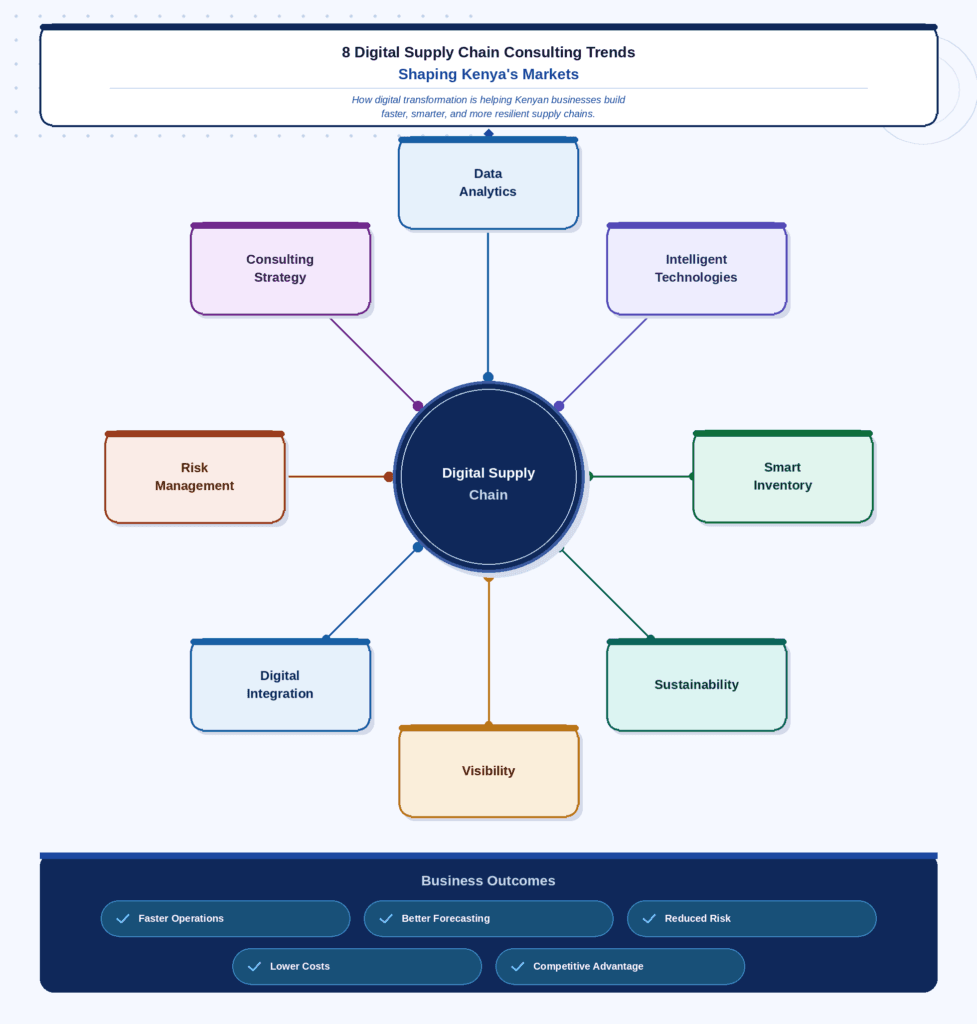
3. Artificial Intelligence Is Shifting Supply Chains From Reactive to Predictive
AI adoption is rapidly reshaping supply chain consulting practices in Kenya.
Machine learning models are now being used for demand forecasting, supplier risk evaluation, and logistics optimization. These systems continuously improve accuracy by learning from historical and real-time data.
Rather than reacting to disruptions, businesses are beginning to anticipate them.
Consultants help organizations implement predictive systems that improve planning accuracy and reduce inefficiencies across procurement and distribution. This is particularly important in sectors with fluctuating demand patterns.
The shift toward predictive supply chain models is one of the most transformative trends in the region.
4. Smarter Inventory Systems Are Reducing Hidden Inefficiencies
Inventory management remains one of the most critical cost drivers in supply chain performance.
Many Kenyan businesses are now adopting intelligent inventory optimization systems that dynamically adjust stock levels based on demand signals.
This evolution in inventory planning reduces:
- Excess stock holding costs
- Stockout risks
- Warehouse congestion
- Cash flow constraints
Modern supply chain consulting approaches focus heavily on aligning inventory strategy with demand variability and supplier reliability. The result is a leaner, more responsive supply chain that avoids both overstocking and operational shortages.
5. Risk Management Is Becoming a Core Supply Chain Priority
Recent global disruptions have forced businesses in Kenya to rethink supply chain resilience.
Companies are increasingly focusing on supply chain risk management strategies that address supplier concentration, logistics disruptions, and currency volatility.
Consultants support organizations by mapping end-to-end supply networks and identifying structural vulnerabilities that may not be visible at an operational level.
This often leads to diversification of suppliers, improved contingency planning, and stronger logistics redundancy. As a result, supply chains are becoming more resilient and less exposed to single-point failures.
6. Sustainability Is Becoming a Competitive Requirement
Sustainability is no longer optional in modern supply chain design; it is now a strategic requirement.
Companies are increasingly adopting sustainable supply chain practices in Kenya to meet both regulatory expectations and global market standards.
This includes improvements in packaging, transportation efficiency, sourcing ethics, and waste reduction across logistics operations.
Export-oriented industries in particular are investing in greener and more efficient systems to remain competitive in international markets where ESG (Environmental, Social, and Governance) compliance is increasingly important.
Sustainability is now closely tied to efficiency rather than being treated as a separate initiative.
7. Supply Chain Visibility Is Driving Operational Control
One of the most important transformations in modern logistics is the rise of real-time visibility.
Businesses are deploying tracking systems, sensors, and cloud-based dashboards to monitor shipments and inventory movement in real time.
This level of transparency improves delivery reliability, reduces delays, and enhances customer satisfaction.
Consultants play a key role in integrating these technologies into existing workflows so that visibility translates into actionable operational improvements rather than just reporting tools.
8. The Evolving Role of Supply Chain Consultants in Kenya
The role of a supply chain consultant in Kenya has evolved significantly in recent years.
It now extends beyond operational troubleshooting into strategic transformation, digital integration, and long-term system design.
Today’s consultants help businesses answer critical questions such as:
- How can supply chains be made more resilient and data-driven?
- What technologies deliver the highest operational ROI?
- How can inventory and logistics systems be optimized for Kenya’s market conditions?
Consultants focus on combining analytics, process redesign, and digital enablement to build scalable supply chain ecosystems that support long-term growth.
Conclusion
Kenya’s supply chain environment is rapidly evolving from traditional, fragmented logistics systems into fully integrated digital ecosystems.
Organizations that invest in supply chain consulting are not only improving efficiency but also building long-term resilience and competitiveness.
From intelligent forecasting to end-to-end digital transformation, the shift toward smarter supply chains is reshaping how businesses operate across East Africa.
Companies that embrace these trends early will be better positioned to scale, adapt, and lead in an increasingly dynamic market.
FAQs
What are the main digital supply chain trends in Kenya?
Key trends include intelligent forecasting, real-time logistics tracking, integrated digital systems, and data-driven decision-making.
Why is supply chain consulting important in Kenya?
It helps organizations improve efficiency, reduce operational risk, and implement digital transformation across supply chain functions.
How are digital technologies transforming supply chain management?
Digital technologies enable predictive forecasting, automated planning, and improved risk assessment across procurement and logistics.
What is end-to-end supply chain transformation?
It is the integration of procurement, production, warehousing, and logistics into a single connected digital system.