Kenyan manufacturers are operating in a highly competitive and cost-sensitive environment shaped by rising energy prices, supply chain instability, fluctuating input costs, and increasing pressure for consistent quality. While demand for manufactured goods continues to grow across all sectors, many factories are struggling to convert that demand into sustainable profitability.
The challenge is no longer just production; it is operational efficiency in manufacturing at scale.
In many facilities, inefficiencies accumulate gradually over time. Small delays, inconsistent workflows, equipment underperformance, and quality variation become normalized until they significantly affect output and margins.
This is why Operational Excellence consulting has become a critical capability for modern manufacturers. Instead of relying on internal trial-and-error improvements, organizations increasingly work with structured consulting approaches that diagnose operational weaknesses, redesign production systems, and embed continuous improvement into daily operations.
What Operational Excellence Consulting Really Means
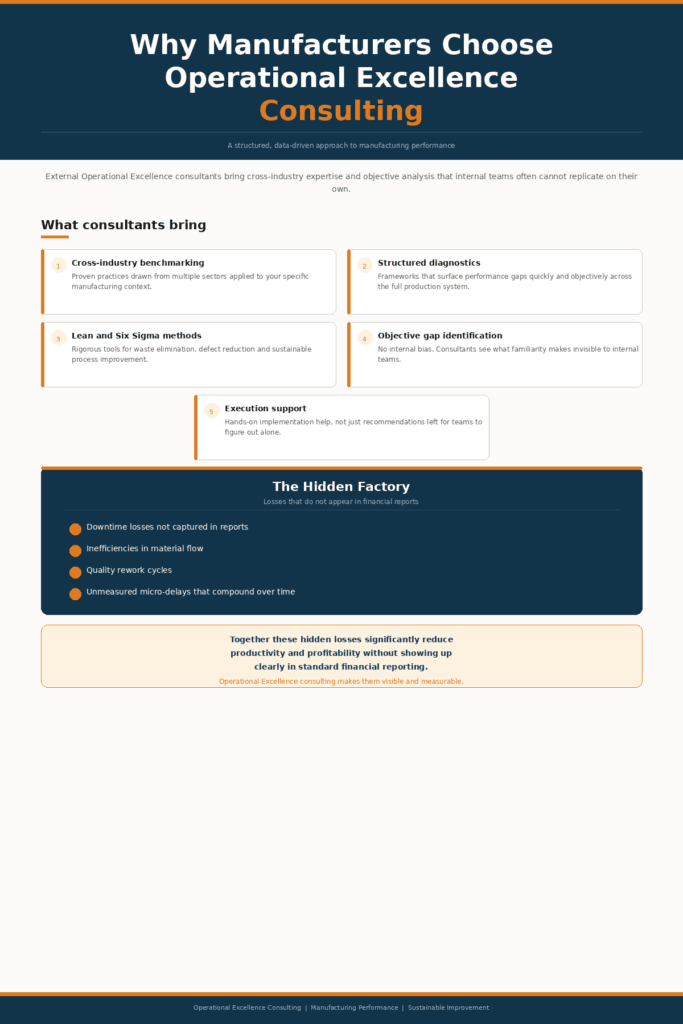
Operational Excellence consulting is a structured, data-driven approach to improving manufacturing performance by eliminating inefficiencies across the entire production system.
Unlike internal improvement efforts that are often constrained by familiarity and limited benchmarking, external consultants bring:
- Cross-industry benchmarking and best practices
- Structured diagnostic frameworks
- Lean and Six Sigma methodologies
- Objective identification of performance gaps
- Implementation-focused execution support
In manufacturing environments, this approach focuses on uncovering what is often called the “hidden factory”; the losses that do not appear clearly in financial reports but significantly reduce productivity and profitability.
These include downtime losses, inefficiencies in material flow, quality rework cycles, and unmeasured micro-delays that compound into major performance gaps.
Why Kenyan Manufacturers Need Operational Excellence Support
Many manufacturing plants in Kenya operate below optimal efficiency not because of a lack of effort, but because inefficiencies have become embedded in routine operations.
Common challenges include:
- Frequent equipment breakdowns and unplanned downtime
- High scrap rates and material waste
- Bottlenecks in production flow and line imbalance
- Inconsistent quality leading to rework and customer complaints
- Low workforce productivity due to unclear standard procedures
Individually, these issues may appear manageable. Combined, they significantly reduce throughput, increase cost per unit, and limit scalability.
Operational Excellence consultants are engaged to systematically identify the root causes behind these challenges and convert them into structured improvement programs.
How Operational Excellence Consulting Works in Manufacturing
A structured engagement typically follows a diagnostic-to-transformation model designed to move from visibility to execution.
1. Operational Diagnostic and Baseline Assessment
The first step is understanding how the factory actually performs in practice, not just how it is designed on paper.
Consultants evaluate:
- Production flow efficiency
- Machine utilization and uptime performance
- Downtime patterns and causes
- Quality rejection and defect rates
- Material consumption and losses
This creates a clear baseline for operational performance and identifies key constraints limiting output.
2. Identification of Hidden Factory Losses
One of the most valuable contributions of consulting is surfacing losses that are not explicitly tracked.
These often include:
- Small stoppages that accumulate into major downtime
- Slow cycle times that reduce throughput capacity
- Excess movement of materials and operators
- Inefficient changeover processes
- Rework cycles not captured in reporting systems
Addressing these hidden inefficiencies often produces significant performance gains without additional capital investment.
3. Process Mapping and System Redesign
Once inefficiencies are identified, production workflows are mapped end-to-end to understand how work truly flows across the factory.
This stage focuses on:
- Removing redundant steps and approvals
- Reducing bottlenecks between production stages
- Improving material and information flow
- Standardizing production procedures
- Aligning processes with output demand
The result is a simplified, more predictable production system that reduces variation and improves throughput.
4. Lean System Implementation and Standardization
After redesign, Lean-based operational systems are introduced to stabilize and sustain improvements. Key components include:
- Standard work procedures
- Waste elimination systems
- Visual management tools
- Root cause problem-solving frameworks
- Workplace organization systems
This ensures that improvements are not one-time fixes but embedded into daily operations.
5. Performance Measurement and Control Systems
To prevent regression into inefficient patterns, performance tracking systems are implemented. These typically include:
- KPI dashboards for real-time monitoring
- Production output tracking per shift
- Downtime and maintenance analytics
- Quality performance indicators
This shifts decision-making from reactive to data-driven management.
Operational Excellence Framework for Factories
A strong Operational Excellence framework typically rests on five pillars:
1. Process Standardization
Ensures consistent execution of tasks to reduce variability and errors.
2. Waste Reduction Systems
Eliminates non-value-adding activities across production processes.
3. Performance Measurement
Uses real-time data to track efficiency, productivity, and quality.
4. Continuous Improvement Culture
Empowers employees to identify inefficiencies and contribute improvements.
5. Technology and Automation Alignment
Improves visibility, speed, and accuracy in production systems.
Where Manufacturers See the Biggest Gains First
Not all improvements deliver equal impact. In most Kenyan manufacturing environments, the highest returns typically come from:
- Reducing unplanned downtime
- Improving production line balance
- Eliminating rework and quality variation
- Optimizing changeover times
- Improving scheduling accuracy
These areas directly influence throughput and cost per unit, making them priority intervention zones.
Why Operational Efficiency in Manufacturing Impacts Profitability
Operational Excellence is not just a production concept; it is a financial driver.
When operational efficiency improves:
- Output increases without additional investment
- Cost per unit decreases
- Delivery reliability improves
- Quality consistency strengthens
- Capacity expands without major capital expenditure
This is why Operational Excellence is increasingly being treated as a core business strategy rather than an operational initiative.
Why Hire Operational Excellence Consultants in Kenya?
Manufacturers typically engage external consultants for three key reasons:
1. Faster Diagnosis
External specialists quickly identify inefficiencies due to experience across multiple production environments.
2. Structured Execution
Consultants apply proven frameworks rather than experimental internal approaches.
3. Objective Analysis
They identify inefficiencies that internal teams may overlook due to familiarity with existing systems.
How to Implement Operational Excellence in Factories
A structured transformation typically follows five steps:
- Operational baseline assessment
- Process mapping and bottleneck identification
- Lean system implementation
- Performance measurement setup
- Continuous improvement integration
This progression ensures that improvements are both measurable and sustainable.
Conclusion
Operational Excellence consulting plays a critical role in strengthening the competitiveness of Kenyan manufacturers. As production environments become more complex and cost pressures continue to rise, incremental improvements are no longer sufficient.
Through structured diagnostic frameworks, process redesign, Lean system implementation, and performance management systems, manufacturers can unlock significant gains in efficiency, quality, and output.
The shift from reactive problem-solving to structured operational design enables factories to operate with greater predictability, lower cost, and higher scalability.
In an increasingly competitive industrial landscape, Operational Excellence is not just an improvement strategy; it is a long-term capability that determines manufacturing survival and growth.
Frequently Asked Questions
What is Operational Excellence consulting for manufacturers in Kenya?
It is a structured approach that identifies inefficiencies in manufacturing systems and implements process, quality, and performance improvements to increase efficiency and reduce waste.
How does operational efficiency improve manufacturing in Kenya?
It increases production output, reduces downtime, lowers cost per unit, and improves quality consistency by optimizing workflows and equipment utilization.
Why hire Operational Excellence consultants in Kenya?
Consultants provide faster diagnosis, proven implementation frameworks, and objective analysis that helps manufacturers improve performance more effectively than internal efforts alone.
What are the first areas to improve in manufacturing operations?
The highest-impact areas typically include downtime reduction, production bottleneck removal, quality consistency improvement, and changeover optimization.
What are the benefits of Operational Excellence consulting?
It leads to higher productivity, reduced operational costs, improved quality, better delivery performance, and stronger long-term competitiveness.
Contact us