Kenya’s manufacturing sector faces growing pressure from rising production costs, fluctuating energy prices, supply chain disruptions, and increased regional competition. To remain competitive, manufacturers must improve productivity, reduce waste, and optimize their operations.
Operational Excellence consulting in Kenya helps manufacturers achieve these goals through structured, data-driven approaches that support continuous improvement. By applying proven methodologies such as Lean manufacturing, Six Sigma, and Total Productive Maintenance (TPM), Operational Excellence consultants in Kenya help factories improve production efficiency, reduce downtime, enhance product quality, and lower operating costs.
Unlike general business advisors, Operational Excellence consultants focus on optimizing manufacturing processes, workflows, equipment performance, and workforce productivity to deliver measurable and sustainable business results.
What Is Operational Excellence in Manufacturing?
Operational Excellence (OpEx) is a structured approach to improving manufacturing performance by systematically eliminating inefficiencies, reducing variation, and improving process flow.
In manufacturing environments, it focuses on:
- Improving production flow and throughput
- Reducing machine downtime and stoppages
- Eliminating waste across operations
- Standardizing production processes
- Improving product quality consistency
- Increasing labor and equipment productivity
In simple terms, Operational Excellence ensures factories produce more output with fewer resources while maintaining quality stability.
For Kenyan manufacturers, this is particularly important due to fluctuating input costs and infrastructure constraints that directly impact competitiveness.
Why Operational Efficiency Matters in Kenya’s Manufacturing Sector
In manufacturing, operational efficiency is a direct driver of profitability. In many Kenyan factories, growth is more often limited by inefficiencies, not lack of demand.
Common operational constraints include:
- Unplanned machine breakdowns due to weak maintenance systems
- Poor production planning and scheduling
- Inefficient plant layouts increasing material movement
- High defect and rework rates
- Limited real-time production visibility
- Inconsistent workforce performance across shifts
These inefficiencies increase the cost per unit, reduce on-time delivery performance, and weaken market competitiveness.
Improving operational efficiency in manufacturing allows companies in Kenya to:
- Lower production costs without reducing output
- Improve capacity utilization
- Stabilize product quality
- Increase delivery reliability
What Operational Excellence Consultants Actually Do
The role of Operational Excellence Consultants in Kenya is often misunderstood as general advisory work. In reality, it is a structured, data-driven transformation process.
1. Operational Diagnostics and Baseline Assessment
Consultants begin by analyzing factory performance using measurable indicators such as:
- Overall Equipment Effectiveness (OEE)
- Downtime frequency and causes
- Cycle time per production stage
- Scrap and rejection rates
- Labor productivity per shift
This creates a factual baseline of operational performance.
2. Identification of Hidden Factory Losses
One of the most valuable contributions of consultants is identifying “hidden losses” that are not visible in financial reports, such as:
- Micro-stoppages in production lines
- Slow cycles caused by outdated methods
- Unbalanced workloads between machines
- Inefficient changeover processes
- Unrecorded quality rework loops
These hidden losses often account for a significant share of lost productivity in manufacturing systems.
3. Process Mapping and Workflow Redesign
Consultants map end-to-end production workflows to understand how value is created and where delays occur.
They then redesign processes to:
- Remove redundant steps
- Reduce unnecessary approvals and handoffs
- Improve material and information flow
- Balance production line workloads
- Standardize work execution
This directly supports manufacturing process efficiency improvement in Kenya.
4. Lean Manufacturing and Waste Reduction Systems
Operational Excellence is heavily anchored in Lean principles, which focus on eliminating non-value-adding activities.
Typical areas of waste reduction include:
- Overproduction
- Excess inventory
- Waiting time between processes
- Unnecessary movement of materials
- Defects and rework
This improves throughput while reducing operating costs.
5. Performance Management Systems
To sustain improvements, consultants implement structured performance systems such as:
- KPI dashboards for real-time monitoring
- Production tracking systems
- Maintenance and downtime analytics
- Quality performance indicators
These systems ensure continuous visibility and accountability in operations.
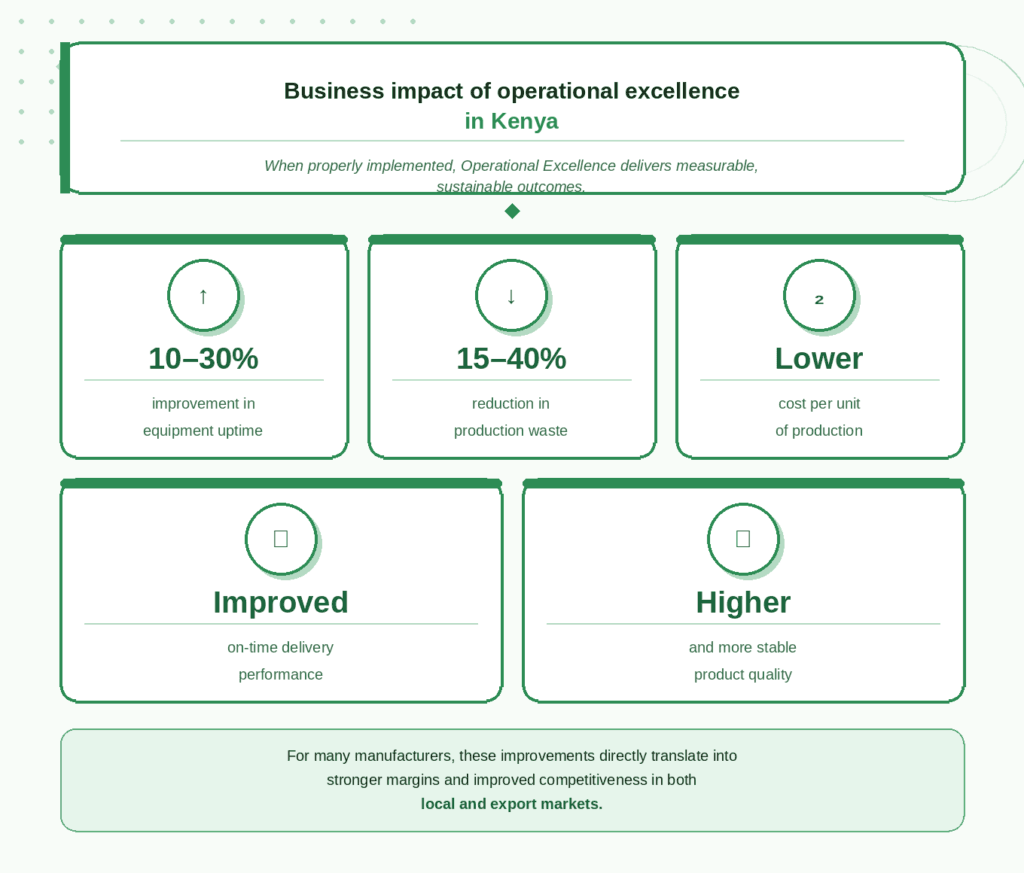
Business Impact of Operational Excellence in Kenya
When properly implemented, Operational Excellence delivers measurable and sustainable outcomes:
- 10–30% improvement in equipment uptime
- 15–40% reduction in production waste
- Lower cost per unit of production
- Improved on-time delivery performance
- Higher and more stable product quality
For many manufacturers, these improvements directly translate into stronger margins and improved competitiveness in both local and export markets.
Why Kenyan Manufacturers Need Operational Excellence Consulting
Many factories in Kenya operate with systems that have evolved over time rather than being intentionally designed. This leads to inefficiencies becoming “normalised” within operations.
Operational Excellence consulting becomes necessary when companies experience:
- Persistent production delays
- Rising operational costs despite stable demand
- Difficulty scaling output
- Frequent quality inconsistencies
- High maintenance-related downtime
In these cases, internal improvements alone are often insufficient without external diagnostic expertise.
Operational Excellence Framework for Factories
A structured Operational Excellence framework typically includes:
1. Lean Manufacturing Systems
Focus on waste elimination and flow efficiency.
2. Six Sigma Methodologies
Reduce variation and improve process stability.
3. Total Productive Maintenance (TPM)
Improve equipment reliability and uptime.
4. Continuous Improvement Systems (Kaizen)
Encourage ongoing incremental improvements across teams.
5. Standardized Work Systems
Ensure consistency and repeatability across shifts and operators.
Together, these frameworks form the foundation of sustainable manufacturing Operational Excellence in Kenya.
Digital Transformation and Operational Excellence
Modern Operational Excellence increasingly integrates digital tools to improve decision-making and visibility.
These include:
- Manufacturing Execution Systems (MES)
- Machine monitoring
- Enterprise Resource Planning (ERP) system integration
- Predictive maintenance analytics
- Real-time production dashboards
This enables data-driven operational performance optimization in Kenya manufacturing environments.
Challenges in Implementation
Despite its benefits, Operational Excellence implementation in Kenya faces practical challenges:
- Limited availability of structured production data
- Resistance to operational change within teams
- Skills gaps in Lean and Six Sigma methodologies
- Legacy equipment and outdated production systems
This is why experienced Operational Excellence consultants are critical; they combine technical expertise with change management capability.
Conclusion
The role of Operational Excellence consultants in Kenya is becoming increasingly important as manufacturers face rising cost pressure and global competition.
By combining structured diagnostics, Lean manufacturing systems, process redesign, and performance management tools, consultants help factories transition from reactive operations to disciplined, data-driven production systems.
Ultimately, Operational Excellence is not a one-time project; it is a continuous system of improvement that defines long-term manufacturing competitiveness in Kenya.
FAQs
What is Operational Excellence in manufacturing?
It is a structured approach to improving manufacturing performance by eliminating waste, reducing inefficiencies, and optimizing production processes.
How do Operational Excellence consultants improve factories in Kenya?
They analyze operations, identify hidden inefficiencies, redesign workflows, and implement systems that improve productivity, quality, and cost efficiency.
Why is operational efficiency important in Kenyan manufacturing?
It reduces production costs, improves equipment utilization, enhances quality consistency, and increases overall competitiveness.
What tools do Operational Excellence consultants use?
They use Lean manufacturing, Six Sigma, TPM, process mapping, KPI dashboards, and continuous improvement systems.
What is the difference between operational efficiency and Operational Excellence?
Operational efficiency focuses on output optimization, while Operational Excellence is a broader system that builds continuous, sustainable improvement into operations.