Kenya’s manufacturing sector is under increasing pressure to do more with less. Rising energy costs, fluctuating raw material prices, supply chain instability, and intensifying regional competition are steadily eroding margins across the sector.
In many factories, the challenge is no longer demand; it is internal inefficiency. Production lines operate below capacity, machines experience avoidable downtime, and variability in output leads to inconsistent quality and higher rework rates. Over time, these inefficiencies quietly inflate the cost of production and weaken competitiveness.
In this environment, it has become a core survival and growth requirement in Kenya to improve operational efficiency in manufacturing plants. Factories that fail to optimize operations risk being priced out of both local and export markets.
What Operational Efficiency in Manufacturing Really Means
Operational efficiency in manufacturing is the ability to convert labor, materials, energy, and machine time into consistent, high-quality output with minimal waste.
In practical terms, it measures how well a production system performs relative to its full potential.
Key performance indicators (KPIs) of operational efficiency include:
- Overall Equipment Effectiveness (OEE)
- Machine uptime versus downtime
- Production cycle time
- Scrap and defect rates
- Labor productivity per shift
- Energy consumption per unit produced
In Kenya’s manufacturing environments, these indicators often reveal a significant gap between actual performance and achievable output.
Why Operational Efficiency Is a Critical Challenge in Kenya
Many manufacturing plants in Kenya operate with legacy systems, semi-automated equipment, and largely manual coordination processes. While these systems may function adequately at low volumes, they become inefficient under scaling pressure.
Common operational challenges include:
- Frequent unplanned machine breakdowns
- Inefficient production scheduling
- Poorly optimized plant layouts
- High energy consumption per unit output
- Limited real-time production visibility
- Delays in material handling and movement
These challenges translate directly into:
- Higher cost per unit
- Reduced production capacity
- Inconsistent product quality
- Missed delivery timelines
Improving efficiency is therefore not just about optimization; it is about restoring control over production performance.
The Real Sources of Inefficiency in Manufacturing Plants
To improve efficiency, manufacturers must first understand where losses originate. In most Kenyan factories, inefficiencies typically fall into five major categories.
1. Equipment Downtime and Reliability Issues
Many plants still rely on reactive maintenance, where equipment is repaired only after failure. This leads to unpredictable downtime and production instability.
2. Inefficient Production Flow
Poorly designed workflows create bottlenecks, excess movement, and uneven workload distribution across production lines.
3. Quality-Related Losses
Defects, rework, and inconsistent production standards reduce yield and increase cost without adding value.
4. Workforce Productivity Gaps
Without standardized work methods and structured training, output varies significantly between shifts and operators.
5. Lack of Real-Time Operational Data
Many factories still depend on manual reporting systems, delaying decision-making and hiding inefficiencies until they become costly.
Addressing these issues is central to any meaningful undertaking for manufacturing process efficiency improvement in Kenya.
How to Improve Operational Efficiency in Manufacturing Plants in Kenya
Improving factory performance requires a structured, data-driven, and systematic approach rather than isolated fixes.
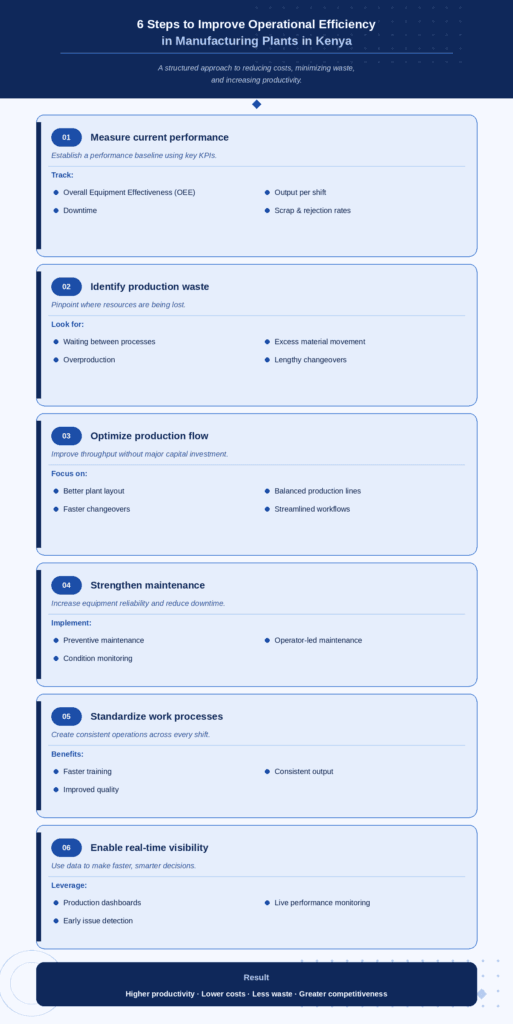
Step 1: Establish a Clear Performance Baseline
Factories must begin by measuring current performance using reliable KPIs such as:
- Overall Equipment Effectiveness (OEE)
- Output per shift
- Downtime frequency and duration
- Scrap and rejection rates
Without this baseline, improvement efforts remain subjective and inconsistent.
Step 2: Identify Waste Across the Production System
Through process mapping and operational analysis, manufacturers can identify where time, materials, and effort are being lost.
Common forms of waste include:
- Waiting time between processes
- Excess material movement
- Overproduction in certain lines
- Inefficient changeover processes
This step forms the foundation of operational performance optimization for manufacturing systems in Kenya.
Step 3: Optimize Production Flow and Plant Layout
Improving flow is one of the fastest ways to unlock efficiency gains without capital investment.
This includes:
- Redesigning plant layout to reduce movement
- Balancing production lines
- Reducing changeover time
- Eliminating redundant steps in workflows
A well-optimized layout reduces idle time and increases throughput significantly.
Step 4: Strengthen Maintenance Systems
Shifting from reactive maintenance to preventive and predictive systems improves equipment reliability and uptime.
Key practices include:
- Scheduled preventive maintenance
- Operator-based basic maintenance
- Condition monitoring systems
This stabilizes production and reduces unexpected breakdowns.
Step 5: Standardize Work Processes
Standard operating procedures (SOPs) ensure consistency across shifts and reduce variation in output.
Standardization improves:
- Training speed
- Output consistency
- Quality predictability
Step 6: Introduce Real-Time Production Visibility
Modern manufacturing efficiency depends on visibility into operations.
Digital dashboards and monitoring systems enable:
- Real-time tracking of production performance
- Early identification of inefficiencies
- Faster operational decision-making
This is becoming essential for scaling operational efficiency for manufacturing in Kenya, especially when dealing with growth across multiple lines and plants.
Role of Operational Excellence in Manufacturing Efficiency
While operational efficiency is the outcome, Operational Excellence consulting in Kenya provides the structured system required to achieve and sustain it.
Operational Excellence integrates:
- Lean manufacturing
- Six Sigma
- Total Productive Maintenance (TPM)
- Continuous improvement (Kaizen)
Together, these frameworks ensure that efficiency improvements are not temporary fixes but embedded into daily operations.
In practice, Operational Excellence services for Kenya provide the execution structure that turns improvement strategies into measurable results.
Operational Excellence Framework for Factories
A structured framework typically includes:
1. Lean Manufacturing Systems
Focuses on eliminating non-value-adding activities and improving flow efficiency.
2. Six Sigma Methodologies
Reduces variation and improves consistency in quality and output.
3. Total Productive Maintenance (TPM)
Improves equipment reliability and reduces downtime through proactive maintenance.
4. Continuous Improvement Systems
Encourages ongoing small improvements across all departments.
Together, these systems form the foundation of Kenya’s Lean Operational Excellence manufacturing.
Benefits of Operational Efficiency Improvement
When implemented effectively, operational efficiency delivers measurable business impact:
- 15–40% reduction in production waste
- 10–30% increase in machine uptime
- Lower cost per unit of production
- Improved delivery reliability
- Higher production capacity without new investment
- More consistent product quality
These outcomes directly strengthen competitiveness in both local and export markets.
Key KPIs for Operational Performance Optimization in Kenya
To sustain improvements, manufacturers must continuously track performance using clear KPIs:
- Overall Equipment Effectiveness (OEE)
- First Pass Yield (FPY)
- Cycle time per unit
- Downtime percentage
- Scrap and rework rates
- On-time delivery performance
These metrics form the foundation of any operational performance optimization strategy in Kenya.
Future of Operational Efficiency in Kenya’s Manufacturing Sector
Kenya’s manufacturing industry is gradually shifting toward digitized and data-driven operations.
Key emerging trends noticed here include:
- Predictive maintenance
- AI-supported production planning
- Smart factory integration
- Real-time analytics dashboards
These technologies will significantly enhance continuous improvement in Kenyan manufacturing and reduce reliance on manual decision-making.
Conclusion
Operational efficiency is no longer optional in manufacturing plants in Kenya; it is a strategic requirement for survival and growth. As cost pressures increase and competition intensifies, factories that fail to optimize operations will continue to struggle with high costs, low productivity, and inconsistent output.
By systematically identifying inefficiencies, improving production systems, and adopting structured improvement methodologies supported by Operational Excellence consulting, Kenyan manufacturers can achieve substantial and sustainable performance gains.
Ultimately, operational efficiency is not a one-time project but a continuous discipline that defines long-term industrial competitiveness in Kenya.
FAQs
What is operational efficiency in manufacturing plants in Kenya?
It is the ability of a factory to maximize output while minimizing waste, downtime, and production costs through optimized systems and processes.
How does operational efficiency improve manufacturing in Kenya?
It increases productivity, reduces costs, improves equipment utilization, and enhances product quality and delivery reliability.
What are the main causes of inefficiency in manufacturing plants?
Key causes include machine breakdowns, poor workflow design, lack of real-time data, and inconsistent production methods.
How can manufacturers improve operational efficiency?
By measuring KPIs, identifying bottlenecks, optimizing workflows, improving maintenance systems, and implementing continuous improvement practices.
What is the role of Operational Excellence consulting?
It provides structured frameworks, tools, and expertise to systematically improve efficiency and sustain long-term operational performance.
Contact us