
Lean manufacturing can help organizations improve process flow, reduce waste, strengthen quality, and support continuous improvement. However, implementing Lean successfully requires more than introducing tools such as 5S, Kaizen, Value Stream Mapping (VSM), or standardized work.
Organizations can face challenges related to leadership alignment, workforce engagement, process discipline, measurement, standardization, and sustaining improvements. Understanding these barriers before implementation can help organizations develop a more practical approach.
For organizations pursuing Operational Excellence in Saudi Arabia, the focus should be on adapting Lean principles to actual operating conditions while building the management systems and workforce capabilities required to sustain improvement.
Key Takeaways
- Lean implementation challenges often involve people, processes, leadership, and management systems rather than Lean tools themselves.
- Workforce involvement is essential for creating sustainable improvement.
- Lean initiatives should begin with clearly defined operational problems and measurable objectives.
- Standardization and management routines are critical for sustaining Lean improvements.
- Lean can work alongside digital transformation when organizations first establish stable and well-understood processes.
What Makes Lean Implementation Difficult?
Lean manufacturing provides a structured approach to improving processes, but implementation can be challenging because it changes how work is managed.
Lean may influence:
- Process design
- Workplace organization
- Performance measurement
- Employee responsibilities
- Management routines
- Problem solving
- Decision making
- Resource utilization
This means Lean implementation is not simply a technical exercise. It is an organizational change process. Organizations need to consider both the operational and human dimensions of Lean.
Why Lean Implementation Matters in Saudi Arabia
Organizations operating across Saudi Arabia are increasingly focused on productivity, efficiency, quality, and Operational Excellence. Lean principles can support these objectives by helping organizations identify and reduce waste.
However, the effectiveness of Lean manufacturing initiatives in Saudi Arabia depends on implementation quality.
A poorly implemented Lean program can become a collection of isolated activities. A well-designed Lean system can become part of everyday management.
This distinction is important when considering Lean strategies that KSA organizations can use for sustainable performance improvement.
Challenge 1: Treating Lean as a Toolkit
One of the most common Lean implementation challenges is focusing too heavily on individual tools.
An organization may introduce:
- 5S
- Kaizen
- Visual Management
- Kanban
- Value Stream Mapping
- Standardized Work
Yet the underlying operational problems may remain.
Why This Happens
Tools are visible. Changing management behavior and process discipline is less visible and often more difficult.
Organizations may therefore measure implementation by the number of Lean activities completed rather than by the problems solved.
The Solution
Start with the operational problem.
Use the following sequence:
Problem → Analysis → Root Cause → Improvement → Standardization → Measurement
The tool should support the improvement process rather than become the objective.
Challenge 2: Limited Leadership Commitment
Lean transformation requires sustained management attention.
If leadership supports Lean only during the initial implementation phase, improvement activities can lose momentum.
Why This Happens
Management priorities can change.
Improvement teams may also struggle when they do not receive sufficient time, resources, or decision-making support.
The Solution
Leadership should establish regular routines for reviewing:
- Improvement activities
- Performance indicators
- Open problems
- Corrective actions
- Standard adherence
- Improvement opportunities
Leadership involvement should be consistent rather than limited to major Lean events.
Challenge 3: Employee Resistance to Change
Lean changes how work is performed.
Employees may be concerned about new standards, responsibilities, performance expectations, or changes to established routines.
Resistance does not necessarily mean employees oppose improvement. It may indicate uncertainty.
The Solution
Organizations should involve employees early. Employees can contribute practical knowledge about:
- Process difficulties
- Repeated problems
- Material movement
- Equipment issues
- Quality concerns
- Unnecessary activities
Participation can help create stronger solutions because people performing the work understand process realities.
Challenge 4: Weak Standardization
Continuous improvement requires a stable baseline.
If every employee performs a process differently, it becomes difficult to determine whether an improvement actually worked.
Why This Happens
Organizations may introduce improvements without documenting or reinforcing the new method. Over time, employees may return to previous practices.
The Solution
Establish standardized work where appropriate.
Standards should define:
- Process sequence
- Key activities
- Required conditions
- Quality requirements
- Responsibilities
Standards should also be reviewed and improved when better methods are identified.
Challenge 5: Poor Problem Definition
Some Lean projects begin with broad objectives such as:
- Improve productivity
- Reduce cost
- Improve efficiency
These objectives are important but may not be sufficiently specific for a Lean improvement project.
The Solution
Define the problem clearly.
A useful problem statement should explain:
- What is happening?
- Where is it happening?
- When does it happen?
- What is the operational impact?
- What evidence supports the problem?
This creates a stronger foundation for root cause analysis.
Challenge 6: Focusing on Symptoms Instead of Root Causes
A visible problem is not always the actual cause.
For example, excessive inventory may appear to be an inventory problem. However, it may be caused by:
- Unreliable processes
- Long lead times
- Poor demand information
- Equipment interruptions
- Quality problems
Similarly, repeated rework may be caused by process variation rather than employee mistakes.
The Solution
Use structured problem-solving techniques.
Useful approaches include:
- 5 Whys
- Cause and effect analysis
- Process observation
- Data analysis
- Value Stream Mapping
The objective is to understand why the problem occurs before implementing countermeasures.
Challenge 7: Inadequate Measurement
Lean implementation needs evidence.
Without appropriate measures, organizations may struggle to determine whether an improvement produced a meaningful result.
Why This Happens
Organizations sometimes track too many indicators or select measures that are disconnected from the improvement objective.
The Solution
Choose a small number of relevant indicators.
Depending on the project, these may include:
- Lead time
- Cycle time
- Defects
- Rework
- Inventory
- Productivity
- Equipment performance
- Delivery performance
- Process interruptions
The measure should directly relate to the problem being addressed.
Challenge 8: Failing to Sustain Improvements
A successful improvement can disappear if the new process is not maintained.
This is one of the most important Lean challenges that KSA organizations may need to address.
Why Improvements Decline
Common causes include:
- Lack of follow-up
- Weak standards
- Management attention shifting elsewhere
- Poor training
- No performance review
- Inadequate ownership
The Solution
Create a sustainability system. This can include:
- Standardized work
- Visual management
- Regular audits
- Performance reviews
- Employee feedback
- Problem-solving routines
Sustainability should be designed into the improvement rather than added later.
Challenge 9: Implementing Lean Without Workforce Capability
Lean requires employees to understand more than individual tools.
People need to understand:
- Why Lean is being implemented
- How to identify waste
- How to solve problems
- How to follow standards
- How to suggest improvements
- How to measure results
The Solution
Develop practical Lean capability.
Training should be connected to real operational problems rather than relying entirely on theoretical instruction. Employees should have opportunities to apply Lean methods directly to their work.
Challenge 10: Poor Cross-Functional Coordination
Many operational problems cross departmental boundaries.
For example, a material flow problem may involve:
- Procurement
- Planning
- Storage
- Operations
- Quality
- Maintenance
Improving one department without considering the entire process can simply move the problem elsewhere.
The Solution
Use cross-functional improvement teams when problems extend across processes.
Value Stream Mapping can also help teams understand the complete flow rather than focusing on isolated activities.
Challenge 11: Digitizing Inefficient Processes
Organizations may believe technology will solve process inefficiencies. However, digital transformation does not automatically eliminate waste.
If a process contains unnecessary steps, digitizing those steps may simply make the inefficient process faster.
The Solution
Use Lean before and alongside digital transformation.
A practical sequence is:
Understand → Simplify → Standardize → Measure → Digitize where appropriate
This creates a stronger foundation for smart manufacturing initiatives.
Challenge 12: Applying Lean Without Considering Organizational Context
Lean principles are broadly applicable, but implementation should reflect the organization’s operating environment.
There is no universal Lean implementation template.
Organizations differ in:
- Processes
- Workforce structures
- Technology
- Supply chains
- Product requirements
- Customer expectations
- Management systems
The Solution
Adapt Lean methods to the actual organization. The principles can remain consistent while the implementation approach changes.
How to Overcome Barriers to Lean Adoption in KSA
Organizations asking how to overcome barriers to Lean adoption in KSA can approach implementation through several stages.
Stage 1: Establish the Business Need
Clearly define why Lean is being considered. The objective should connect to a real organizational challenge.
Stage 2: Assess the Current State
Understand how work is currently performed. This can involve:
- Process observation
- Data analysis
- Employee discussions
- Value Stream Mapping
- Performance review
Stage 3: Prioritize Improvement Opportunities
Not every problem should be addressed simultaneously.
Prioritize based on factors such as:
- Operational impact
- Customer impact
- Frequency
- Feasibility
- Resource requirements
Stage 4: Engage Employees
Involve people who understand the process.
This creates stronger practical knowledge and can improve adoption.
Stage 5: Implement Focused Improvements
Use the Lean techniques appropriate to the selected problem.
Stage 6: Standardize
Document and reinforce successful improvements.
Stage 7: Measure
Evaluate whether the improvement achieved its intended result.
Stage 8: Sustain and Expand
Embed successful practices into regular management routines before expanding the approach.
Measuring Lean Success in Saudi Organizations
The question of how to measure Lean success in Saudi organizations requires more than tracking the number of improvement projects completed.
Organizations should evaluate both operational results and management capability.
Potential operational measures include:
- Lead time
- Productivity
- Quality
- Rework
- Inventory
- Equipment performance
- Delivery performance
- Process interruptions
Capability measures can include:
- Employee participation
- Improvement activity completion
- Standard adherence
- Problem-solving effectiveness
- Management review routines
The measures should be relevant to the organization’s objectives.
How Lean Consultants Can Support Implementation
Organizations may choose to develop Lean capability internally or work with Lean consultants Saudi Arabia for structured support.
A Lean management consultant can potentially assist with:
- Current-state assessments
- Lean implementation planning
- Process improvement
- Value Stream Mapping
- Waste identification
- Standardized work
- Root cause analysis
- Performance measurement
- Continuous improvement systems
Lean manufacturing consultants should focus on building practical organizational capability rather than creating dependency on external support.
The objective should be to help internal teams understand the improvement approach and sustain it.
Lean Consulting Services KSA: What Should Organizations Evaluate?
Organizations considering Lean consulting services in KSA should evaluate whether the approach:
- Starts with operational problems
- Uses evidence
- Involves employees
- Includes measurable objectives
- Builds internal capability
- Addresses sustainability
- Adapts Lean methods to organizational requirements
The methodology matters, but so does implementation discipline.
Lean and Industry 4.0
Lean and Industry 4.0 can complement one another.
Lean helps organizations understand:
- Where waste exists
- Where variation occurs
- Which processes require improvement
- What information is important
Industry 4.0 technologies can then support:
- Data collection
- Process visibility
- Analytics
- Automation
- Connected systems
This provides a foundation for Lean plus Industry 4.0 strategies for KSA industries.
The key is to avoid using technology as a substitute for process improvement.
Conclusion
Lean implementation can provide significant opportunities for organizations seeking stronger productivity, quality, flow, and Operational Excellence.
However, the main barriers are rarely limited to the technical difficulty of Lean tools.
The greater challenges often involve leadership commitment, employee engagement, standardization, measurement, problem definition, root cause analysis, and sustaining improvements.
Organizations in Saudi Arabia can address these Lean challenges of KSA through a structured, problem-focused approach.
- Start with the operational problem
- Understand its causes
- Involve the workforce
- Select the appropriate Lean technique
- Measure the result
- Standardize the improvement
- Then continue improving
This approach can help organizations avoid treating Lean as a collection of isolated tools.
For organizations considering Lean consultants in Saudi Arabia, the priority should be practical capability building, measurable improvement, and long-term sustainability.
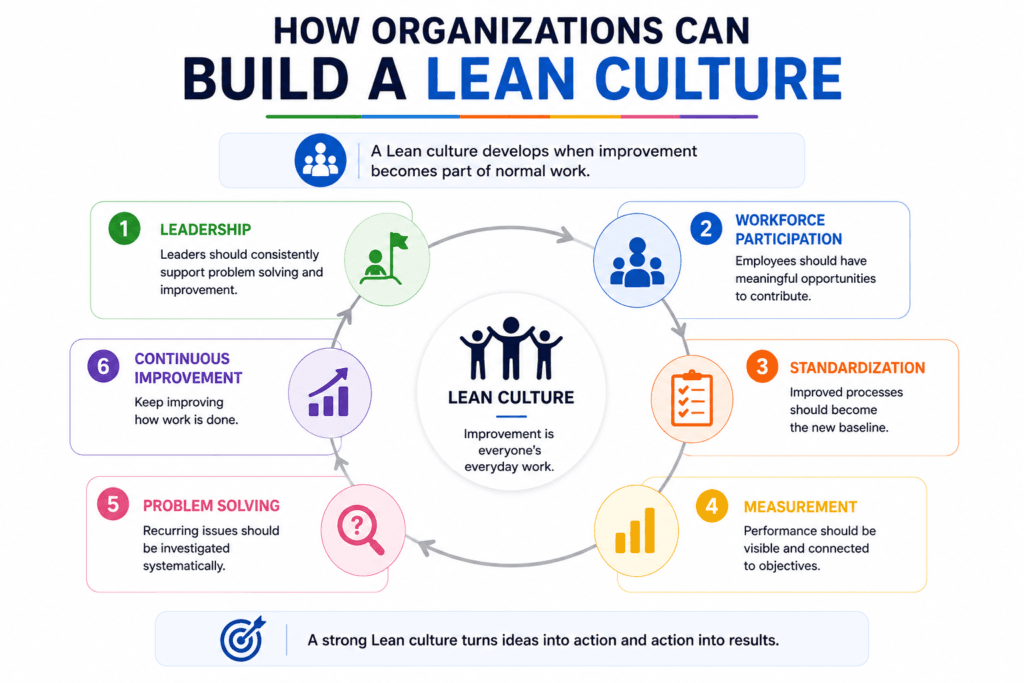
Lean transformation is successful when continuous improvement becomes part of how the organization manages work every day.
Frequently Asked Questions
What are the main Lean implementation challenges in Saudi Arabia?
Common challenges can include limited leadership commitment, resistance to change, weak standardization, insufficient workforce involvement, poor measurement, unclear problem definition, and difficulty sustaining improvements.
How can organizations overcome barriers to Lean adoption in KSA?
Organizations can overcome Lean adoption barriers by defining clear problems, involving employees, providing practical capability development, using appropriate Lean techniques, measuring results, standardizing improvements, and maintaining consistent leadership support.
How can Lean success be measured in Saudi organizations?
Lean success can be measured through relevant indicators such as productivity, lead time, quality, inventory, rework, equipment performance, delivery performance, and process interruptions. Organizations should also consider workforce participation and improvement capability.
Why do Lean improvements fail to sustain?
Lean improvements can fail to sustain when organizations lack standardized work, management follow-up, workforce engagement, measurement, or clear ownership. Sustaining improvement requires embedding new practices into everyday management routines.
Can Lean and Industry 4.0 be implemented together?
Yes. Lean can help organizations understand and improve processes, while Industry 4.0 technologies can provide data, visibility, analytics, and automation. Improving and standardizing processes before digitizing them can create a stronger foundation for technology adoption.