Cost pressure is often treated as a financial problem, but many manufacturing costs are created by operational inefficiencies.
Excess movement, waiting, rework, scrap, unnecessary inventory, equipment downtime, and inefficient processes can all consume resources without creating additional value. Addressing these losses can therefore support both cost reduction manufacturing in Saudi Arabia and stronger operational performance.
For Saudi Arabian organizations focused on operational efficiency in manufacturing, the objective should not be to reduce costs indiscriminately. Sustainable cost efficiency comes from removing unnecessary activities while protecting quality, safety, reliability, and customer value. This is where Lean manufacturing, process improvement, performance measurement, and appropriate technology can work together.
What Causes Unnecessary Manufacturing Costs?
Manufacturing costs can be influenced by many operational factors. Some are directly visible, such as material waste or equipment downtime. Others are less obvious, such as excessive movement, long process lead times, or repeated administrative activities.
Common operational sources of unnecessary costs include:
- Excess inventory
- Scrap and defects
- Rework
- Waiting
- Equipment downtime
- Unnecessary transportation
- Excess processing
- Poor production flow
- Inefficient material handling
- Process variation
The first step toward cost reduction is therefore understanding where resources are being consumed and why.
Cost & Waste Reduction Tactics That Improve Operational Efficiency
1. Start With Waste Identification
Lean provides a useful framework for identifying operational waste.
The commonly recognized categories of waste include:
- Overproduction
- Waiting
- Transportation
- Overprocessing
- Inventory
- Motion
- Defects
These categories provide a starting point for examining processes.
For example, excess inventory may indicate unreliable production flow or purchasing practices. Repeated movement may indicate poor workplace layout. Defects may indicate process variation or inadequate controls.
The important point is to investigate the cause behind the waste rather than simply remove the visible symptom.
2. Use Value Stream Mapping to Find Cost Drivers
Value Stream Mapping (VSM) can help organizations understand how work, materials, and information move through a process. It provides a broader view than analyzing individual workstations separately.
A process may appear efficient at each individual stage while still containing substantial delays between stages.
Mapping can reveal:
- Waiting time
- Process delays
- Excess work-in-process
- Unnecessary movement
- Information bottlenecks
- Repeated activities
This makes VSM useful when developing manufacturing process improvement strategies for KSA factories. Once the major sources of inefficiency are visible, organizations can prioritize improvements according to their operational impact.
3. Reduce Scrap and Rework
Scrap and rework can create direct and indirect costs.
The direct cost may include wasted material and additional labor. The indirect impact can include lost capacity, additional inspection, scheduling disruption, and longer process lead times.
Scrap reduction techniques for Saudi manufacturing companies should therefore focus on prevention.
Teams can investigate:
- Where defects occur
- When they occur
- What conditions are associated with them
- Whether the same issue repeats
- Why existing controls do not prevent recurrence
Root cause analysis can then be used to address the underlying process issue.
The objective is not simply to improve inspection. It is to make the process less likely to generate defects.
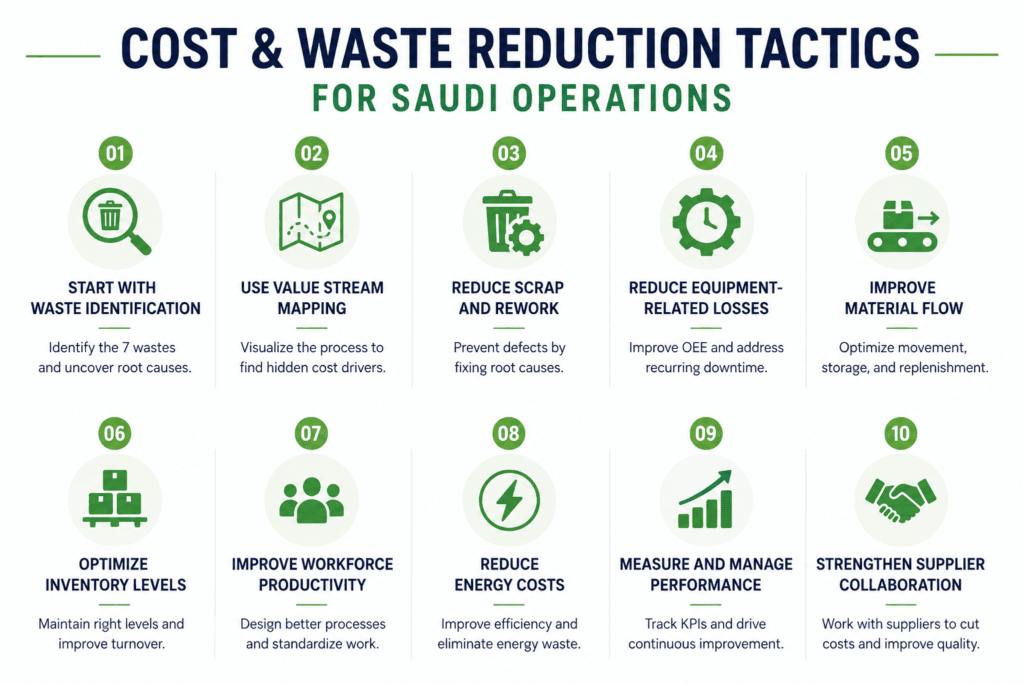
4. Reduce Equipment-Related Losses
Equipment downtime can create significant operational inefficiency. When equipment is unavailable, production capacity may be lost while labor, materials, and other resources remain committed to the process.
Organizations can use Overall Equipment Effectiveness (OEE) and other equipment performance measures to understand where losses occur.
Teams can examine:
- Planned versus unplanned downtime
- Recurring interruptions
- Minor stoppages
- Performance losses
- Quality losses associated with equipment
The purpose of measurement is to identify improvement priorities. Maintenance activities can then be aligned with the causes of recurring equipment losses.
5. Improve Material Flow
Material handling can create hidden operational costs. Materials may be moved multiple times, stored in unnecessary locations, or delivered before they are required. These activities consume space, time, labor, and equipment capacity.
Improving material flow can involve:
- Reviewing storage locations
- Reducing unnecessary movement
- Improving replenishment methods
- Aligning material availability with production requirements
- Removing unnecessary handling steps
The objective is not simply to minimize inventory. It is to establish a reliable flow of materials through the operation.
6. Address Inventory Waste
Inventory can provide useful protection against uncertainty, but excessive inventory can tie up resources and create additional handling requirements. It can also hide underlying process problems.
For example, organizations may maintain high inventory levels because production processes are unreliable or material replenishment is inconsistent.
A more sustainable approach is to understand why the inventory exists. Teams can examine:
- Demand variability
- Production lead times
- Replenishment processes
- Supplier reliability
- Process stability
- Material usage
Reducing unnecessary inventory can then become part of broader process improvement rather than an isolated cost-cutting exercise.
7. Improve Process Flow
Poor process flow can increase cost through waiting, work-in-process, repeated handling, and extended lead times.
Process improvement teams can examine how work moves from one stage to another. Questions may include:
- Where does work accumulate?
- Which activities create waiting?
- Where are approvals required?
- Which steps are repeated?
- Where does material move unnecessarily?
Improving flow can reduce several types of waste simultaneously. It can also improve responsiveness without requiring additional resources.
8. Use Standardized Work to Reduce Variation
Variation can make both productivity and cost difficult to control. When similar tasks are performed using substantially different methods, outcomes can vary in terms of cycle time, quality, and resource consumption.
Standardized work establishes a consistent method for performing an activity. It can define:
- Work sequence
- Process requirements
- Quality checks
- Materials
- Expected timing
Once a standard exists, deviations can be identified and investigated. This creates a foundation for continuous improvement.
9. Apply Technology to Reduce Waste
Industry 4.0 technologies can support waste reduction when they address clearly defined operational problems. Automated data collection can improve visibility into production losses. Advanced analytics can help identify recurring patterns. Equipment monitoring can provide additional information about downtime. Automated systems can reduce repetitive manual activity where appropriate. AI-supported analysis can help examine complex operational datasets.
However, technology should not be introduced simply because it is available.
A practical sequence is:
Identify the waste → understand its cause → improve the process → determine whether technology can strengthen the solution.
This is particularly relevant to Industry 4.0 waste reduction initiatives for KSA.
Sustainability-Driven Waste Reduction
Waste reduction and sustainability can often support one another.
Reducing material waste can lower unnecessary resource consumption. Improving energy efficiency can reduce resource use. Reducing rework can prevent additional material and process consumption. Improving production flow can reduce unnecessary movement and handling.
This makes sustainability-driven waste reduction strategies in Saudi Arabia relevant to organizations pursuing both operational and environmental objectives.
However, sustainability initiatives should also be connected to measurable operational performance. The objective is to identify improvements that reduce unnecessary resource consumption while maintaining required performance.
Building a Cost Reduction System
Cost reduction should not depend on occasional improvement projects. Organizations can build a structured system around several practices.
Establish Baselines
Understand current performance before implementing changes.
Prioritize High-Impact Losses
Focus improvement resources on problems with meaningful operational consequences.
Investigate Root Causes
Avoid treating symptoms as permanent solutions.
Measure Improvement
Compare performance before and after an intervention.
Standardize Successful Changes
Make successful improvements part of normal work.
Continue Monitoring
Look for new opportunities once the initial improvement has been sustained.
This creates a connection between Lean, continuous improvement, and operational cost reduction in the manufacturing sector of Saudi Arabia.
Conclusion
Effective waste reduction in manufacturing is not simply about cutting expenses. It is about identifying activities that consume resources without creating corresponding value and systematically reducing or eliminating them.
Together, these approaches can support manufacturing waste reduction in KSA, operational efficiency, productivity improvement, and cost efficiency.
The most sustainable approach is to improve the process first, measure the outcome, standardize successful changes, and continue looking for the next source of waste.
Frequently Asked Questions
What is waste reduction in manufacturing?
Waste reduction in manufacturing involves identifying and reducing activities that consume resources without creating corresponding value. Common examples include excess inventory, waiting, unnecessary movement, defects, rework, overprocessing, and equipment-related losses.
How can Lean help reduce manufacturing waste?
Lean helps organizations identify different forms of process waste and improve the flow of materials, information, and work. Tools such as Value Stream Mapping, standardized work, and root cause analysis can support waste elimination.
How can manufacturers reduce scrap?
Manufacturers can reduce scrap by identifying where defects occur, analyzing recurring patterns, investigating root causes, improving process controls, and standardizing successful corrective actions.
How does Industry 4.0 help reduce manufacturing waste?
Industry 4.0 technologies can improve visibility into production, equipment, quality, and process performance. Automated data collection and advanced analytics can help teams identify recurring losses and prioritize improvement actions.
How can manufacturers reduce costs without affecting quality?
Sustainable cost reduction focuses on eliminating unnecessary activities and resource consumption rather than indiscriminately cutting resources. Process improvement, waste reduction, equipment optimization, and quality improvement can reduce costs while maintaining required performance.