
Continuous improvement in manufacturing becomes part of the culture when small improvements become a daily habit, not when a plant runs another improvement workshop. Improvement events can deliver quick gains, yet without daily routines, standards and leadership follow-up, those gains fade. Plants that build a lasting continuous improvement culture combine occasional focused events with everyday problem-solving, so improvement continues long after the workshop ends.
Many plants have run an improvement event. A cross-functional team spends a few days on a problem, the line is rearranged, waste is removed and results improve. The closing presentation is full of before-and-after photos. Six months later, much of the change has quietly reversed. The event worked; the habit never formed. Continuous improvement in manufacturing is meant to deliver both.
What does continuous improvement in manufacturing look like as a culture?
Continuous improvement in manufacturing, at its best, is a way of working in which everyone, from operators to senior leaders, looks for and solves small problems as part of normal work. The idea is described in management literature as a continual improvement process, and it sits at the heart of lean manufacturing, where daily improvement is part of the job rather than a special activity.
In practice, improvement takes two forms. Improvement events are short, focused workshops on a specific problem. Daily improvement is the ongoing habit of spotting and solving small problems in everyday work. Both have a place, but they serve different purposes.
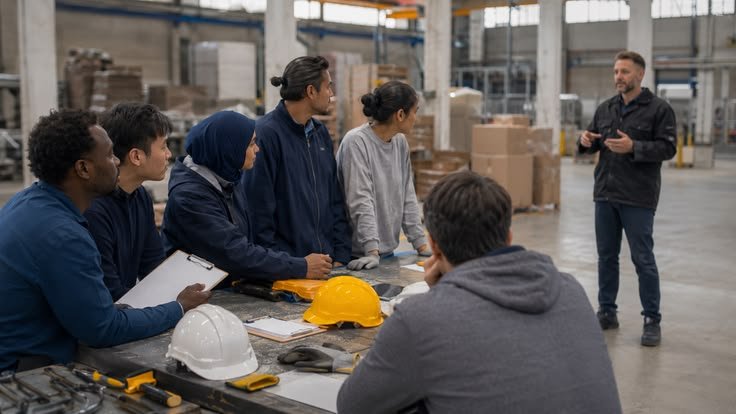
What is the difference between an improvement event and daily improvement?
Improvement events and daily improvement work best together, but they are often confused when a plant starts building a continuous improvement culture.
| Aspect | Improvement event | Daily improvement |
|---|---|---|
| Duration | A few days, focused | Ongoing, every shift |
| Who is involved | A selected cross-functional team | Everyone in the area |
| Typical scope | A specific process or problem | Small problems found in daily work |
| Main benefit | Quick, visible step change | Steady improvement and stronger capability |
| Main risk | Gains fade if not sustained | Activity fades without leadership follow-up |
Improvement events are useful for breakthroughs, such as redesigning a cell or cutting a long changeover. Daily improvement keeps those gains in place and adds many small improvements on top.
Why do improvement gains fade after the event?
Gains fade because the conditions that created them disappear when the event ends. During the event, the team has time, attention and support. Afterwards, everyone returns to normal work, and the new way of working competes with old habits. If the new standard is not documented, trained and checked, the process drifts back.
Other causes include changes made by the event team without enough involvement from the operators who run the process every day, and follow-up actions that are never completed.
But there is a more fundamental question worth asking: is the plant using improvement events to replace daily improvement, or to accelerate it?
How do you make continuous improvement in manufacturing a daily habit?
Making continuous improvement in manufacturing a habit starts with standards. Every improvement, whether from an event or from daily work, should end with an updated standard: a revised work instruction, a new visual control or a changed layout. The standard protects the gain and becomes the baseline for the next improvement.
Make problems visible every day. Simple tools such as hour-by-hour production boards, abnormality tags and andon signals show when the process deviates from the standard. Visible problems give teams something concrete to work on.
Give teams a simple method and time to use it. The PDCA cycle is enough for most daily improvement. Allocate short, regular time slots for teams to work on small problems, rather than expecting improvement to happen in their spare time.
Build follow-up into daily management. A short huddle at the start of each shift, reviewing performance and open problems, keeps improvement on the agenda. A structured daily work management routine connects these huddles across levels, so problems that teams cannot solve are escalated quickly.
What role do leaders play in continuous improvement in manufacturing?
Leaders make a continuous improvement culture stick by showing up and asking the right questions. Regular visits to the gemba, where the work happens, let leaders see standards in use, recognise improvements and remove obstacles. Asking “what problem did you solve this week?” rather than “did you hit the target?” signals that improvement matters as much as output.
Leaders also decide where improvement events are used. The best events target problems that matter to the business and are followed by a clear plan to sustain the gains, with named owners and review dates.
How do you measure whether improvement has become a habit?
To measure continuous improvement in manufacturing, measure the habit, not just the results. Useful indicators include the number of small improvements implemented per team, the share of improvements that led to an updated standard, how quickly problems are closed and how regularly huddles and gemba walks happen. Results such as productivity, quality and safety should follow, but the habit measures show whether improvement will continue.
How do you choose the right problems for improvement events?
Choose problems that matter to the business and are too large for a team to solve in daily work. Good candidates include long changeovers on a bottleneck, a cell with poor flow or a recurring quality issue with several possible causes. Problems that can be solved in a day by the team that owns them are better handled through daily improvement.
Before the event, agree the scope, the measure of success and who will own the process afterwards. Plan the follow-up at the same time as the event itself, with named owners and review dates, so the gains are protected once the event team disbands.
What do everyday improvements look like on the shop floor?
Daily improvements are small, practical and usually suggested by the people who do the work.
| Problem noticed | Daily improvement | Benefit |
|---|---|---|
| Operator walks to fetch a tool several times a shift | Move the tool to a marked place at the workstation | Less walking, faster cycle |
| Wrong part sometimes picked | Add colour coding to bins | Fewer errors |
| Machine leaks oil unnoticed | Add a visual check to the start-up routine | Earlier detection, fewer breakdowns |
| Changeover waits for paperwork | Prepare documents before the line stops | Shorter changeover |
| Material runs out during the shift | Add a simple reorder signal at the point of use | Fewer stops for material |
Each improvement is small, but dozens of them each month add up to a noticeable change in safety, quality and productivity. This is how continuous improvement in manufacturing builds results steadily over time.
How do you recognise and share daily improvements?
Recognition keeps daily improvement alive, but it works best when it is simple and frequent rather than formal and rare. A short mention in the shift huddle, a before-and-after photo on the area board or a leader thanking the team in person during a gemba walk all signal that small improvements matter. Recognising the people who found and fixed a problem, not only the size of the result, encourages others to try.
Sharing matters as much as recognition. An improvement that works on one line is often useful on another, yet many plants solve the same problem several times in different areas. A simple improvement board or shared folder, organised by problem type, lets teams find and copy what already works. Supervisors can review it in their weekly meeting and pick one idea to spread each week. Over time, this turns individual fixes into plant-wide standards and makes continuous improvement in manufacturing faster, because every team builds on what others have already learned. It also gives new team members a practical library of ideas they can use from their very first week on the shop floor.
Frequently asked questions about continuous improvement in manufacturing
Are improvement events still worth running?
Yes, when they target important problems and are followed by daily routines that sustain the gains. Events without follow-up often deliver short-lived improvements and can make teams cynical about future efforts.
How small should a daily improvement be?
Small enough to be completed quickly by the team that found the problem, often within a day or a week. Examples include relocating a frequently used tool, adding a visual check or simplifying a step in a work instruction.
What is the most common mistake when building a continuous improvement culture?
Treating improvement as a series of events rather than a daily practice. Without daily routines, standards and leadership follow-up, even successful events fail to create lasting change.
From improvement events to a continuous improvement culture
A continuous improvement culture delivers its full value when focused events and daily habits work together. Events create breakthroughs; daily improvement protects them and builds on them. Plants that combine both inside a wider operational excellence system build a culture where continuous improvement in manufacturing is simply how work gets done.
Each small improvement may seem minor on its own, but together they change how the plant works. Over months and years, that steady habit is what separates plants that keep improving from those that stand still.