
As ESG expectations continue to evolve in Kenya and globally, organizations are under increasing pressure to better understand, manage, and communicate their environmental, social, and governance (ESG) performance.
Two areas where this pressure is most visible are ESG reporting and risk management. Businesses are expected not only to disclose sustainability-related information, but also to demonstrate how ESG risks are identified and integrated into decision-making processes.
At Faber Infinite, we approach ESG reporting and risk management as interconnected elements of business resilience. Rather than treating reporting as a standalone output, we see it as a reflection of how well an organization understands and manages its ESG risks and opportunities.
Key Takeaways
- ESG reporting and risk management are increasingly linked to business resilience and stakeholder expectations.
- ESG consultants help organizations structure ESG data, align reporting approaches, and improve disclosure readiness.
- Climate and environmental risks are becoming more relevant to long-term business planning in Kenya.
- Carbon footprint awareness is increasingly important for supply chain and investor requirements.
- ESG advisory focuses on frameworks, governance integration, and decision-useful sustainability information, not certification or auditing.
Understanding ESG Reporting and Risk Management
ESG reporting refers to how organizations communicate their environmental, social, and governance performance to stakeholders.
ESG risk management refers to how organizations identify, assess, and integrate ESG-related risks into their governance and decision-making systems.
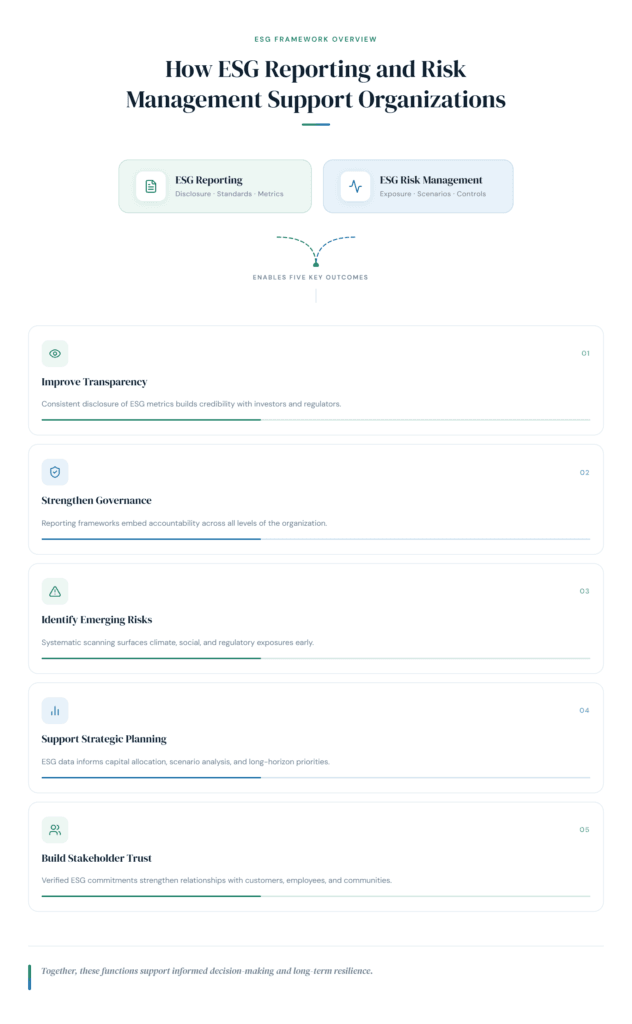
When combined, these two functions help organizations:
- Improve transparency
- Strengthen governance
- Identify emerging risks
- Support strategic planning
- Build stakeholder trust
In Kenya, these practices are becoming increasingly important as businesses respond to evolving investor expectations, supply chain requirements, and sustainability frameworks.
Why ESG Risk Management Is Becoming Important in Kenya
Organizations in Kenya are increasingly recognizing that ESG-related risks can have material impacts on business performance.
These risks may include:
- Environmental risks such as resource scarcity or climate variability
- Social risks such as workforce issues or community relations
- Governance risks such as compliance gaps or weak oversight structures
While these risks vary by industry, they all share a common feature: they can affect long-term business stability if not properly understood and managed.
As a result, ESG risk management is becoming an essential part of corporate governance.
The Role of ESG Consultants in Reporting and Risk Management
An ESG consultant in Kenya helps organizations develop structured approaches to understanding and managing ESG-related issues.
At Faber Infinite, this support is focused on clarity, structure, and integration into existing business systems.
Rather than replacing internal processes, ESG consultants help organizations strengthen how they think about ESG data, risks, and reporting.
ESG Reporting Readiness and Framework Alignment
One of the key roles of ESG consultants is supporting organizations in preparing for ESG reporting.
This does not necessarily mean producing reports directly, but rather helping organizations build the internal systems needed for effective disclosure.
This may include:
- Identifying relevant ESG disclosure priorities
- Structuring ESG data collection approaches
- Improving consistency of sustainability information
- Aligning reporting approaches with frameworks such as Global Reporting Initiative (GRI) and the International Sustainability Standards Board (ISSB)
The goal is to ensure that ESG reporting becomes more structured, reliable, and decision-useful over time.
Climate Risk Awareness in ESG Advisory
Climate risk is becoming an increasingly important consideration for businesses in Kenya.
Rather than focusing on technical climate modelling, ESG consultants help organizations understand how climate-related factors may influence business operations and long-term resilience.
This includes:
- Identifying potential physical risks such as weather variability or resource constraints
- Understanding transition risks linked to changing market expectations
- Assessing how climate considerations may affect business strategy and planning
The focus is on awareness and integration into decision-making, rather than technical climate engineering or forecasting.
Carbon Footprint Awareness and Business Context
Carbon footprint considerations are becoming more relevant for organizations due to supply chain expectations, investor requirements, and global sustainability standards.
ESG consultants support organizations by helping them understand:
- Carbon footprints in business: What a carbon footprint actually means within a corporate and operational context.
- Emission hot spots: Which specific operational areas and supply chain links contribute most to emissions.
- Reporting expectations: How carbon emissions considerations directly relate to modern ESG reporting standards.
- Strategic integration: How to seamlessly build carbon awareness into a broader, long-term ESG strategy.
This support is typically focused on interpretation and strategic understanding rather than detailed emissions verification or certification.
ESG Risk Management and Governance Integration
Effective ESG risk management depends on strong governance structures.
ESG consultants help organizations integrate ESG considerations into governance and risk systems so that sustainability factors are considered in decision-making processes.
This may include:
- Strengthening oversight of ESG-related risks
- Embedding ESG into enterprise risk management systems
- Supporting clearer accountability structures
- Helping leadership teams understand ESG risk exposure
When ESG is integrated into governance, organizations are better positioned to respond to emerging challenges.
ESG Reporting Challenges in Kenyan Organizations
Many organizations in Kenya face challenges when developing ESG reporting and risk systems.
Limited Data Structure
ESG-related data is often not collected in a structured or consistent way across organizations.
Unclear Reporting Expectations
Organizations may struggle to determine which ESG information is most relevant to disclose.
Evolving Framework Landscape
Multiple reporting frameworks exist, making alignment decisions complex.
Integration with Business Systems
ESG data is often not integrated into existing governance or risk management processes.
These challenges highlight the need for structured ESG advisory support focused on clarity and alignment.
How ESG Consultants Support Better Decision-Making
Beyond reporting, ESG consulting supports better business decision-making by providing structured insights into sustainability-related risks and opportunities.
This helps organizations:
- Improve long-term planning
- Identify potential risks earlier
- Strengthen governance structures
- Enhance stakeholder confidence
- Build more resilient business models
The value of ESG consulting lies not only in reporting outputs, but in improving how organizations understand and use ESG information.
ESG Reporting Frameworks Commonly Used in Kenya
Organizations often align their ESG reporting approaches with globally recognized frameworks, including:
Global Reporting Initiative (GRI)
Used for structured sustainability reporting across environmental, social, and governance topics.
IFRS Sustainability Disclosure Standards
Focused on improving consistency and comparability in sustainability-related disclosures.
Task Force on Climate-related Financial Disclosures (TCFD)
Focused on identifying and disclosing climate-related risks and opportunities.
These frameworks help organizations structure ESG information in a way that is meaningful to stakeholders.
The Future of ESG Reporting and Risk Management in Kenya
ESG reporting and risk management in Kenya are expected to become more structured over time as global sustainability expectations continue to evolve.
Rather than reacting to external pressure, businesses that proactively develop ESG frameworks can improve resilience, strengthen governance, and enhance long-term competitiveness.
At Faber Infinite, we believe that ESG reporting and risk management are ultimately about enabling better decision-making and creating organizations that are more prepared for future challenges.
Frequently Asked Questions
What is ESG risk management?
ESG risk management refers to identifying and integrating environmental, social, and governance risks into an organization’s governance and decision-making processes.
How do ESG consultants help with reporting?
ESG consultants help organizations structure ESG data, align with reporting frameworks, and build internal systems that support consistent sustainability disclosures.
What is climate risk in ESG?
Climate risk refers to potential impacts of environmental and climate-related factors on business operations, including physical and transition risks.
Do ESG consultants calculate carbon footprints?
ESG consultants typically help organizations understand carbon footprint concepts and reporting relevance, rather than conducting formal verification or certification.
Why is ESG reporting important?
ESG reporting improves transparency, supports stakeholder trust, strengthens governance, and helps organizations understand sustainability-related risks.