Many organizations invest heavily in machinery, technology, and workforce expansion. Yet performance challenges often persist because maintenance systems remain reactive rather than proactive.
This is where Total Productive Maintenance (TPM) consulting delivers clear operational improvements.
Why More Kenyan Manufacturers Are Investing in TPM Consulting
Kenya’s manufacturing sector is becoming increasingly competitive. Rising operating costs, growing customer expectations, and regional competition are forcing manufacturers to improve productivity while controlling costs.
Whether you operate a growing plastics factory in Nairobi, a food processing facility in Mombasa, or a large tea manufacturing plant in Kericho, equipment reliability and workforce productivity directly influence profitability.
By aligning people, processes, and equipment around shared operational goals, TPM helps manufacturers reduce downtime, improve asset reliability, increase Overall Equipment Effectiveness (OEE), and build a culture of continuous improvement.
However, successful TPM implementation is not about adopting a generic framework. It requires a structured approach that reflects the realities of the organization, its workforce, equipment profile, and growth objectives.
At Faber Infinite, TPM implementation begins with understanding those realities before developing a practical roadmap for sustainable operational improvement.
What Is Total Productive Maintenance Consulting and Why Does It Matter for Manufacturers in Kenya?
TPM consulting helps manufacturers move from reactive maintenance to structured, preventive systems that keep equipment running consistently.
It focuses on reducing unplanned stoppages, improving equipment stability, and strengthening day-to-day production reliability.
For Kenyan manufacturers facing rising costs and pressure to improve output from existing assets, TPM consulting provides a practical way to improve operational performance and long-term competitiveness.
TPM is a globally recognized manufacturing improvement methodology designed to maximize equipment effectiveness through proactive maintenance, operator involvement, and continuous improvement.
Unlike traditional maintenance approaches that rely heavily on maintenance departments, TPM encourages shared ownership of equipment performance across the organization.
Operators, supervisors, engineers, maintenance teams, and leadership all play a role in improving reliability and reducing losses.
For manufacturers in Kenya, TPM offers a practical pathway to:
- Reduce equipment breakdowns
- Improve asset reliability
- Increase equipment uptime
- Strengthen workforce productivity
- Improve product quality
- Reduce maintenance costs
- Support lean management initiatives
- Build sustainable continuous improvement systems
As manufacturing organizations seek higher performance without excessive capital investment, TPM implementation is becoming a strategic priority across East Africa.
How TPM Consulting Improves OEE, Equipment Reliability, and Workforce Productivity
TPM implementation services improve operational performance by reducing equipment failures, eliminating production losses, strengthening maintenance systems, and increasing workforce engagement. These improvements help manufacturers achieve higher OEE, stronger asset reliability, and improved organizational effectiveness.
One of the primary objectives of TPM is improving OEE. Its principles are also consistent with internationally recognized approaches to asset reliability and maintenance systems used across modern manufacturing industries.
OEE measures manufacturing performance through three key dimensions:
- Availability
- Performance
- Quality
Many manufacturers unknowingly lose substantial production capacity through recurring equipment-related issues such as breakdowns, minor stoppages, speed losses, and quality defects.
Effective TPM implementation services focus on identifying and eliminating these losses systematically.
This often includes:
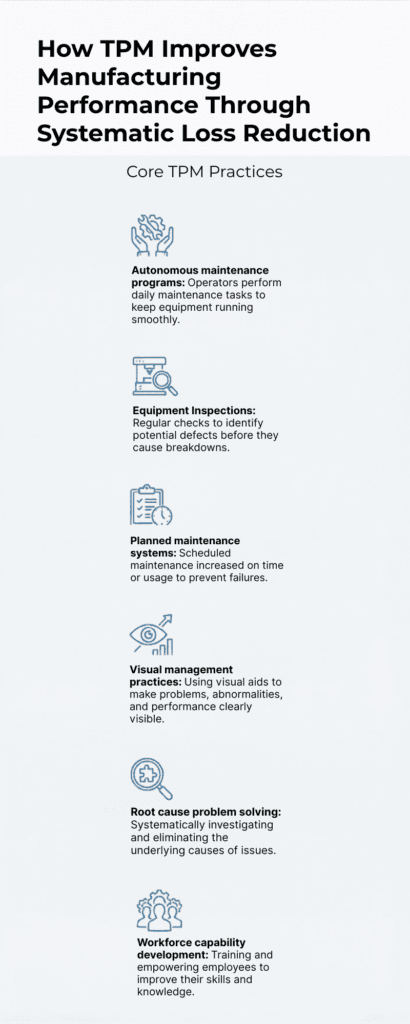
- Autonomous maintenance programs
- Planned maintenance systems
- Root cause problem solving
- Equipment inspections
- Visual management practices
- Workforce capability development
The result is more than improved equipment performance.
Organizations often experience improvements in workforce engagement because operators become active participants in maintaining equipment reliability.
Operational Insight:
Many manufacturers discover that significant productivity gains can be achieved by improving how existing equipment is operated and maintained rather than investing immediately in new machinery.
This combination of technical improvement and workforce ownership is one of the reasons TPM remains one of the most effective frameworks for operational excellence.
TPM Consulting for Large Factories in Kenya: Building Enterprise-Wide Manufacturing Excellence
TPM consulting for large factories in Kenya focuses on cross-functional alignment, equipment reliability, workforce capability development, and long-term culture change. Successful implementation creates sustainable improvements across operations, maintenance, engineering, quality, and leadership functions.
Large manufacturing plants often face a different challenge.
The issue is rarely a lack of resources.
Instead, complexity becomes the primary obstacle.
Many large factories struggle with:
- Departmental silos
- Legacy equipment
- Inconsistent maintenance standards
- Fragmented reporting systems
- Resistance to change
- Limited equipment ownership
In these environments, TPM implementation must extend beyond maintenance activities.
Successful TPM consulting for large factories in Kenya creates alignment across operations, engineering, maintenance, quality, and leadership teams.
Cross-functional steering teams are often established to drive accountability around shared objectives such as:
- Reliability improvement
- OEE performance
- Downtime reduction
- Workforce development
- Continuous improvement initiatives
World-class manufacturers understand that equipment reliability is not solely a maintenance responsibility.
It is an organizational responsibility.
This mindset creates the foundation for long-term manufacturing excellence.
Why Manufacturers Across East Africa Choose Faber Infinite for TPM Implementation Services
Faber Infinite helps manufacturers achieve measurable operational improvements through customized TPM implementation services, practical shop-floor execution, and deep experience across East Africa’s industrial sector.
Many consulting firms provide recommendations.
Faber Infinite focuses on implementation.
Our philosophy is simple: operational excellence is achieved on the shop floor, not in presentation slides.
As experienced Kenyan TPM consultants that manufacturers trust, we work alongside leadership teams, supervisors, operators, and maintenance personnel to ensure transformation initiatives are embedded into daily operations.
Unlike one-size-fits-all consulting models, every TPM implementation roadmap is designed around:
- Operational maturity
- Workforce capability
- Equipment profile
- Business objectives
- Organizational culture
Our experience across East Africa provides valuable insight into the practical challenges manufacturers face throughout the region.
Most importantly, our hands-on implementation approach helps bridge the gap between strategic ambition and operational execution.
The goal is not simply to deploy TPM tools.
The goal is to improve workforce productivity, strengthen equipment reliability, and create measurable business results.
Conclusion: Operational Excellence for Large Scale Manufacturing
Successful Total Productive Maintenance consulting recognizes that every factory has unique operational realities. Sustainable transformation requires a TPM framework aligned with organizational size, workforce capability, and business objectives.
At Faber Infinite, we help manufacturers move beyond theory and achieve measurable results through practical, customized TPM implementation services.
If your organization is ready to improve equipment reliability, increase workforce productivity, strengthen organizational effectiveness, and accelerate manufacturing excellence, now is the time to explore the benefits of TPM implementation and partner with experienced TPM consultants who understand the realities of manufacturing in Kenya and across East Africa.
Frequently Asked Questions
What operational issues does TPM consulting for large factories in Kenya solve?
TPM consulting helps address excessive downtime, poor equipment reliability, siloed departments, inconsistent maintenance practices, low workforce engagement, and limited operational accountability.
How long does TPM implementation typically take?
Initial improvements can often be observed within several months. Comprehensive TPM transformation programs generally evolve over one to three years depending on organizational size and complexity.
How is TPM different from preventive maintenance?
Preventive maintenance focuses primarily on scheduled maintenance activities. TPM is a broader operational excellence framework that engages operators, supervisors, maintenance teams, and leadership in improving equipment effectiveness and reliability.
Where can manufacturers find verified TPM consulting success stories in East Africa?
Manufacturers should seek implementation partners that can demonstrate measurable operational outcomes through case studies, performance metrics, and documented improvements in reliability, OEE, and workforce productivity.