The pursuit of operational excellence often focuses on complex statistical models or expensive technology upgrades. Yet, one of the most powerful and accessible methodologies—the 5S System—proves that a foundation of order, discipline, and efficiency is the true catalyst for exponential growth. The successful transformation of a leading sanitary ware solutions manufacturer serves as a compelling case study, demonstrating that fundamental workplace organization can directly translate into dramatic financial and operational gains.
The Problem: A Bottleneck of Clutter and Congestion
Before the implementation of 5S, the sanitary ware manufacturer, despite receiving a high volume of sales orders, faced severe limitations that prevented it from capitalizing on market demand. The core challenges were rooted in a lack of proper spatial management and organizational discipline:
-
Delayed On-Time Delivery (OTD): The primary indicator of operational failure was the inability to meet customer deadlines, leading to customer dissatisfaction and potentially lost repeat business.
-
Insufficient Storage Space: The organization could not produce above a specific unit threshold because of a critical lack of space to store finished goods. This was the most immediate constraint on production capacity.
-
Space Occupied by Unwanted Items: The root cause of the storage crisis was the accumulation of non-productive and unwanted things, a classic manifestation of the Waste of Inventory and Defects common in manufacturing environments.
-
Reduced Employee Capacity: The congested, disorganized workspace created friction, requiring employees to waste time searching for tools, navigating obstacles, or dealing with clutter. This congestion prevented employees from working at their full capacity, directly lowering productivity.
In essence, the company was battling the Waste of Motion, Waiting, and Inventory—all textbook targets of the Lean philosophy. The managing director wisely recognized that solving the spatial and organizational chaos was the necessary first step to unlocking production potential.
The Solution: Strategic and Integrated 5S Deployment
The managing director’s decision to immediately apply the 5S Methodology was a strategic move to address the organizational chaos directly. The implementation was holistic, emphasizing both the physical transformation and the necessary cultural change.
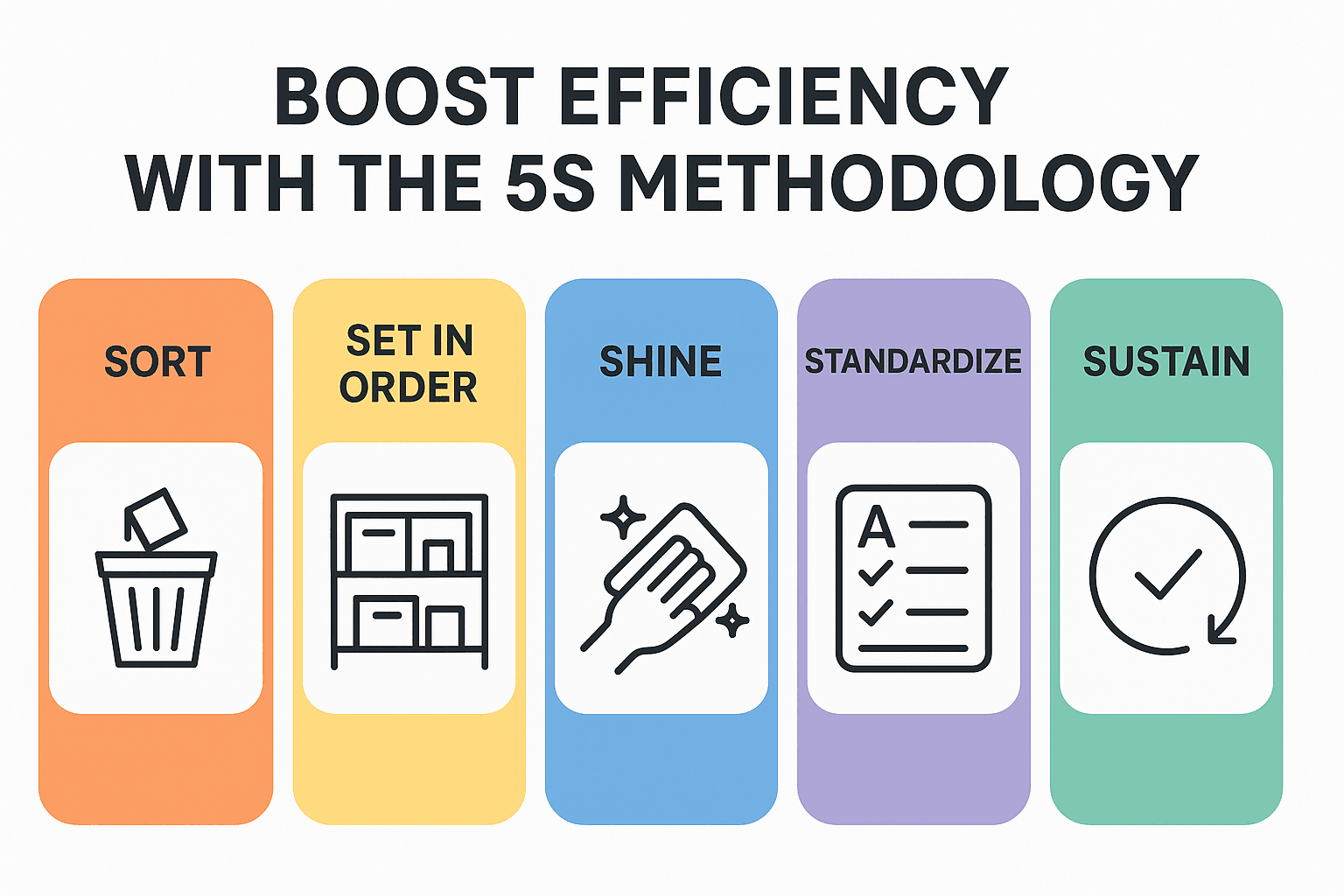
1. Sort & Set in Order: The Red Tag Campaign
The initial phases of Sort (Seiri) and Set in Order (Seiton) were executed with surgical precision using the Red Tag Methodology.
-
Red Tag Strategy: Every item of equipment, material, or tool was evaluated. Items deemed unnecessary or non-productive were marked with a Red Tag and moved to a central holding area (a “waste zone”).3 This process systematically removed mental and physical clutter from the work areas.
-
Waste Zone Creation: The creation of a dedicated waste zone ensured that decisions on disposal were deliberate, immediate, and final. Objects identified as non-productive were later disposed of, permanently freeing up valuable space.
-
Creating Flow: By removing the unnecessary and arranging the necessary for easy access, the flow of both materials and personnel was streamlined, laying the groundwork for increased speed and efficiency.
2. Shine, Standardize, and Sustain: Building a Culture of Discipline
The transformation extended beyond physical clean up into the critical areas of Standardization (Seiketsu) and Sustain (Shitsuke).
-
Visual Management: Designing and placing charts, alerts, and notices in easily visible areas established Visual Management. This ensured that the new standards of organization were instantly recognizable and deviations were immediately obvious to everyone.
-
Standardized Activities: The modification of rules and regulations for performing different activities ensured process consistency. This standardization is crucial, as consistent processes are predictable processes, which are easier to measure and improve.
-
Total Employee Involvement (TEI): A critical success factor was the training given to every employee, from the shop floor to the management team. Furthermore, creating zones and sub-zones and assigning responsibilities to each employee ensured active participation and ownership. 5S ceases to be a management mandate and becomes a cultural expectation.
The Transformative Results: Operational and Financial Impact
One year after the comprehensive implementation of 5S, the manufacturer measured a host of transformative results, demonstrating a clear link between a structured workplace and business profitability.
| Key Metric | Result After 1 Year | Direct Operational Impact |
| Additional Space Freed | 34% | Solved the capacity bottleneck, enabling production growth. |
| Working Hours Saved | 1,200 hours/year | Increased labor productivity by eliminating wasted time searching and moving materials (Waste of Motion). |
| Defect Rate Reduction | 9% down to 2% (within 3 months) | Improved Quality. Reduced defects due to a cleaner, more organized environment, better material handling, and adherence to new standards. |
| Production Increase | 12% | Direct consequence of freed space and higher employee efficiency. |
| Overall Revenue Increase | 21% | The ultimate financial outcome of increased capacity, higher production, and improved on-time delivery. |
Analysis of the Multi-Faceted Impact
-
Financial Growth: The most striking result proves that solving organizational waste is a direct revenue driver. By removing the bottleneck of insufficient storage space and increasing production capacity by 12%, the organization could finally satisfy the high sales orders it was already receiving.
-
Quality Improvement : The quick reduction in defects (within three months) highlights the power of Shine, where cleaning becomes an inspection. An organized environment allows problems (like faulty equipment, wrong materials, or messy procedures) to be instantly spotted and corrected, proving that 5S is as much a quality tool as it is an organization tool.
-
Efficiency Gains (1,200 Hours Saved): The staggering number of saved working hours represents time that was previously wasted on non-value-adding activities. This time was immediately reallocated to productive work, allowing employees to operate at their full capacity and fulfil the increased production schedule.
Conclusion: The Strategic Value of 5S
The case of the sanitary ware manufacturer powerfully illustrates that the 5S Methodology is not merely janitorial work; it is a strategic business imperative. It is the essential first step in any operational excellence journey:
-
It creates stability: A clean, organized, and standardized workplace provides the stable foundation necessary for the application of more advanced methodologies like Six Sigma or Lean Manufacturing.
-
It reveals problems: It makes waste (Muda) and abnormal conditions instantly visible, which is crucial for continuous improvement (Kaizen).
-
It fosters discipline: The Sustain step creates a culture of accountability and standardization that ensures long-term gains.
By investing in simple organizational discipline, the manufacturer not only solved its spatial crisis but fundamentally transformed its quality, efficiency, and financial health, demonstrating that organizational basics often deliver the most profound and measurable results.
Contact us