
How Can Strategic Factory Layout Design Transform Your Production Efficiency?
In the competitive landscape of modern manufacturing, the physical arrangement of a facility is far more than a simple floor plan; it is a vital driver of operational ROI. As industrial sectors rapidly evolve to meet global standards, the demand for high-performance production environments has intensified. A well-executed factory layout design serves as the foundation for excellence, ensuring that every movement on the shop floor adds value to the final product.
Many manufacturers find themselves restricted by legacy layouts that hinder growth. These unplanned floor plans, where machines are placed based on available gaps rather than logical flow, create hidden costs that diminish margins. By transitioning to a strategic design, companies can unlock latent capacity and turn their physical space into a performance asset.
Why Should You Engage Specialized Factory Planning Consultants?
The complexities of building or scaling a production unit, ranging from fluctuating infrastructure demands to varying labor skill sets, require more than intuition. Factory planning consultants bring a scientific, data-driven methodology to spatial arrangement. They don’t just move equipment; they engineer a synchronized flow that anticipates future growth and technological integration.
Hiring an expert ensures that facility layout planning is a proactive strategy rather than a reactive fix. These specialists utilize simulation tools to model material transit and worker movement, identifying potential bottlenecks before a single machine is bolted to the floor. In contexts where industrial real estate premiums are high, maximizing plant efficiency through professional consultation is often the difference between stagnation and significant expansion.
How Does Industrial Factory Design Minimize Operational Waste?
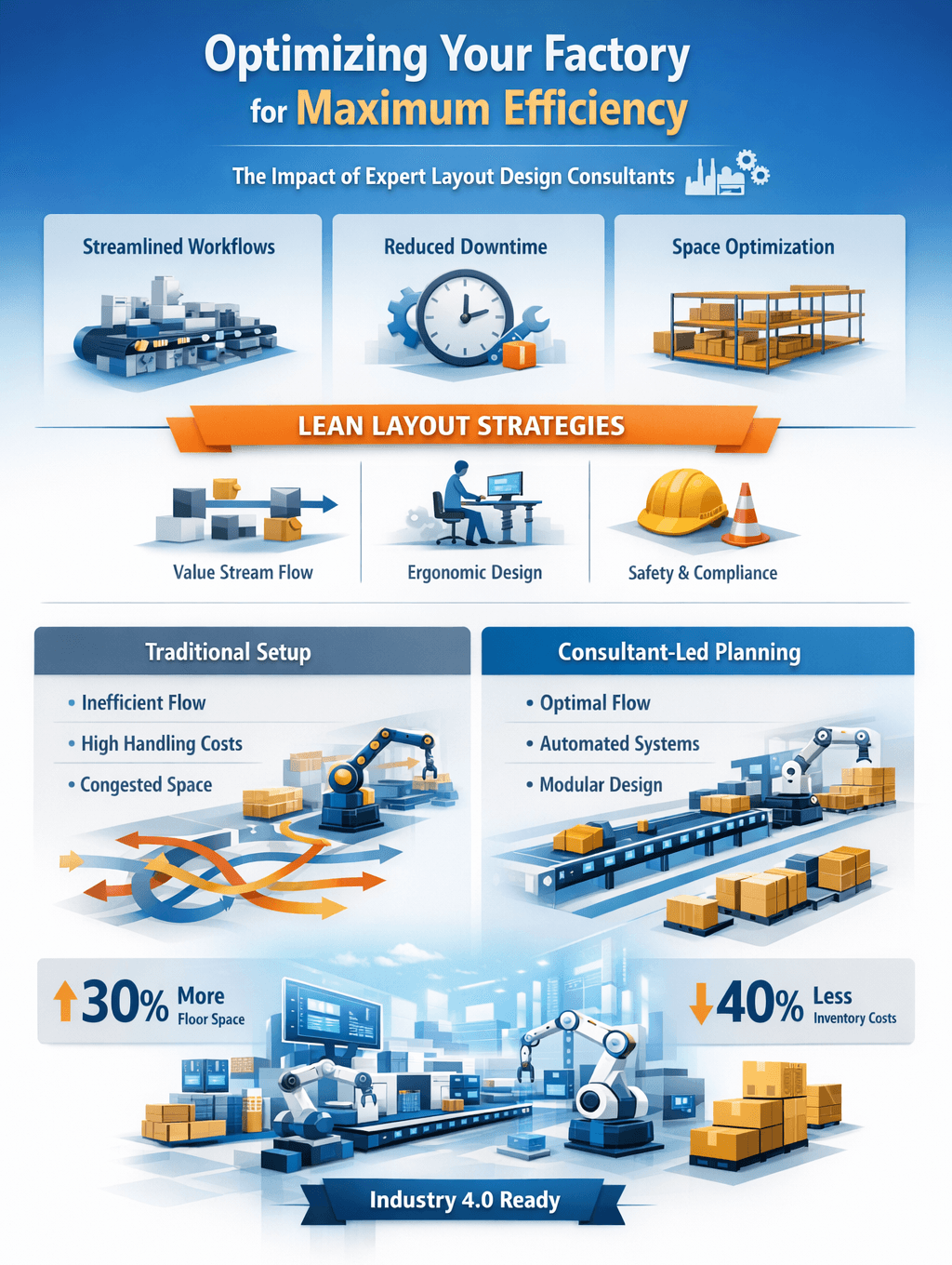
At the heart of high-quality industrial factory design is the principle of lean manufacturing. The goal is to systematically eliminate non-value-added activities that consume resources without improving the product. This includes excessive transportation, unnecessary motion, and over-processing caused by a fragmented manufacturing plant layout.
By analyzing the movement of value through the plant, consultants ensure that sequential processes are physically aligned. This reduces the “hidden drain” of material handling, which in traditional unoptimized setups can account for nearly 30% to 70% of total manufacturing costs. A lean approach ensures that the production path is direct, visual, and free of the backtracking that typically plagues unoptimized floors.
What Are the Tangible Benefits of Factory Layout Design Services?
Investing in professional factory layout design services provides a roadmap for long-term scalability. These services focus on creating a smart factory layout that is prepared for the integration of automation and Industry 4.0 technologies. By eliminating cluttered work-in-progress storage areas, design services often reclaim significant floor area. For instance, strategic redesigns have successfully achieved a 65.8% reduction in travel distance while reclaiming 13.2% of the total floor space, allowing for new production lines to be installed without any new civil construction.
- Improved Employee Morale: A clean, organized, and ergonomic layout reduces the physical strain on the workforce, leading to higher retention and lower error rates.
- Enhanced Safety: Professional planning segregates pedestrian walkways from heavy material-handling paths, a critical factor for maintaining compliance and passing safety audits.
- Cost-Effective Planning: Effective spatial logic allows for a 17% production capacity enhancement within the same footprint by optimizing the density of production lines.
Why Do Manufacturers Need Factory Planning Consulting Services?
Scaling up often leads to spatial chaos if not managed through expert factory planning consulting services. When a company attempts to fit new lines into an old manufacturing plant layout, they often inadvertently create bottlenecks that slow down the entire facility. Consultants provide a bridge between production targets and physical constraints, ensuring that every square foot is utilized effectively.
One of the primary deliverables of these services is the transition to a cellular model. Instead of grouping machines by function, consultants create integrated work cells where a product is completed within a tight radius. This lean manufacturing technique drastically reduces lead times. In high-precision engineering environments, this transition has resulted in a 62% increase in revenue per square meter, proving that the physical layout is a direct lever for financial growth.
How Does Manufacturing Plant Layout Design Support Scalability?
High-quality manufacturing plant layout design focuses on modularity. In a volatile market, a facility must be able to pivot or expand quickly. Industrial engineers design these layouts to be flexible, ensuring that new technology or product lines can be integrated with minimal disruption to existing operations.
This agility is further evidenced in large-scale specialized facilities, where applying advanced layout principles has reduced storage requirements by 30% and cut tied-up working capital by 50%. By reducing the physical distance materials must travel, manufacturers have seen production cycles shrink significantly, in some cases, reducing a 9-month lead time down to 5 months, representing a 40% improvement in throughput.
FAQ: Optimizing Productivity Through Smart Design
How do factory planning consultants for Industry 4.0 manufacturing help?
Consultants ensure that the physical infrastructure, such as power distribution, network cabling, and robotic cell clearances, is integrated into the layout from day one. This makes the transition to Industry 4.0 seamless, allowing for real-time data tracking and automation without the need for expensive structural retrofitting later.
How does factory layout design improve productivity?
It improves productivity by minimizing the total travel distance for both materials and workers. By placing sequential processes next to each other, you eliminate the waste of waiting and transportation. Optimized designs have been shown to reduce material flow distance by over 60%, directly impacting the speed of the entire production line.
What are the common factory planning mistakes manufacturers should avoid?
The most common mistake is “land-locking” key processes, making it impossible to expand them without moving the entire plant. Another is ignoring the “vertical cube,” failing to utilize the height of the factory shed for storage or utilities. Finally, many fail to segregate material flows, leading to safety hazards and traffic jams on the shop floor.
Why hire factory planning consultants for sustainable manufacturing?
Sustainability is often a byproduct of efficiency. By reducing the physical footprint through better space utilization, you reduce the energy needed for lighting, heating, and cooling. Optimized layouts ensure that manufacturing cost reduction goes hand-in-hand with a smaller environmental footprint.
Are there factory planning solutions for small manufacturing companies?
Absolutely. For small firms, manufacturing cost reduction is even more critical. Consultants help smaller enterprises organize limited space to handle high-volume flows. A professional factory layout design company for industrial facilities can help a small firm double its output without moving to a larger, more expensive location.
Conclusion: Turning Your Floor into a Performance Asset
In the modern manufacturing market, your layout is either a bottleneck or a catalyst. By partnering with professional industrial factory planning consultants, you unlock the hidden capacity currently lost to waste and backtracking. Whether you are building a greenfield project or upgrading a legacy site, the expertise of a factory layout design specialist is the fastest route to achieving a high-velocity, high-profit environment.
Contact us