Manufacturing organizations continuously look for ways to improve efficiency, maintain consistent quality, and create more reliable operational systems. One of the most widely adopted Lean approaches for achieving these goals is Five S (5S) in manufacturing, a workplace organization methodology designed to improve how people, processes, and resources interact.
Also known as 5S Lean manufacturing, this approach provides a structured way to organize work environments, eliminate unnecessary activities, and establish standardized practices. By improving workplace visibility and process discipline, Five S helps organizations create a stronger foundation for continuous improvement.
For organizations implementing Lean practices in Egypt, Five S Lean manufacturing initiatives can support operational improvement by addressing common workplace challenges such as inefficient layouts, inconsistent processes, and difficulty maintaining standards.
Rather than being limited to cleaning or organizing workspaces, the Five S methodology focuses on creating systems that help employees work more effectively and identify improvement opportunities.
What Is Five S Lean Manufacturing?
Five S Lean manufacturing is a Lean workplace organization framework based on five principles:
Sort
Sort involves identifying what is necessary for daily operations and removing items that do not add value. This reduces clutter and helps ensure that workspaces contain only essential resources.
Set in Order
Set in Order focuses on arranging necessary items in logical locations. Tools, materials, and equipment should have clearly defined places so employees can access and return them efficiently.
Shine
Shine involves maintaining clean and well inspected work areas. Regular cleaning activities can also help identify abnormalities, equipment concerns, and workplace issues before they affect operations.
Standardize
Standardization creates consistent methods for maintaining workplace organization. Visual controls, documented procedures, and routine checks help teams follow agreed practices.
Sustain
Sustain ensures that improvements continue over time. It requires leadership involvement, employee participation, regular reviews, and continuous improvement practices.
Together, these five principles form the Lean manufacturing Five S framework, helping organizations build more organized and disciplined operating environments.
How Five S in Manufacturing Improves Productivity in Egypt
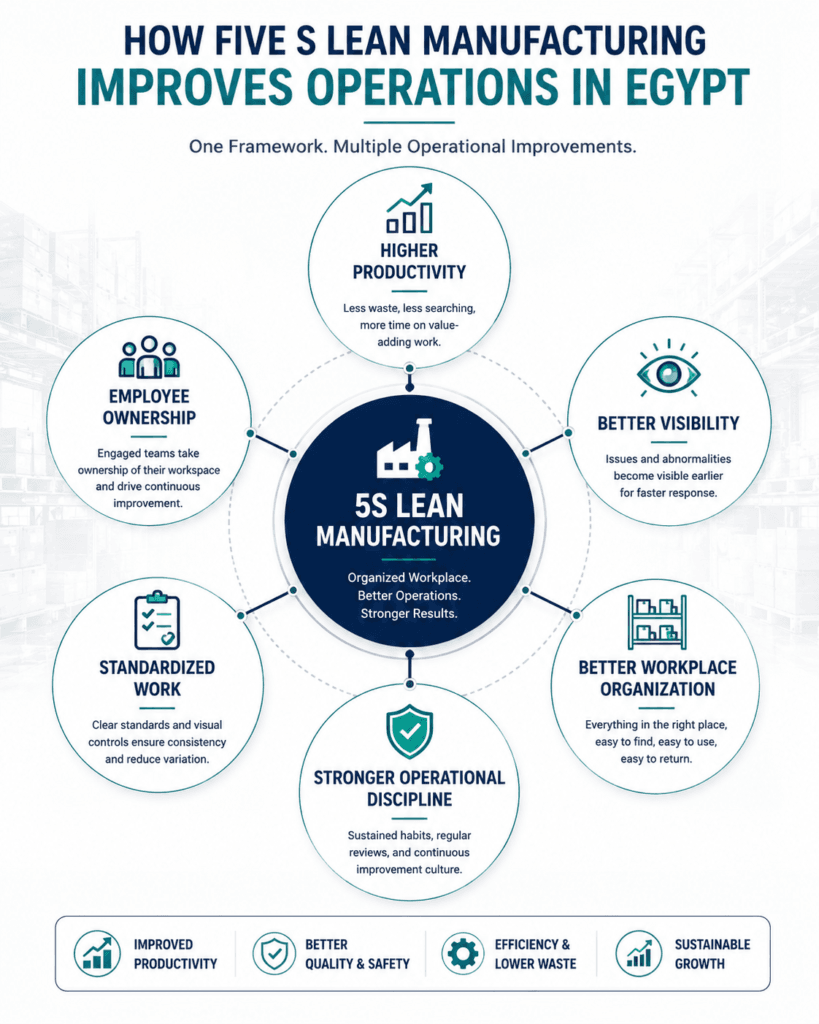
A key reason organizations adopt Five S in manufacturing is its ability to improve productivity through better workplace organization.
Productivity challenges are not always caused by equipment limitations or production capacity. In many cases, inefficiencies occur because employees spend time searching for resources, managing unnecessary movement, or dealing with inconsistent processes.
Five S helps address these challenges by improving visibility and reducing avoidable disruptions.
Reducing Unnecessary Movement
Poor workplace organization can lead to wasted motion, such as employees walking repeatedly to locate tools, materials, or information.
Through workplace organization using Five S, essential items are positioned according to operational needs. This allows employees to spend more time on value-adding activities.
Improving Process Visibility
An organized workplace makes it easier to identify problems.
When standards are clear, deviations become more visible. Missing tools, misplaced materials, or changes in workplace conditions can be identified earlier, allowing teams to respond more effectively.
Supporting Standardized Work
Standardized processes are an important part of Lean manufacturing.
Five S supports standardization by creating consistent workplace arrangements and clear expectations. This helps employees perform tasks using defined methods and reduces unnecessary variation.
Strengthening Employee Ownership
Successful Five S implementation involves employees at every stage.
When teams participate in improving their own work environments, they often develop stronger ownership of workplace standards. This participation supports a culture of continuous improvement.
Why Should Factories Adopt Five S Methodology in Egypt?
Organizations often ask: Why should factories adopt Five S methodology in Egypt?
The answer lies in the foundation that Five S creates for Operational Excellence.
Better Workplace Organization
A structured workplace allows employees to locate resources more easily and maintain clearer workflows. This improves daily operations and supports more consistent performance.
Improved Quality Awareness
Quality issues are easier to identify when processes and work areas are organized.
Five S encourages employees to notice abnormalities and maintain conditions that support reliable operations.
Enhanced Safety Practices
An organized workplace can help reduce avoidable workplace risks by improving visibility, accessibility, and housekeeping standards.
Stronger Lean Foundations
Five S is frequently considered a starting point for broader Lean improvement efforts because it establishes discipline, standardization, and visual management.
The Connection Between Five S and Operational Excellence
The impact of Five S in Manufacturing in Egypt extends beyond individual workstations. When implemented effectively, it influences how teams manage daily activities and improvement initiatives.
Creating a Visual Workplace
Visual management is a major component of Lean practices.
Five S supports visual workplaces where information is easy to understand. Employees can quickly recognize normal conditions and identify situations requiring attention.
Supporting Continuous Improvement
Five S encourages teams to regularly review workplace conditions and identify opportunities for improvement.
This creates a continuous improvement mindset rather than relying on occasional improvement projects.
Improving Operational Discipline
Maintaining standards requires consistent effort from both leadership and employees.
Over time, Five S can help organizations develop stronger operational discipline by making expectations clear and repeatable.
Implementing a Sustainable Five S Approach in Egypt
A sustainable Five S implementation model requires more than an initial workplace organization activity.
Many organizations can successfully complete the early stages of Five S but struggle to maintain improvements. Long term success depends on integrating 5S into everyday management practices.
Establish Clear Standards
Organizations should define what good workplace conditions look like.
Standards may include:
- Workplace organization guidelines
- Visual management practices
- Cleaning responsibilities
- Review processes
- Standard operating procedures (SOPs)
Involve Employees
Employees should participate in identifying improvement opportunities and maintaining standards.
Their practical knowledge helps ensure that workplace improvements remain effective.
Conduct Regular Reviews
Periodic reviews help identify whether standards are being followed and where additional improvements may be needed.
These reviews should focus on improvement rather than simply identifying non compliance.
Encourage Continuous Improvement
Five S should evolve as operational requirements change.
Organizations that treat 5S as an ongoing improvement approach are more likely to maintain its benefits over time.
Common Mistakes When Implementing Five S in Egypt
Although the concept of 5S is simple, implementation challenges can reduce its effectiveness.
Common mistakes include:
Treating Five S as Only Cleaning
Five S is not simply a housekeeping activity. It is a structured approach for improving workplace systems and operational discipline.
Lack of Leadership Involvement
Without visible support from leadership, teams may struggle to maintain workplace standards.
Focusing Only on Initial Results
Sustaining improvements requires ongoing attention, reviews, and employee engagement.
Creating Standards Without Participation
Standards are more effective when employees understand their purpose and contribute to their development.
Is Five S Lean Manufacturing Suitable for Egypt Industries?
Yes, 5S Lean manufacturing can be adapted to different manufacturing environments in Egypt because its principles focus on universal operational challenges.
The methodology does not depend on a specific technology, production method, or organizational size. Instead, it focuses on improving workplace organization, standardization, and continuous improvement.
Organizations at different stages of Lean maturity can use Five S as a foundation for improving operational systems and preparing for broader improvement initiatives.
Conclusion
Five S in manufacturing provides a practical approach for improving workplace organization, supporting productivity, and strengthening operational discipline.
Through the principles of Sort, Set in Order, Shine, Standardize, and Sustain, organizations can create environments where processes are easier to manage and improvements are easier to maintain.
For organizations in Egypt, adopting Five S Lean manufacturing practices can support long-term operational improvement by creating a stronger foundation for Lean transformation.
The success of Five S depends on consistent implementation, employee involvement, leadership commitment, and a focus on continuous improvement. When integrated into daily operations, 5S becomes more than an organizational method. It becomes a system for building better ways of working.
Frequently Asked Questions
How does Five S in manufacturing improve productivity in Egypt?
Five S improves productivity by creating organized workplaces, reducing unnecessary movement, supporting standardized processes, and making resources easier to locate. These improvements help employees work more efficiently and reduce avoidable operational disruptions.
Why should factories adopt Five S methodology in Egypt?
Factories should adopt the Five S methodology because it helps improve workplace organization, strengthen process consistency, support quality awareness, and create a foundation for continuous improvement.
What are the benefits of 5S Lean manufacturing?
The benefits of 5S Lean manufacturing include improved workplace organization, better process visibility, stronger standardization, reduced waste, and increased employee involvement in continuous improvement activities.
How does workplace organization using Five S support Lean manufacturing?
Workplace organization using 5S supports Lean manufacturing by creating visual workplaces, reducing inefficiencies, improving access to resources, and making process issues easier to identify.
Is Five S lean manufacturing suitable for Egypt industries?
Yes, Five S Lean manufacturing is suitable for Egypt industries because it is a flexible methodology that can be applied across different manufacturing environments to improve organization, standardization, and operational discipline.