
Effective supply chain management has become a strategic priority for manufacturing companies seeking to improve operational efficiency, strengthen resilience, and respond to changing market conditions. Across Egypt, organizations are increasingly adopting structured supply chain management strategies to improve visibility, optimize resources, and support long-term business growth.
Rather than focusing solely on the movement of goods, modern supply chain management brings together planning, procurement, inventory management, production coordination, logistics, and performance monitoring into a connected operating model. When these functions work together, organizations are better positioned to improve decision making, reduce operational inefficiencies, and create greater value across the supply chain.
This article explores the supply chain management strategies used by firms in Egypt, highlights the role of a supply chain consultant in supporting transformation initiatives, and examines how strategic supply chain management contributes to stronger operational performance.
Key Takeaways
- Supply chain management strategies help manufacturing companies improve operational efficiency, strengthen resilience, and support long term business growth.
- End-to-end supply chain optimization enables organizations to improve visibility, coordination, and decision making across the entire supply chain.
- Strategic supply chain management aligns procurement, production, inventory, logistics, and planning with broader business objectives.
- Supply chain performance improvement depends on continuous monitoring, collaboration, and process optimization rather than isolated initiatives.
- A supply chain consultant provides an objective perspective to identify improvement opportunities and support structured transformation initiatives.
- Strong supplier relationships, effective inventory management, and data-driven planning contribute to a more agile and resilient supply chain.
- Organizations in Egypt increasingly view supply chain management as a strategic capability that supports Operational Excellence and sustainable business performance.
Understanding Supply Chain Management
Supply chain management is the process of planning, coordinating, and optimizing the flow of materials, information, and products across the entire value chain. It extends beyond logistics by aligning sourcing, inventory, production planning, warehousing, transportation, and customer fulfillment with business objectives.
An effective supply chain management strategy enables organizations to respond more efficiently to operational challenges while improving collaboration between internal teams and external partners.
For manufacturing companies in Egypt, supply chain management is increasingly viewed as a business capability that supports Operational Excellence rather than simply a support function.
Why Supply Chain Strategy Matters in Egypt
Many organizations invest in technology or operational improvements without first establishing a clear supply chain strategy. While these initiatives may produce short term improvements, sustainable performance depends on aligning supply chain activities with broader business goals.
A well defined strategy helps organizations:
- Improve operational visibility
- Strengthen planning accuracy
- Optimize inventory management
- Improve supplier collaboration
- Enhance operational agility
- Support continuous improvement
These outcomes contribute to more resilient operations and better long term decision making.
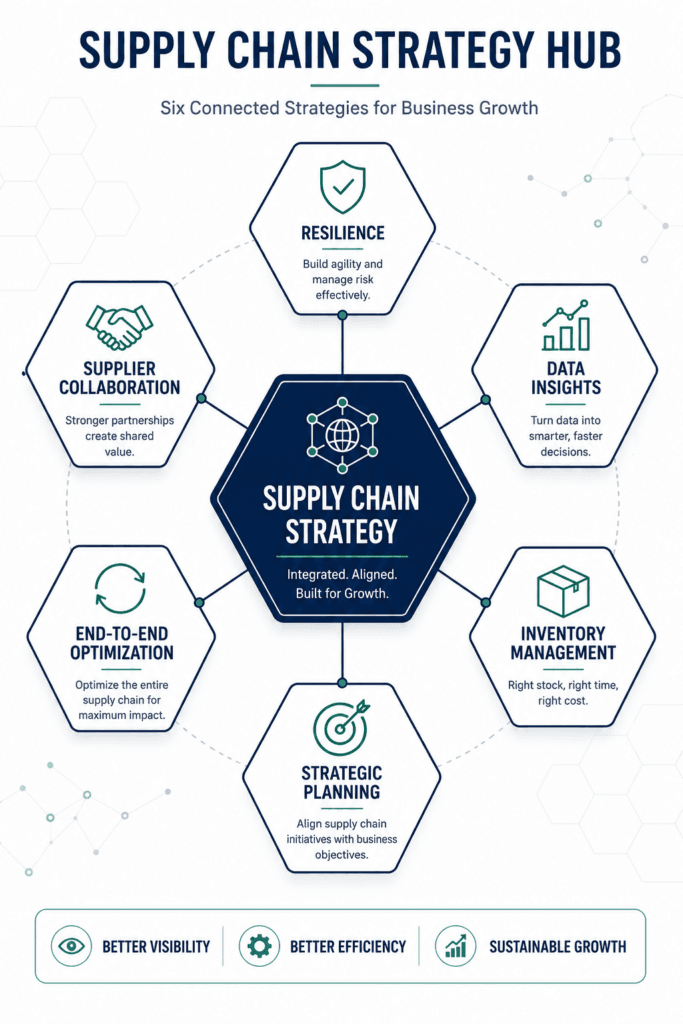
Strategy 1: Focus on End-to-End Supply Chain Optimization
One of the most effective approaches adopted by manufacturing companies is end-to-end supply chain optimization.
Rather than improving isolated functions, organizations evaluate the complete supply chain, from procurement through production and delivery, to identify opportunities for greater efficiency and collaboration.
This approach enables decision makers to understand how changes in one area may influence performance across the broader supply chain.
End-to-end supply chain optimization often includes:
Process Alignment
Organizations review operational workflows to eliminate duplication, improve coordination, and create consistent processes across supply chain activities.
Information Visibility
Improving access to reliable operational information supports faster and more informed decision making while reducing communication gaps.
Performance Integration
Instead of measuring individual departments independently, organizations evaluate supply chain performance using shared operational objectives.
Strategy 2: Strengthen Strategic Supply Chain Management
Strategic supply chain management focuses on aligning operational activities with long term business priorities.
Rather than responding only to immediate operational needs, organizations develop structured plans that support future growth, operational resilience, and continuous improvement.
A strategic approach often includes:
Long-Term Planning
Supply chain planning should consider future operational requirements alongside current business needs.
Cross Functional Collaboration
Procurement, production, logistics, and planning teams benefit from working toward shared operational objectives.
Continuous Evaluation
Regular reviews help organizations adapt their supply chain strategies as business priorities evolve.
Strategy 3: Improve Supply Chain Performance Through Data
Reliable information plays a central role in modern supply chain management.
Organizations increasingly rely on operational data to evaluate supply chain performance, identify inefficiencies, and prioritize improvement initiatives.
Areas commonly monitored include:
- Inventory performance
- Supplier reliability
- Production planning
- Order fulfillment
- Operational efficiency
- Resource utilization
Data driven decision making supports continuous improvement while reducing reliance on assumptions.
Strategy 4: Develop Collaborative Supplier Relationships
Effective supply chain management depends on strong collaboration with suppliers and business partners.
Organizations that build transparent relationships with suppliers often improve communication, planning accuracy, and operational responsiveness.
Supplier collaboration should focus on:
- Clear communication
- Shared operational expectations
- Consistent performance reviews
- Long-term relationship development
- Joint problem solving
Collaboration helps reduce uncertainty while supporting more stable supply chain operations.
Strategy 5: Optimize Inventory Management
Inventory represents a significant component of supply chain performance.
Maintaining appropriate inventory levels helps organizations balance operational continuity with efficient resource utilization.
Rather than focusing only on inventory volume, organizations should evaluate how inventory supports production planning, customer requirements, and overall operational objectives.
An effective inventory strategy includes regular reviews, demand planning, and continuous monitoring to improve responsiveness while minimizing unnecessary stock accumulation.
Strategy 6: Build Supply Chain Resilience
Operational disruptions can arise from changes in demand, supplier performance, transportation challenges, or broader market conditions.
Supply chain resilience focuses on improving an organization’s ability to respond effectively to changing circumstances while maintaining operational continuity.
Key practices include:
Risk Identification
Organizations should regularly assess potential operational risks across their supply chain.
Scenario Planning
Considering alternative operational approaches helps improve preparedness when unexpected events occur.
Flexible Operations
Building flexibility into planning and operational processes enables organizations to respond more effectively as conditions change.
The Role of a Supply Chain Consultant
Implementing strategic improvements often requires an objective assessment of existing operations.
A supply chain consultant helps organizations evaluate current processes, identify improvement opportunities, and develop practical roadmaps that align operational performance with business objectives.
Depending on organizational needs, a supply chain consultant in Egypt may support initiatives such as process assessments, supply chain performance improvement, operational diagnostics, and strategic planning.
Similarly, supply chain management consulting in Egypt focuses on helping organizations strengthen operational efficiency through structured analysis and continuous improvement rather than isolated operational changes.
Supply chain consultants also facilitate cross functional collaboration, helping organizations establish consistent processes, improve visibility, and create sustainable improvement initiatives across the supply chain.
Conclusion
As manufacturing companies across Egypt continue to operate in an increasingly competitive and dynamic environment, supply chain management has become a key driver of operational performance rather than simply a logistics function. Organizations that adopt structured supply chain management strategies are better positioned to improve operational visibility, strengthen supplier relationships, optimize inventory, and respond more effectively to changing market conditions.
Rather than pursuing isolated improvement initiatives, successful organizations focus on creating an integrated supply chain that connects planning, procurement, production, logistics, and performance management. This holistic approach supports more informed decision making, greater operational efficiency, and long-term business resilience.
Whether the objective is improving supply chain performance, supporting business growth, or strengthening operational agility, investing in strategic supply chain management provides a strong foundation for continuous improvement. With the support of experienced supply chain consultants and a structured improvement roadmap, manufacturing firms in Egypt can build more efficient, responsive, and sustainable supply chains that create lasting competitive advantage.
Frequently Asked Questions
What is supply chain management?
Supply chain management is the process of planning, coordinating, and optimizing the flow of materials, information, and products from suppliers to customers. It includes procurement, inventory management, production planning, warehousing, transportation, and performance monitoring to ensure operations remain efficient and aligned with business objectives.
Why is supply chain management important for manufacturers in Egypt?
Manufacturers in Egypt operate in a competitive environment where operational efficiency, cost control, and responsiveness are essential. Effective supply chain management helps organizations improve planning, reduce operational waste, strengthen supplier collaboration, and build greater resilience against disruptions.
What are the main supply chain management strategies?
Common strategies include end-to-end supply chain optimization, strategic planning, data-driven decision making, supplier collaboration, inventory optimization, and building operational resilience. Together, these approaches improve visibility, efficiency, and long-term business performance.
When should a company work with a supply chain consultant?
Organizations often engage a supply chain consultant when they want an independent assessment of their operations, need to improve efficiency, are experiencing operational challenges, or are implementing broader business transformation initiatives. Consultants provide structured analysis and practical recommendations that support sustainable operational improvements.