
Egypt’s manufacturing sector plays an important role in economic development, supporting a wide variety of industries. As manufacturers face increasing competition, changing customer expectations, supply chain challenges, and pressure to improve efficiency, many organizations are looking for structured ways to strengthen their operations.
This is where manufacturing consulting firms provide strategic value. By combining industry knowledge, process improvement methodologies, operational analysis, and business strategy, consultants help manufacturers identify improvement opportunities and build more efficient production systems.
Modern manufacturing challenges are rarely solved through isolated changes. Improving factory performance requires understanding how processes work together, from production planning and quality management to workforce productivity and resource utilization.
For businesses in Egypt, partnering with manufacturing consulting firms can help create a roadmap for operational improvement, sustainable growth, and stronger competitiveness.
Why Manufacturing Consulting Firms Matter for Egypt’s Businesses
Manufacturing organizations operate in complex environments where small inefficiencies can significantly affect productivity, cost, and customer satisfaction.
Common manufacturing challenges include:
- Production delays
- Inefficient workflows
- Quality inconsistencies
- Excessive waste
- Poor process visibility
- Limited performance measurement
- Difficulty scaling operations
Many businesses attempt to address these challenges internally, but existing teams are often focused on daily operations. This can make it difficult to identify deeper process issues or develop long-term improvement strategies.
A manufacturing consultant brings an external perspective and structured approach to evaluate current operations, identify improvement opportunities, and support implementation.
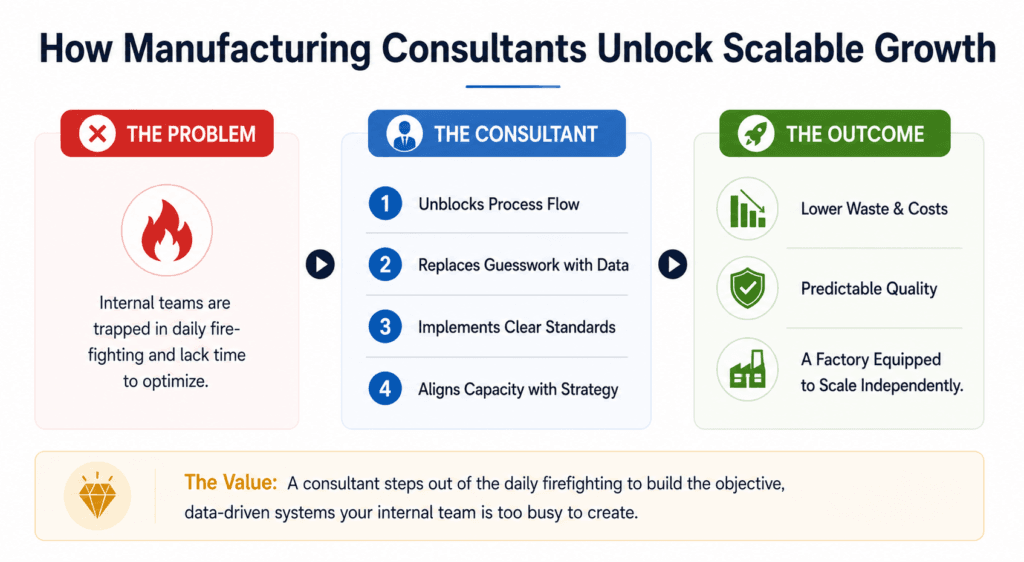
How Do Manufacturing Consulting Firms Help Egyptian Businesses?
Manufacturing consulting firms help organizations improve performance by analyzing existing operations and developing practical improvement strategies aligned with business goals.
Their approach typically focuses on several key areas:
Improving Manufacturing Processes
One of the primary roles of manufacturing process consulting firms is helping organizations understand and optimize how work is performed.
Consultants analyze production workflows to identify:
- Process bottlenecks
- Unnecessary activities
- Production delays
- Inefficient resource utilization
- Opportunities for standardization
Through manufacturing process improvement consulting, organizations can develop more efficient workflows that support higher productivity and consistent output quality.
Process improvement is not only about increasing speed. It involves creating reliable processes that deliver predictable results while reducing operational challenges.
Enhancing Operational Excellence
Operational Excellence is a key focus for manufacturers seeking sustainable growth.
Operational Excellence consulting services help organizations establish systems and practices that improve performance across multiple areas, including:
- Production efficiency
- Quality management
- Process consistency
- Resource utilization
- Continuous improvement
Rather than focusing only on short-term improvements, Operational Excellence approaches help manufacturers build capabilities that support ongoing performance improvement.
Organizations often use structured methodologies such as Lean thinking, Six Sigma principles, and continuous improvement frameworks to identify waste, reduce variation, and improve operational discipline.
Developing Manufacturing Strategies
Growth requires more than improving current operations. Manufacturers also need strategies that support future business objectives.
Manufacturing strategy consulting firms in Egypt can help organizations evaluate questions such as:
- How can production capacity support growth?
- Which processes require improvement?
- How can operational costs be managed effectively?
- How can quality standards be strengthened?
- What capabilities are needed for future competitiveness?
A manufacturing strategy connects operational decisions with broader business goals, helping organizations make informed investment and improvement decisions.
Improving Factory Efficiency Through Data-Driven Analysis
Modern manufacturing improvement depends increasingly on data.
Manufacturing consulting firms help organizations understand performance by examining operational information such as:
- Production output
- Cycle times
- Downtime patterns
- Quality indicators
- Process performance metrics
Using data-driven analysis allows businesses to move away from reactive problem-solving and toward proactive improvement.
For example, instead of simply responding to repeated production delays, organizations can analyze patterns, identify root causes, and implement preventive solutions.
This approach supports more reliable decision-making and long-term performance improvement.
Supporting Industrial Transformation in Egypt
Manufacturing is evolving rapidly due to technological advancement, changing customer expectations, and global competition. Organizations are increasingly exploring ways to improve flexibility, efficiency, and resilience.
Industrial transformation consulting solutions support manufacturers by helping them evaluate and improve:
- Production processes
- Operational systems
- Workforce capabilities
- Performance management practices
- Improvement frameworks
Transformation does not always mean adopting new technology immediately. Successful transformation often begins with understanding existing processes and improving operational foundations.
A well-structured improvement approach ensures that technology investments and operational changes create meaningful business value.
How Manufacturing Consulting Firms Improve Factory Efficiency
Improving factory efficiency requires a comprehensive understanding of people, processes, equipment, and resources.
Manufacturing consulting firms typically focus on areas such as:
Production Flow Optimization
Consultants analyze how materials, information, and work move through production environments.
Improvement opportunities may include:
- Reducing unnecessary movement
- Improving workflow organization
- Eliminating process delays
- Creating smoother production sequences
Quality Improvement
Consistent quality is essential for manufacturing competitiveness.
Consulting approaches help organizations examine quality challenges, identify sources of variation, and improve process reliability.
Resource Utilization
Manufacturers need to maximize the value of available resources. Consultants analyze how organizations use:
- Equipment
- Labor
- Materials
- Production capacity
The objective is to identify opportunities for improved utilization and reduced operational waste.
Standardizing Processes
Standardized processes help organizations maintain consistent performance, especially as operations grow.
Manufacturing consultants support organizations in documenting processes, defining best practices, and creating repeatable operating methods.
The Role of Manufacturing Performance Optimization Experts
Manufacturing performance optimization experts help businesses evaluate operational performance and identify opportunities for improvement.
Their role often involves:
- Assessing current manufacturing capabilities
- Identifying performance gaps
- Developing improvement roadmaps
- Supporting implementation activities
- Establishing measurement systems
The focus is on creating measurable improvements while ensuring solutions are practical for the organization’s operating environment.
Benefits of Hiring Manufacturing Consulting Firms in Egypt
Organizations often consider consulting support when they want to improve performance but need additional expertise, structured methodologies, or an objective assessment of their operations.
Key benefits include:
Access to Specialized Expertise
Manufacturing consulting firms bring experience in analyzing operational challenges and identifying improvement opportunities. They provide structured approaches that help organizations evaluate processes beyond day-to-day operational perspectives.
Faster Identification of Improvement Opportunities
Internal teams often understand operational challenges but may not have the time or tools required for detailed analysis.
Consultants help organizations identify:
- Performance gaps
- Process inefficiencies
- Improvement priorities
- Potential operational risks
This allows businesses to focus improvement efforts where they can create meaningful value.
Improved Decision-Making
Manufacturing improvements require informed decisions. Consultants support decision-making by using:
- Process analysis
- Performance measurements
- Operational assessments
- Structured improvement frameworks
This helps organizations make decisions based on evidence rather than assumptions.
Building Continuous Improvement Capability
The long-term value of consulting extends beyond individual projects. Effective consulting engagements help organizations develop internal capabilities by encouraging:
- Problem-solving skills
- Performance measurement practices
- Process ownership
- Continuous improvement thinking
This enables businesses to continue improving after the consulting engagement ends.
Supporting Sustainable Manufacturing Growth
Growth in manufacturing requires more than increasing production volume. Organizations need processes that can scale while maintaining quality and efficiency.
End-to-end manufacturing consulting services focus on understanding the complete operational journey, from process assessment to improvement implementation.
This approach helps organizations address interconnected challenges rather than solving isolated problems.
For example, improving production efficiency may require examining not only the production line but also planning processes, inventory management, quality practices, and workforce capabilities.
A connected approach creates stronger and more sustainable improvements.
Choosing Manufacturing Consulting Firms in Egypt
Selecting the right consulting partner is an important decision for organizations seeking operational improvement.
Businesses evaluating top manufacturing consulting firms for Egypt should consider several factors:
Understanding of Manufacturing Operations
A consulting partner should demonstrate knowledge of manufacturing environments and understand how operational challenges affect business performance.
Experience with process improvement, Operational Excellence, and manufacturing systems is important when selecting support.
Structured Improvement Methodology
A reliable consulting approach should include:
- Understanding current operations
- Identifying improvement opportunities
- Developing practical solutions
- Supporting implementation
- Measuring progress
The methodology should be adapted to the organization’s specific needs rather than applied as a generic solution.
Focus on Practical Implementation
Manufacturing improvement strategies need to work in real operating environments.
Consultants should consider factors such as:
- Existing capabilities
- Available resources
- Workforce readiness
- Business priorities
The most effective solutions balance strategic objectives with practical execution.
The Future Role of Manufacturing Consulting Firms
The manufacturing sector continues to evolve through technology adoption, changing market expectations, and increasing focus on operational resilience.
Future-focused manufacturers will need stronger capabilities in areas such as:
- Data-driven decision-making
- Process optimization
- Workforce development
- Operational flexibility
- Continuous improvement
Manufacturing consulting firms will continue to play an important role by helping organizations navigate these changes and build stronger operational foundations.
Rather than focusing only on solving current challenges, future consulting approaches will increasingly help businesses prepare for long-term competitiveness.
Conclusion
Manufacturing consulting firms in Egypt can provide valuable support in improving processes, strengthening operational performance, and developing strategies for sustainable growth.
From manufacturing process improvement consulting to Operational Excellence initiatives, consultants help businesses identify inefficiencies, optimize resources, and create stronger systems for continuous improvement.
As Egypt’s manufacturing sector continues to develop, organizations that invest in structured improvement approaches will be better positioned to respond to competition, customer expectations, and changing market conditions.
The role of manufacturing consultants is not simply to recommend changes; it is to help businesses understand their operations, improve decision-making, and build capabilities that support long-term success.
Frequently Asked Questions
How do manufacturing consulting firms help Egypt’s businesses?
Manufacturing consulting firms help Egypt’s businesses by analyzing operational processes, identifying inefficiencies, improving production workflows, supporting strategic planning, and developing improvement initiatives that enhance efficiency and competitiveness.
Why hire manufacturing consulting firms in Egypt today?
Businesses hire manufacturing consulting firms to gain specialized expertise, improve factory efficiency, address operational challenges, optimize processes, and develop strategies that support sustainable manufacturing growth.
What services do manufacturing consulting firms offer in Egypt?
Manufacturing consulting firms in Egypt may support organizations through process improvement consulting, Operational Excellence initiatives, manufacturing strategy development, performance optimization, process analysis, and continuous improvement frameworks.
How do manufacturing consulting firms improve factory efficiency?
Manufacturing consulting firms improve factory efficiency by analyzing workflows, identifying bottlenecks, reducing operational waste, improving resource utilization, standardizing processes, and supporting data-driven improvement decisions.
What should businesses look for in manufacturing consulting firms?
Businesses should evaluate consulting firms based on manufacturing expertise, improvement methodologies, practical implementation capabilities, industry understanding, and their ability to support measurable operational improvements.