Manufacturing organizations in Egypt are operating in an environment where efficiency, quality, and adaptability increasingly determine long-term competitiveness. As customer expectations rise and industrial markets become more demanding, manufacturers are looking for structured ways to improve operations, optimize resources, and create processes that can support sustainable growth.
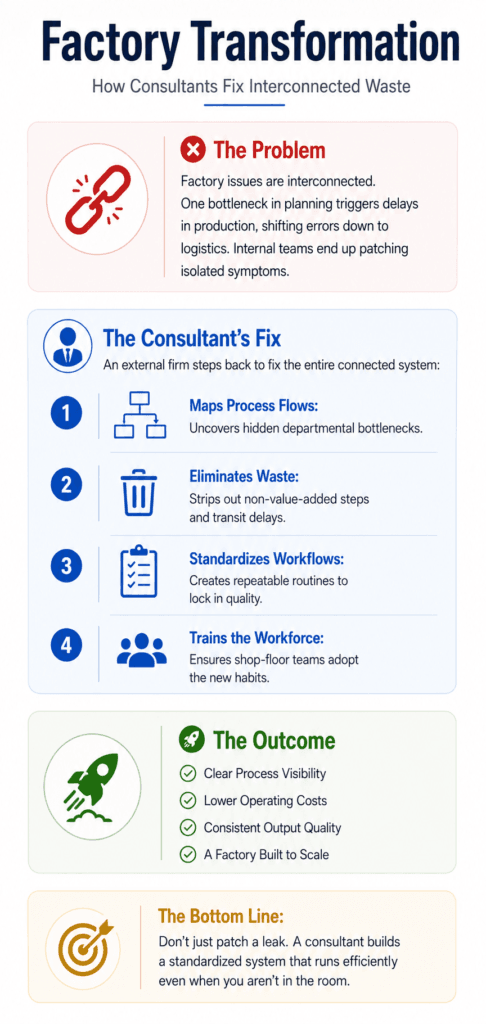
However, operational challenges in manufacturing are often interconnected. A production delay may be linked to workflow issues, planning gaps, quality variation, equipment utilization, or inefficient coordination between departments. Solving these challenges requires more than isolated fixes, it requires a structured approach to understanding and improving the entire manufacturing system.
This is where manufacturing consulting firms support businesses by helping organizations evaluate their current operations, identify improvement opportunities, and implement strategies that enhance performance.
Through manufacturing consulting firms in Egypt, organizations can access structured expertise focused on improving processes, strengthening operational capabilities, and supporting industrial transformation.
Why Manufacturing Operations Need Transformation
Manufacturing transformation is not only about increasing production output. It involves creating efficient, reliable, and adaptable systems that allow businesses to compete effectively.
Many manufacturers face operational challenges such as:
- Inefficient production workflows
- Excessive process variation
- Quality inconsistencies
- Poor visibility into performance
- High operational waste
- Limited process standardization
- Difficulty scaling production
These challenges can affect productivity, customer satisfaction, and overall business performance.
A transformation approach helps organizations move from reactive problem-solving toward proactive improvement by understanding the causes behind operational issues and developing sustainable solutions.
What Role Do Manufacturing Consulting Firms Play in Operational Transformation?
Manufacturing consulting firms help organizations analyze their current state, identify performance gaps, and develop improvement strategies aligned with business objectives.
Their role typically includes:
- Assessing manufacturing processes
- Identifying operational inefficiencies
- Developing improvement roadmaps
- Supporting process optimization
- Establishing performance measurement systems
- Building continuous improvement capabilities
Rather than providing generic recommendations, effective consulting approaches focus on understanding the specific operating environment of each manufacturer.
Every factory has different challenges related to products, processes, workforce capabilities, equipment, and market requirements. A successful transformation strategy must reflect these realities.
How Manufacturing Consulting Firms Improve Factory Efficiency
One of the most important goals of manufacturing transformation is improving factory efficiency.
Manufacturing process consulting firms in Egypt often focus on improving the relationship between people, processes, technology, and resources.
Process Assessment and Analysis
The first step in operational transformation is understanding the current manufacturing environment.
Consultants analyze processes to identify:
- Workflow inefficiencies
- Production constraints
- Unnecessary activities
- Performance gaps
- Improvement opportunities
This assessment creates visibility into how work is currently performed and where changes can create meaningful impact.
Without understanding the current state, improvement efforts may address symptoms rather than underlying causes.
Process Improvement
A major focus of transformation initiatives is improving how manufacturing processes operate.
Manufacturing process improvement consulting helps organizations evaluate workflows and identify opportunities to:
- Reduce delays
- Improve process flow
- Increase consistency
- Minimize waste
- Strengthen operational control
Process improvement often involves reviewing the complete manufacturing journey, including:
- Material movement
- Production steps
- Quality checkpoints
- Information flow
- Resource allocation
By improving the connection between these elements, organizations can create smoother and more efficient operations.
Reducing Operational Waste
Waste reduction is a central principle in many manufacturing improvement approaches.
Manufacturing consulting firms help organizations identify activities that consume resources without creating customer value.
Examples may include:
- Excess movement of materials
- Waiting time between processes
- Unnecessary processing steps
- Production delays
- Inefficient resource utilization
Reducing waste does not simply mean cutting costs. It means improving how resources are used to create greater value.
Improving Performance Through Data
Modern manufacturing transformation increasingly depends on measurable performance information.
Manufacturing performance optimization experts help organizations use operational data to understand:
- Production performance
- Process efficiency
- Quality indicators
- Equipment utilization
- Workflow effectiveness
Data-driven improvement allows manufacturers to identify patterns, measure progress, and make informed decisions.
Instead of relying only on experience or assumptions, organizations can use evidence to prioritize improvement activities.
Building Operational Excellence in Manufacturing
Operational Excellence is achieved when organizations consistently deliver value through efficient, reliable, and continuously improving processes.
Operational Excellence consulting services support manufacturers by helping them develop systems that encourage:
- Standardized processes
- Continuous improvement
- Performance measurement
- Employee involvement
- Problem-solving capabilities
Operational Excellence is not a single project. It is an ongoing approach that helps organizations adapt as business conditions change.
The Importance of Industrial Transformation Consulting Solutions
Manufacturing transformation requires organizations to look beyond individual processes and consider how the entire operating system works together.
Industrial transformation consulting solutions help businesses evaluate areas such as:
- Production processes
- Operational systems
- Performance management
- Workforce capabilities
- Improvement practices
A structured transformation approach helps organizations create stronger foundations before implementing larger operational changes.
For many manufacturers, transformation begins with improving process visibility, strengthening operational discipline, and developing the ability to continuously improve.
Transforming Manufacturing Through Standardization
Standardization plays an important role in improving manufacturing performance.
When processes vary significantly between shifts, teams, or locations, organizations may experience inconsistent quality and unpredictable results.
Manufacturing consulting firms help businesses establish clearer operating methods through:
- Process documentation
- Defined work standards
- Performance indicators
- Improvement routines
Standardized processes make it easier to measure performance, identify deviations, and create repeatable results.
Supporting Workforce Engagement During Transformation
Manufacturing transformation is not only a technical initiative. People play a central role in whether improvements succeed. Employees who work directly with processes often have valuable insights into operational challenges.
Successful transformation approaches encourage:
- Employee participation
- Problem identification
- Improvement suggestions
- Knowledge sharing
When teams understand the purpose behind changes and participate in improvement efforts, organizations are more likely to sustain results over time.
A Structured Roadmap for Manufacturing Transformation
Successful manufacturing transformation requires a clear approach. Without a structured roadmap, organizations may implement disconnected improvements that fail to create lasting value.
Manufacturing consulting firms typically support organizations through several stages:
Understanding the Current State
Before recommending improvements, organizations need a clear understanding of their existing operations.
This involves reviewing:
- Manufacturing workflows
- Production performance
- Process efficiency
- Quality performance
- Resource utilization
- Operational challenges
A detailed assessment creates a foundation for improvement decisions based on actual operational conditions.
Identifying Improvement Priorities
Not every process requires immediate transformation. Organizations need to identify areas where improvements can create the greatest operational impact.
Priorities may include:
- Processes affecting customer experience
- Activities creating significant delays
- Operations with high waste levels
- Areas with inconsistent performance
A focused improvement strategy allows businesses to direct resources effectively.
Implementing Practical Improvements
Transformation strategies must consider the realities of the manufacturing environment.
Effective improvements are:
- Practical for employees
- Aligned with business objectives
- Measurable through performance indicators
- Sustainable over time
Manufacturing consulting firms help organizations move from analysis to execution by supporting implementation planning and improvement activities.
Monitoring and Sustaining Performance
Transformation does not end after improvements are introduced.
Organizations need systems to monitor performance and ensure that improvements continue delivering value.
This includes:
- Reviewing key performance indicators (KPIs)
- Maintaining process standards
- Identifying new improvement opportunities
- Encouraging continuous improvement practices
Sustainable transformation requires ongoing attention and organizational commitment.
Benefits of Manufacturing Transformation Consulting
Organizations that invest in structured manufacturing improvement can achieve several long-term benefits.
Improved Operational Efficiency
By identifying inefficiencies and optimizing workflows, businesses can improve how resources are used and how processes perform.
Better Process Visibility
Transformation initiatives help organizations understand their operations through clearer processes, measurements, and performance indicators.
Stronger Quality Consistency
Improved process control helps organizations reduce variation and create more reliable outputs.
Enhanced Business Agility
Manufacturers with efficient and adaptable processes are better prepared to respond to changing market requirements.
Stronger Continuous Improvement Culture
A successful transformation approach encourages employees and leaders to continuously identify opportunities for improvement.
Common Challenges During Manufacturing Transformation
Although transformation creates significant opportunities, organizations may face challenges during implementation.
Resistance to Change
Employees may be uncertain about new processes or operating methods.
Successful transformation requires communication, involvement, and leadership support to create understanding and acceptance.
Lack of Clear Objectives
Transformation initiatives should begin with clearly defined goals.
Without measurable objectives, organizations may struggle to evaluate progress or prioritize improvement activities.
Focusing Only on Technology
Technology can support manufacturing improvement, but it is not a replacement for strong processes.
Organizations should first understand and optimize their operations before introducing new technologies.
Limited Sustainability Planning
Improvements must be supported by ongoing monitoring and ownership.
Without proper controls, organizations may gradually return to previous ways of working.
Choosing the Right Manufacturing Consulting Partner
Selecting a consulting partner is an important step in any transformation initiative.
Organizations evaluating top manufacturing consulting firms for Egypt should consider:
Manufacturing Expertise
The consulting partner should understand manufacturing environments and the operational challenges businesses face. Industry knowledge helps ensure recommendations are practical and relevant.
Improvement Methodology
A strong consulting approach should include:
- Process assessment
- Data analysis
- Improvement planning
- Implementation support
- Performance monitoring
Practical Business Understanding
Manufacturing improvement is not only about applying frameworks. It requires understanding business priorities, operational limitations, and organizational goals.
Focus on Sustainable Results
The strongest consulting relationships help organizations build internal improvement capabilities rather than creating dependency.
Conclusion
Manufacturing consulting firms transform operations in Egypt by helping organizations improve processes, strengthen efficiency, and develop stronger operational systems.
Through manufacturing process improvement consulting, Operational Excellence approaches, and industrial transformation consulting solutions, businesses can identify inefficiencies, optimize resources, and create more reliable manufacturing environments.
Transformation is not achieved through one single change. It requires a structured approach that combines process understanding, data-driven decisions, employee involvement, and continuous improvement.
For Egypt’s manufacturing sector, organizations that focus on operational improvement and long-term capability building will be better positioned to compete, adapt, and grow.
Frequently Asked Questions
How do manufacturing consulting firms improve factory efficiency?
Manufacturing consulting firms improve factory efficiency by analyzing production processes, identifying bottlenecks, reducing waste, improving workflow, standardizing operations, and using performance data to support better decision-making.
What services do manufacturing consulting firms offer Egypt?
Manufacturing consulting firms may offer process improvement consulting, manufacturing strategy development, Operational Excellence support, performance optimization, process assessment, and industrial transformation consulting solutions.
Why should manufacturers consider process improvement consulting?
Manufacturers consider process improvement consulting to identify inefficiencies, improve productivity, strengthen quality consistency, optimize resources, and create sustainable operational improvements.
What is the role of industrial manufacturing consulting firms in Egypt?
Industrial manufacturing consulting firms help organizations evaluate operations, improve manufacturing processes, strengthen performance systems, and develop strategies that support operational growth.
How do manufacturing consulting firms support Operational Excellence?
Manufacturing consulting firms support Operational Excellence by helping organizations create standardized processes, measure performance, eliminate inefficiencies, and develop continuous improvement practices.