Most organizations still view maintenance as a cost centre a necessary expense to keep machines running. But what if maintenance could directly impact profitability, productivity, and long-term growth?
That’s where Total Productive Maintenance (TPM) shifts the narrative.
At Faber Infinite Consulting, TPM is not treated as a maintenance tool—it is positioned as a core business excellence strategy. When implemented correctly, TPM transforms operations, aligns teams, and drives measurable improvements in Overall Equipment Effectiveness (OEE), cost reduction, and reliability.
What is TPM in Today’s Context?
Total Productive Maintenance (TPM) is a structured approach to maximize equipment effectiveness through proactive and preventive maintenance, involving every level of the organization.
Key Objective:
Improve Overall Equipment Effectiveness (OEE) by eliminating:
- Breakdowns
- Minor stoppages
- Speed losses
- Defects
TPM as a Business Excellence Tool
| Aspect | Traditional Maintenance | TPM Approach |
| Focus | Fixing breakdowns | Preventing losses |
| Ownership | Maintenance team | Entire organization |
| Impact | Operational | Strategic |
| Goal | Machine uptime | Business excellence |
Implementation of TPM
TPM implementation across manufacturing plants has shown:
| Challenge | Intervention | Result |
| Frequent machine breakdowns | Autonomous maintenance training | 35% reduction in downtime |
| Low OEE (below 60%) | Structured TPM implementation framework | Improved to 80%+ OEE |
| High maintenance cost | Planned maintenance system | 20–25% cost reduction |
| Lack of ownership | Cross-functional TPM teams | Strong accountability culture |
These are not isolated results. According to industry data from organizations like Japan Institute of Plant Maintenance (JIPM):
- Companies implementing TPM report 15–30% productivity improvement
- Equipment breakdowns can reduce by up to 70%
Core Pillars of TPM
-
Autonomous Maintenance
Operators take ownership of basic maintenance tasks.
Impact:
- Faster issue detection
- Reduced dependency on maintenance teams
-
Planned Maintenance
| Activity | Outcome |
| Scheduled servicing | Reduced breakdowns |
| Predictive maintenance | Increased equipment life |
| Data-driven planning | Lower maintenance cost |
-
Focused Improvement (Kaizen)
- Identifies root causes of losses
- Uses structured problem-solving
Result: Continuous improvement in manufacturing processes
-
Quality Maintenance
- Prevent defects at source
- Maintain consistent output quality
-
Training & Skill Development
| Level | Focus |
| Operators | Basic maintenance skills |
| Engineers | Advanced diagnostics |
| Leaders | Strategic TPM implementation |
-
Safety, Health & Environment
- Zero accidents
- Safer work environment
-
Early Equipment Management
- Design machines for maintainability
- Reduce lifecycle costs
-
Office TPM
- Extend TPM principles beyond shop floor
- Improve administrative efficiency
How TPM Consulting Improves Manufacturing OEE
Overall Equipment Effectiveness (OEE) is the backbone of TPM.
| OEE Component | TPM Impact |
| Availability | Reduced downtime |
| Performance | Optimized speed |
| Quality | Fewer defects |
Formula Insight:
OEE = Availability × Performance × Quality
With structured TPM Consulting Services India, organizations typically see:
- 10–25% improvement in availability
- 5–15% increase in performance efficiency
- 20–40% defect reduction
Integrating Lean and TPM for Operational Excellence
TPM works best when integrated with Lean principles.
| Lean Tool | TPM Integration |
| Value Stream Mapping | Identifies equipment-related waste |
| 5S | Foundation for TPM |
| Kaizen | Continuous improvement |
Outcome:
A combined approach drives manufacturing process optimization and sustainable growth.
Role of Management in TPM Success
TPM is not a shop-floor initiative—it is leadership-driven.
Key Responsibilities:
| Role | Responsibility |
| Leadership | Set vision and commitment |
| Middle Management | Drive implementation |
| Operators | Execute daily practices |
Insight:
Without management involvement, TPM fails to sustain beyond initial gains.
Strategies for Reducing Machine Downtime in Plants
| Strategy | Description |
| Root Cause Analysis | Identify true failure reasons |
| Preventive Maintenance | Scheduled checks |
| Predictive Tools | Sensors & analytics |
| Operator Training | First-line maintenance |
| Spare Parts Management | Reduce waiting time |
Benefits of Total Productive Maintenance in India
With increasing competition in Indian manufacturing, TPM offers:
- Improved manufacturing productivity tools utilization
- Reduced operational costs
- Higher asset reliability
- Enhanced workforce engagement
- Better compliance with global standards
Why Choose TPM Consultants?
Working with experienced TPM Consultants ensures:
| Advantage | Impact |
| Structured framework | Faster implementation |
| Industry expertise | Proven results |
| Benchmarking | Global best practices |
| Training support | Sustainable outcomes |
At Faber Infinite Consulting, the focus is on:
- Customized TPM implementation framework
- Measurable KPIs
- Long-term sustainability
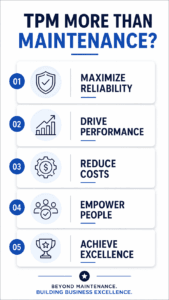
Conclusion: TPM is a Business Strategy, Not Just Maintenance
TPM is no longer optional—it is essential for organizations aiming for manufacturing excellence.
Actionable Takeaways:
- Treat maintenance as a strategic function
- Focus on improving OEE metrics
- Build cross-functional ownership
- Integrate TPM with Lean practices
- Invest in training and leadership alignment
When implemented correctly, TPM doesn’t just maintain machines—it builds resilient, high-performing businesses.
FAQs
-
What is the main goal of Total Productive Maintenance?
To maximize equipment effectiveness by reducing downtime, improving quality, and increasing productivity.
-
How TPM Consulting Improves Manufacturing OEE?
By addressing availability, performance, and quality losses through structured maintenance practices and continuous improvement.
-
Is TPM suitable for all industries?
Yes, TPM can be applied across manufacturing sectors including FMCG, automotive, pharmaceuticals, and heavy industries.
-
How long does TPM implementation take?
Typically 6–24 months depending on plant size, complexity, and organizational readiness.
-
What is the role of employees in TPM?
Every employee—from operators to leadership—plays a role in maintaining and improving equipment performance.