
Most businesses don’t fail because of lack of strategy—they struggle because processes don’t perform consistently.
Across industries like biotech, textiles, and pharmaceuticals, the story is similar:
low yield, high wastage, rising costs, and underutilized capacity.
What changes the game is not advice—it’s execution.
This blog presents real case studies from Faber Infinite Consulting, showcasing how Six Sigma consulting services, structured methodologies, and on-ground implementation transformed enterprise performance.
Case Study 1: Operational Excellence in Biotech Industry
The Business Context
A leading probiotic manufacturer in India, serving industries like pharmaceuticals, agriculture, and food, faced significant operational inefficiencies.
Key Challenges Identified
- Low yield ratio
- High batch failures
- Underutilized capacity
- High throughput time
- Lack of structured inventory management
Six Sigma Approach Applied
The engagement focused on Lean Six Sigma and process excellence consulting, with a strong emphasis on root cause analysis and waste elimination:
- Deployment of Six Sigma methodology to reduce process errors
- Identification and elimination of waste (Muda, Mura, Muri)
- Value Stream Mapping (VSM) to reduce throughput time
- Implementation of Standard Operating Procedures (SOPs)
- Inventory optimization models
Additionally, tools like Fishbone analysis and Why-Why analysis were used to identify root causes of low yield and rejection rates.
Implementation Highlights
- Rolled out 7 Quality Control Tools
- Introduced Autonomous Maintenance
- Redesigned plant layout using pull-based systems
- Established Overall Line Effectiveness (OLE) tracking
- Conducted Kaizen-based improvements
Results Achieved
- Rejection reduced by ~94% and 91% in major products
- Yield consistency improved by 71% and 25%
- Productivity improved by 50%
- Labor cost reduced by 50%
- Breakdown reduction by 83%
- Search time reduced by 90%
- 50 SOPs implemented across functions
Real Insight
The biggest shift wasn’t just in numbers—it was in discipline.
Once processes were standardized and monitored daily, variability dropped significantly.
Case Study 2: Quality Excellence in Textile Industry
The Business Context
A leading textile manufacturer producing polyester chips, yarn, and fabric was facing quality inconsistencies despite strong market presence.
Key Challenges Identified
- High wastage percentage
- Variation in process parameters
- Non-standardized pack cleaning and changeover
- Equipment reliability issues
Six Sigma Consulting Approach
The project followed a structured DMAIC methodology:
Define
- Project charter creation
- Baseline performance and target setting
- SIPOC mapping
Measure
- Data collection on process parameters
- Sigma level and DPMO calculation
- Process mapping
Analyze
- Process capability analysis (Cp, Cpk)
- Pareto analysis to identify critical factors
- Regression and correlation analysis
Improve
- SMART action plan implementation
- SOP standardization
Control
- Control charts deployed at Gemba
- Defined upper and lower control limits
- Daily Work Management framework
Results Achieved
- Waste reduction by 0.99% (30,000 kg/month)
- Annual savings of ₹3.2 crore
- First-grade quality improved by 4.89%
- Revenue increase of ₹1.4 crore/month
- Reduction in second-grade production by 1.65%
- Sigma level improved from 3.25 to 4.80
Real Insight
Even a 1% improvement in waste created multi-crore impact—highlighting how small process improvements scale massively in high-volume industries.
Case Study 3: Operational Excellence in Pharmaceuticals
The Business Context
A top-ranked pharmaceutical company with over 6500 employees and a diverse product portfolio struggled with inefficiencies in production and maintenance.
Key Challenges Identified
- High production cost
- Low throughput
- Frequent breakdowns
- High in-process wastage
- Poor inventory and monitoring systems
Consulting Approach
The focus was on business transformation consulting through Lean Six Sigma:
- Designed and implemented Overall Line Effectiveness (OLE)
- Introduced Autonomous and Planned Maintenance
- Conducted Small Group Activities for waste identification
- Implemented ABC analysis for inventory classification
- Trained workforce on process improvement techniques
Implementation Highlights
- Breakdown trend analysis and corrective actions
- Kobetsu Kaizen for equipment efficiency
- Project tracking framework for execution
- Training 100+ employees on waste identification
- Integration of Six Sigma and Total Quality Management
Results Achieved
- Breakdown reduction by 85%
- Batch production increased from 12 to 22 per month
- 42% increase in throughput
- Inventory reduced by 7%
- Savings of ₹7 million+ through improvement initiatives
- 150+ employees trained
Real Insight
The turning point was not technology—but structured maintenance and workforce involvement.
What These Case Studies Reveal
Across all three industries, a clear pattern emerges:
-
Problems Were Similar
- Low efficiency
- High waste
- Lack of process control
-
Approach Was Structured
- DMAIC methodology
- Data-driven decision-making
- Standardization and training
-
Results Were Measurable
- Cost reduction
- Productivity gains
- Quality improvement
How Six Sigma Consulting Drives Enterprise Performance
These case studies demonstrate how Six Sigma consultants in India create real impact:
Process-Level Impact
- Reduced variability
- Improved yield
- Faster throughput
Financial Impact
- Multi-crore savings
- Reduced operational cost
- Increased revenue
Organizational Impact
- Skilled workforce
- Strong process discipline
- Sustainable improvement systems
Why Faber Infinite Consulting Stands Out
What makes these transformations sustainable is not just methodology—but execution:
- Deep shop-floor engagement
- Focus on continuous improvement
- Integration of Kaizen implementation
- Strong governance through Daily Work Management (DWM)
- Sustenance via Systematic Audit & Improvement Loop (SAIL)
Actionable Takeaways
If you’re considering Six Sigma consulting services, here’s what to focus on:
- Start with data, not assumptions
- Fix processes before blaming people
- Standardize before scaling
- Train teams for long-term sustainability
- Track performance daily—not monthly
FAQs
-
What industries benefit most from Six Sigma consulting?
Manufacturing, textiles, pharmaceuticals, and biotech industries benefit significantly due to high process dependency and scale.
-
How does Six Sigma improve profitability?
By reducing waste, improving yield, and optimizing processes, it directly lowers cost and increases output.
-
What is the role of DMAIC in these case studies?
DMAIC provides a structured framework to identify, analyze, and solve process inefficiencies systematically.
-
How long does it take to see results?
Initial improvements can be seen within months, while full transformation depends on scale and implementation depth.
-
Is Six Sigma only for large enterprises?
No. Even mid-sized organizations can achieve significant gains through focused implementation.
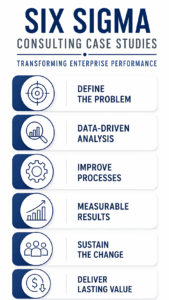
Conclusion: From Inefficiency to Measurable Excellence
These real-world case studies prove one thing clearly:
Transformation is not a concept—it’s a measurable outcome.
With the right Lean Six Sigma consultant, backed by structured methodology and disciplined execution, businesses can move from inconsistent performance to predictable excellence.
And when improvement becomes part of daily work—not a one-time project—that’s when true transformation happens.