
Lean management is not a buzzword in Egypt anymore—it’s a survival mechanism. Egyptian manufacturers and SMEs are operating under intense pressure: rising input costs, currency volatility, productivity gaps, and increasing competition from more efficient regional and global players. Yet many businesses still misunderstand lean as cost-cutting or workforce reduction. That misunderstanding is exactly why lean initiatives fail.
From our experience as lean management consultants in Egypt, lean succeeds only when it is treated as a structured system for operational excellence, not a short-term efficiency drive. When combined with Industry 4.0, smart manufacturing, and digital transformation in manufacturing, lean becomes a powerful engine for sustainable business performance improvement in Egypt.
This article breaks down how lean management actually works in Egyptian businesses—backed by practical, real-world case studies—and how it integrates with industrial automation, IIoT, and manufacturing innovation.
Why Lean Management Matters in the Egyptian Business Context
Egyptian factories face a unique mix of challenges:
- High process variability due to manual operations
- Skill gaps across supervisory and middle-management levels
- Inefficient layouts and long material movement
- Weak data visibility for decision-making
These are classic lean problems—but many companies try to solve them with technology alone. That’s a mistake.
Lean management provides the foundation for:
- Business process improvement
- Cost optimization consulting outcomes
- Scalable smart factory implementation
Without lean discipline, digital tools only automate inefficiency.
Lean Management Meets Industry 4.0 and Smart Manufacturing
Lean and Industry 4.0 are not opposites. In fact, they reinforce each other when implemented correctly.
How Lean Supports Digital Transformation in Manufacturing
Lean defines:
- What should be measured
- Where waste exists
- Which processes deserve automation
Digital transformation consultants who ignore lean principles often deploy dashboards that look impressive but don’t change behavior.
In contrast, lean-driven digital transformation uses:
- IIoT (Industrial Internet of Things) for real-time waste detection
- Smart production boards instead of manual logs
- Predictive maintenance aligned with TPM (Total Productive Maintenance)
This combination is the backbone of a practical smart manufacturing strategy in Egypt.
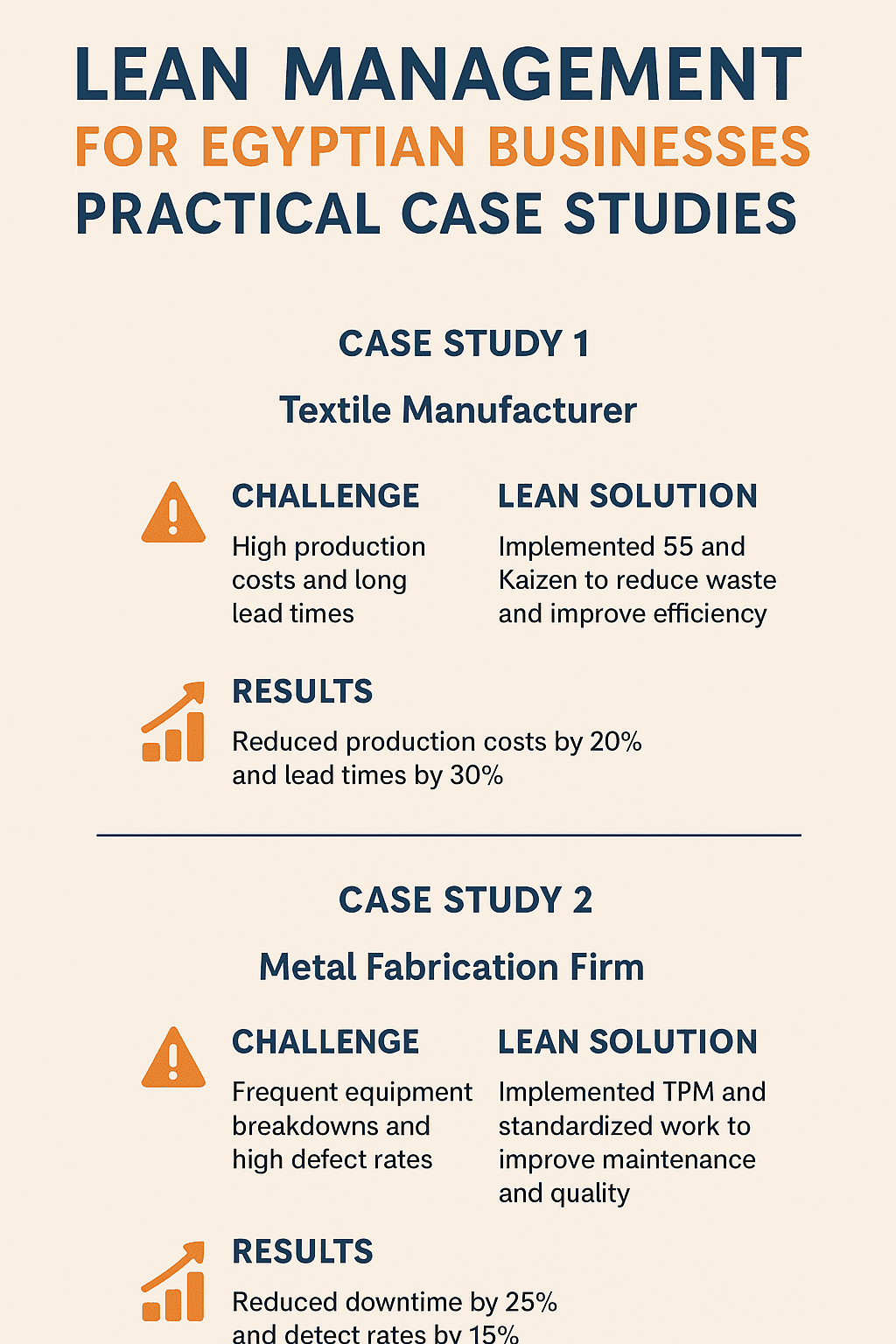
Practical Case Study 1: Lean in a Mid-Sized Egyptian
Manufacturing Plant
The Challenge
A mid-sized FMCG packaging manufacturer in an Egyptian industrial zone faced chronic delivery delays and rising operational costs. Despite stable demand, output per shift was declining.
Key issues identified:
- Excessive changeover times
- No standardized work procedures
- Manual production reporting with 48-hour delays
Lean Intervention
As operational excellence consultants in Egypt, we implemented:
- Value Stream Mapping (VSM)
- SMED (Single-Minute Exchange of Die) principles
- Daily performance management routines
Results
Within 5 months:
- Changeover time reduced by 32%
- Output per shift increased by 18%
- Overtime costs reduced significantly
This improvement created the baseline for future industrial automation investments.
Practical Case Study 2: Lean + IIoT for Factory Performance Improvement
The Challenge
An engineering components manufacturer struggled with unplanned downtime and reactive maintenance. Maintenance costs were rising, but reliability wasn’t improving.
Lean + Digital Solution
Instead of jumping straight into automation, we applied lean first:
- TPM framework to define critical assets
- Downtime categorization and root-cause analysis
- Operator-led maintenance routines
Only then did we introduce IIoT sensors to track:
- Machine runtime
- Vibration and temperature trends
- Micro-stoppages
Results
- Unplanned downtime reduced by 25%
- Maintenance cost stabilized within one year
- Management gained real-time visibility for decisions
This is a textbook example of manufacturing innovation driven by lean thinking.
Practical Case Study 3: Lean Management for Egyptian SMEs
The Challenge
An SME in the food processing sector wanted growth but faced severe cash flow pressure. Inventory levels were high, yet stockouts were frequent.
Lean Approach
Through SME consulting services in Egypt, we implemented:
- Pull-based inventory planning
- Layout redesign to reduce movement
- Visual management for daily control
Results
- Inventory reduced by 20%
- Cash flow improved within one quarter
- Order fulfillment reliability increased
Lean here wasn’t about cutting—it was about freeing trapped capital.
Common Lean Failures in Egyptian Businesses (And Why They Happen)
Let’s be blunt. Lean fails when:
- Leadership delegates it entirely to consultants
- KPIs exist only in presentations
- Middle management is not trained or incentivized
Lean is not a project. It’s an operating system.
This is where organizational development consultants in Egypt play a critical role—aligning structure, skills, and accountability.
The Role of Business Consulting in Lean Transformation
Effective business consulting services in Egypt go beyond tools. They:
- Diagnose root causes, not symptoms
- Customize lean frameworks to local realities
- Integrate lean with business strategy development
As business management consultants in Egypt, we see the biggest gains when lean initiatives are directly linked to growth, not just efficiency.
Lean Management as a Gateway to Smart Factories
Lean prepares factories for:
- Scalable industrial automation
- Data-driven smart factory operations
- Sustainable digital transformation in manufacturing
Without lean maturity, Industry 4.0 investments underperform.
Conclusion: Actionable Takeaways for Egyptian Business Leaders
If you’re serious about competitiveness, here’s the hard truth:
- Lean is not optional—it’s foundational
- Technology amplifies discipline, not chaos
- Start with processes, then automate
- Invest in people, not just machines
- Choose consultants with execution experience
Lean management, when done right, delivers measurable business performance improvement in Egypt and sets the stage for long-term manufacturing innovation.
Frequently Asked Questions (FAQs)
1. What are the biggest productivity challenges in Egyptian manufacturing?
Process variability, manual controls, skill gaps, and lack of real-time data are the most common challenges.
2. Is lean management suitable for SMEs in Egypt?
Yes. In fact, SMEs often benefit faster because lean frees cash, space, and capacity quickly.
3. How does lean support Industry 4.0?
Lean defines what to automate, where to use IIoT, and how to turn data into action.
4. How do I choose the best lean management consultants in Egypt?
Look for on-ground case experience, sector knowledge, and a clear execution roadmap—not theory-heavy pitches.
5. Does lean management mean workforce reduction?
No. Lean focuses on eliminating waste, not people. Productivity gains come from better systems, not layoffs.
Contact us for Lean Management Consulting