Cost reduction in the manufacturing industry requires more than reducing expenses; it requires understanding how processes, resources, and operational decisions influence overall factory performance. For Egyptian manufacturers operating in competitive markets, improving efficiency and controlling costs have become important priorities for maintaining profitability and long-term growth.
Practical examples of manufacturing improvement initiatives help organizations understand how cost optimization works in real operational environments. While every factory has different challenges, common improvement approaches focus on reducing waste, improving productivity, optimizing processes, and strengthening resource utilization.
This article explores manufacturing cost reduction approaches, practical case examples based on recognized improvement methodologies, and how Egyptian manufacturers can apply structured strategies to improve operational efficiency.
Key Takeaways
- Manufacturing cost reduction focuses on improving systems, not only cutting expenses.
- Lean methods, process optimization, and automation can help reduce operational waste.
- Successful improvement projects begin with understanding current performance and cost drivers.
- Sustainable cost reduction requires continuous monitoring and process improvement.
Why Manufacturing Cost Reduction Requires a Structured Approach
Manufacturing costs are influenced by multiple factors across the production system.
These include:
- Material usage
- Labor productivity
- Equipment performance
- Production downtime
- Quality losses
- Inventory efficiency
- Process flow
Because these areas are interconnected, reducing costs requires understanding the relationship between different operational activities.
For example, reducing inventory levels without improving planning processes may create material shortages. Similarly, reducing resources without improving productivity may negatively affect production performance.
This is why effective cost reduction strategies for manufacturing industries in Egypt focus on improving operational systems rather than applying isolated cost-cutting measures.
A structured approach helps manufacturers identify where costs are generated, why inefficiencies occur, and which improvements can create sustainable value.
How Manufacturers Identify Cost Reduction Opportunities
Before implementing improvement actions, manufacturers need to understand their current operational performance.
Analyzing Process Performance
Process analysis helps organizations identify activities that consume resources without creating sufficient value.
Manufacturers may evaluate:
- Production flow
- Cycle times
- Waiting periods
- Material movement
- Equipment utilization
- Quality performance
This analysis provides visibility into where operational improvements can have the greatest impact.
For example, a factory experiencing high production costs may discover that the main issue is not production capacity, but excessive waiting time between process steps or repeated quality corrections.
Identifying Manufacturing Waste
One of the most common approaches to cost improvement is identifying waste within manufacturing processes.
Lean Manufacturing categorizes waste into several areas, including:
- Overproduction
- Waiting time
- Unnecessary transportation
- Excess processing
- Excess inventory
- Unnecessary motion
- Defects
By identifying these sources of waste, manufacturers can improve efficiency without necessarily requiring major capital investments.
This is the foundation of many Lean Manufacturing cost reduction methods used globally.
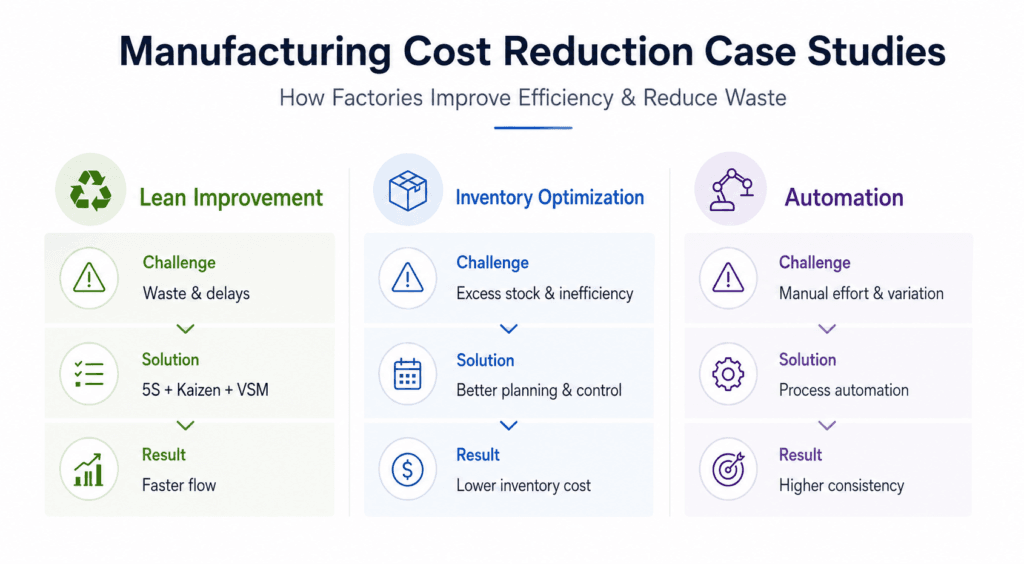
Manufacturing Cost Reduction Example 1: Reducing Waste Through Lean Improvement
The following example illustrates a typical manufacturing improvement scenario based on established Lean principles. It is provided for illustrative purposes and does not represent a specific Egyptian company case study.
A manufacturing facility may experience challenges such as:
- Long production lead times
- Excess movement of materials
- Repeated process delays
- Difficulty identifying bottlenecks
A structured Lean improvement approach may begin with analyzing the production flow using tools such as Value Stream Mapping (VSM).
The objective is to understand:
- Where value is created
- Where delays occur
- Where unnecessary activities exist
Following this analysis, improvement actions may include workplace organization through 5S, clearer standard procedures, and continuous improvement activities through Kaizen.
The expected operational benefits of these approaches include:
- Improved workflow
- Reduced unnecessary movement
- Better workplace organization
- Increased process visibility
The important point is that Lean cost reduction does not focus only on removing activities, it focuses on creating a more efficient manufacturing system.
Manufacturing Cost Reduction Example 2: Improving Inventory and Material Efficiency
Inventory is another important area where manufacturers often identify cost improvement opportunities.
Excess inventory can increase:
- Storage requirements
- Handling activities
- Risk of obsolete materials
- Working capital requirements
On the other hand, insufficient inventory availability can create production interruptions and urgent purchasing requirements.
A common inventory improvement approach involves analyzing:
- Material consumption patterns
- Inventory accuracy
- Stock movement
- Planning practices
Manufacturers may use inventory optimization techniques to create better balance between availability and cost.
Improving inventory efficiency supports manufacturing industry cost optimization in Egypt by helping organizations use working capital more effectively while maintaining production requirements.
Manufacturing Cost Reduction Example 3: Improving Efficiency Through Automation
Automation can also contribute to manufacturing cost reduction when applied to suitable processes.
A typical improvement scenario may involve a repetitive manufacturing activity that creates challenges such as:
- High manual effort
- Process variation
- Quality inconsistencies
- Limited performance visibility
Before introducing automation, manufacturers should analyze the process itself.
This may involve:
- Understanding current workflow
- Identifying inefficiencies
- Evaluating improvement opportunities
Automation can then support better performance by improving consistency, reducing repetitive effort, and increasing operational visibility.
However, technology alone does not guarantee cost reduction.
The greatest benefits usually occur when automation supports a well-designed process.
This connection between process improvement and technology is an important part of industrial cost reduction solutions in Egypt.
Lessons From Manufacturing Cost Reduction Projects
Although every manufacturing environment is different, successful improvement projects often share several common principles.
Cost Reduction Starts With Data
Manufacturers need accurate information before making improvement decisions.
Useful performance indicators may include:
- Production efficiency
- Downtime levels
- Quality performance
- Inventory performance
- Resource utilization
Data helps organizations identify actual improvement opportunities rather than relying on assumptions.
Process Improvement Should Come Before Technology
Technology can improve processes, but it cannot replace process understanding. Before investing in automation or digital solutions, manufacturers should evaluate whether existing workflows are efficient.
Improving processes first often helps organizations identify where technology can create the greatest value.
Continuous Improvement Creates Sustainable Results
Cost reduction is not a one-time activity.
Manufacturing environments continue to change due to:
- Customer requirements
- Production volumes
- Market conditions
- Supply chain factors
A continuous improvement culture helps organizations maintain efficiency improvements over time.
Practices such as Kaizen encourage teams to identify small improvements regularly rather than relying only on large improvement projects.
The Role of Manufacturing Cost Reduction Consulting in Egypt
Manufacturing cost reduction consulting for Egypt supports organizations by providing structured approaches for identifying inefficiencies and improving operational performance.
A consulting approach typically focuses on:
- Assessing current processes
- Understanding cost drivers
- Identifying improvement opportunities
- Prioritizing actions based on operational impact
The objective is to help manufacturers develop practical improvement plans aligned with their specific requirements.
Effective consulting focuses on building sustainable capabilities rather than temporary cost reductions.
Step-by-Step Cost Reduction Approach for Egyptian Factories
Step 1: Understand Current Cost Drivers
The first step is identifying where manufacturing costs originate. This includes analyzing:
- Production processes
- Resource usage
- Waste sources
- Operational inefficiencies
Step 2: Identify Improvement Opportunities
After understanding current performance, manufacturers can prioritize areas with the greatest potential impact. Common focus areas include:
- Process flow
- Waste reduction
- Productivity improvement
- Inventory efficiency
- Quality improvement
Step 3: Implement Improvement Actions
Improvement actions should be practical and measurable. Depending on the situation, this may involve:
- Lean methods
- Process optimization
- Workflow improvements
- Automation opportunities
Step 4: Monitor and Sustain Improvements
Long-term cost reduction requires ongoing measurement. Manufacturers should monitor whether improvements are creating the expected operational benefits and adjust processes when required.
Benefits of Manufacturing Cost Optimization
Effective cost optimization can support manufacturers in several ways.
Improved Operational Efficiency
Better processes reduce unnecessary effort and improve resource utilization.
Stronger Competitiveness
Lower operational costs can help manufacturers improve market competitiveness.
Better Decision-Making
Improved visibility enables managers to make more informed operational decisions.
Sustainable Growth
Efficient manufacturing systems create a stronger foundation for future expansion.
Conclusion
Cost reduction in the manufacturing industry is achieved through improving processes, reducing waste, and making better use of available resources. While cost-cutting measures may provide temporary results, sustainable improvement requires a structured approach focused on operational efficiency.
For Egyptian manufacturers, Lean Manufacturing, process optimization, and targeted automation provide practical pathways for improving performance and controlling costs.
Manufacturing cost reduction is not about doing less, it is about creating smarter, more efficient systems that allow factories to produce better results with fewer unnecessary losses.
Frequently Asked Questions (FAQs)
How does cost reduction in the manufacturing industry work in Egypt?
Cost reduction in the manufacturing industry works by identifying operational inefficiencies, analyzing cost drivers, and implementing improvement strategies that reduce waste while maintaining production performance. Manufacturers often use Lean principles, process optimization, and efficiency improvement methods.
What are the best cost reduction strategies for manufacturing companies in Egypt?
The best strategies depend on each factory’s challenges but commonly include Lean Manufacturing, waste reduction, process improvement, productivity improvement, inventory optimization, and targeted automation.
What is the role of manufacturing cost reduction consulting in Egypt?
Manufacturing cost reduction consulting helps organizations analyze operations, identify improvement opportunities, and develop structured plans to improve efficiency and reduce unnecessary costs.
How can Lean Manufacturing reduce manufacturing costs?
Lean Manufacturing reduces costs by identifying and eliminating activities that do not add customer value. It helps manufacturers improve workflow, reduce waste, increase productivity, and create more efficient processes.
Are manufacturing cost reduction improvements permanent?
Cost reduction improvements can be sustained when organizations establish continuous improvement practices, monitor performance, and maintain standardized processes.