Manufacturing organizations across Egypt are transforming their shop floors to stay competitive in an evolving regional market. Building long-term market leadership requires moving beyond temporary fixes to adopt structured operational methodologies. Factory managers and operations leaders rely on proven frameworks to lower conversion costs, eliminate material waste, and increase machine output.
Understanding productivity improvement methods used in manufacturing helps Egypt’s industrial enterprises select the right tools for their specific site conditions. Combining structured Lean practices, Total Productive Maintenance (TPM), and scientific work measurement creates predictable operations across multi-shift facilities.
Foundational Operational Methodologies Deployed in Egypt
Modern factory management relies on established systems to convert operational waste into measurable capacity. Deploying these methods systematically prevents shift-to-shift quality variations and lowers operating costs.
1. The Lean Manufacturing Framework and Waste Elimination
At the center of modern manufacturing productivity optimization strategies is Lean manufacturing. Lean focuses on identifying and systematically eliminating non-value-added activities (known as Muda) across the entire production chain.
Factories deployment of Lean methods typically begins with core practices:
- Value Stream Mapping (VSM): Detailed process mapping that traces the physical flow of material and operational information from supplier intake to final shipment. This reveals throughput bottlenecks, queue delays, and hidden floor inventory.
- 5S Workplace Organization: A structured system incorporating Sort, Set in Order, Shine, Standardize, and Sustain. 5S cleans and organizes production zones, reducing material search times and establishing visual control.
- Kaizen Cycles: Small, continuous improvement projects driven by cross-functional floor teams to address localized process issues.
2. Total Productive Maintenance (TPM) for Machine Reliability
Unplanned equipment downtime directly reduces operating margins. Manufacturing plants across Egypt use Total Productive Maintenance (TPM) to maximize asset reliability and track Overall Equipment Effectiveness (OEE):
TPM engages operators directly in machine care through autonomous maintenance. Training operators to perform basic inspections, routine lubrication, and daily cleanings prevents minor defects from turning into major mechanical failures.
This proactive approach shifts factory culture from reactive fixing to planned preventive maintenance.
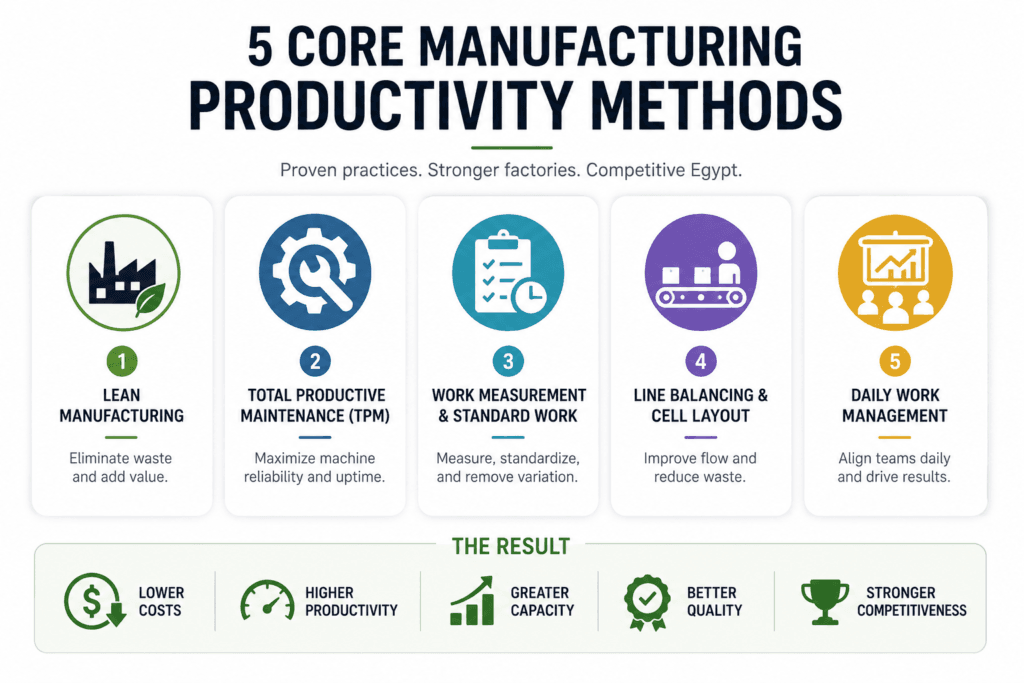
3. Work Measurement, Time and Motion Studies, and Standardized Work
Achieving reliable industrial workforce productivity enhancement requires scientific work measurement. Standardized work prevents reliance on individual operator habits, ensuring consistent cycle times regardless of shift changes.
Industrial engineers use Time and Motion Studies to analyze manual operations:
| Measurement Phase | Core Objective | Typical Operational Outcome |
| Method Study | Analyze physical movements and workstation ergonomics. | Eliminates excessive bending, lifting, and unnecessary transit motion. |
| Time Study | Measure individual task element times under standard operating conditions (SOPs). | Establishes realistic baseline capacity standards and line targets. |
| Standard Work Creation | Document optimal task sequences, Takt times, and in-process stock requirements. | Reduces output variation and simplifies cross-training for new operators. |
Line Balancing and Factory Layout Optimization
Equipment and labor perform best when production lines maintain continuous material movement. Material handling delays and uneven workload distribution often limit shop-floor efficiency.
Transitioning to Cellular Manufacturing and U-Shaped Lines
Traditional layouts group similar machinery in isolated departments, forcing materials to travel long distances between operations. Modern factory productivity improvement programs in Egypt favor cellular manufacturing layouts.
Arranging machines and workstations in dedicated U-shaped production cells matching the processing sequence offers key operational benefits:
- Significantly cuts internal material handling and transport distances.
- Improves line balancing, allowing operators to assist adjacent workstations during line surges.
- Enables single-piece flow, lowering work-in-process (WIP) inventory and exposing quality issues immediately.
The Role of Daily Work Management and Visual Governance
Methodologies only deliver long-term results when supported by daily shop-floor governance. A structured Daily Work Management (DWM) system connects broad leadership goals to daily execution on the factory floor.
Tiered Review Structures and Escalation Protocols
To keep daily operations aligned, plants introduce structured, brief stand-up meetings across management levels:
- Tier 1 (Shift Handover / Cell Level): Line operators and supervisors review safety metrics, output versus target, and hourly machine downtime.
- Tier 2 (Department Level): Department heads review inter-departmental bottlenecks, quality variations, and open maintenance tickets.
- Tier 3 (Plant Leadership Level): Executive teams track overall operational KPIs, resource allocation, and continuous improvement project timelines.
Visual management boards, hourly production counters, and standardized downtime logs support this tiered structure. Making process deviations visible immediately helps teams resolve small issues before they impact customer deliveries.
Engaging Productivity Improvement Consulting for Manufacturing Industry in Egypt
Implementing these operational methodologies across complex production sites requires specialized experience and execution focus. Partnering with experienced productivity improvement consulting professionals for Egypt’s manufacturing industry accelerates transformation initiatives while training internal teams.
External specialists support operational transformations by:
- Conducting rigorous plant diagnostics to quantify hidden losses across material, machine, and labor flows.
- Designing customized Lean, Six Sigma, and TPM implementation roadmaps tailored to facility requirements.
- Providing hands-on coaching on the shop floor to establish standard work routines and daily management discipline.
- Auditing process adherence to ensure continuous improvement practices remain active over time.
Implementation Roadmap for Manufacturing Efficiency Improvement in Egypt
To successfully implement these methodologies, plant leadership should follow a clear execution sequence.
Phase 1: Operational Diagnostic and Loss Mapping
Start with a detailed diagnostic audit across all operational areas. Map end-to-end value streams, evaluate historical equipment failure logs, and perform initial work measurement studies to identify key constraints.
Phase 2: Pilot Implementation and Workplace Standardization
Select a representative production line or bottleneck operation as a pilot area. Roll out 5S organization, introduce initial visual management tools, and implement basic autonomous maintenance checks. Refine standard operating routines based on feedback from floor operators.
Phase 3: Plant-Wide Rollout and Daily Management Institutionalization
Expand proven methods across all production areas. Institutionalize tiered daily review meetings, implement formal time-study benchmarks, and train supervisory staff in root-cause problem-solving to sustain gains.
Frequently Asked Questions
What drives productivity improvement in manufacturing in Egypt?
Productivity improvement is driven by deploying structured Lean manufacturing tools, Total Productive Maintenance (TPM), visual daily management, cellular line layouts, and scientific Time and Motion Studies. Combining process standardization with operator capability development delivers reliable output gains.
How can productivity improvement in manufacturing help Egypt?
Adopting structured manufacturing improvement methods increases operational efficiency, cuts raw material waste, and maximizes production capacity within existing plants. This lowers total conversion costs, helping manufacturers maintain high quality standards and compete effectively in regional and global markets.
Why is productivity improvement in manufacturing important in Egypt?
Improving plant productivity is essential for protecting operating margins against rising material costs, managing operational bottlenecks, and ensuring on-time delivery. It allows industrial operations to optimize asset utilization and scale production without requiring massive capital investments.
When should factories focus on productivity improvement in Egypt?
Factories should implement productivity improvement programs when facing operational challenges such as low equipment utilization, high scrap rates, unbalanced line throughput, rising unit production costs, or delayed customer shipments. Performing a diagnostic audit helps identify target areas for maximum return.