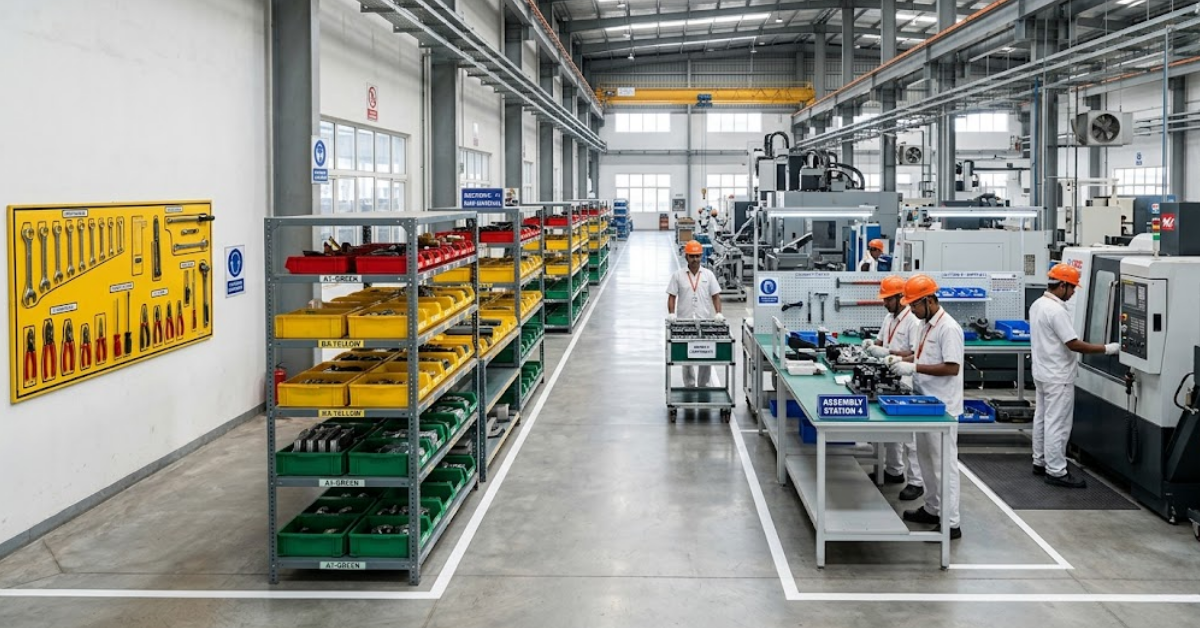
Operational efficiency is no longer a back-end improvement project. In 2026, it has become a boardroom priority.
Across industries, companies are shifting from short-term cost cutting to structured operational optimization. The goal? Sustainable growth, stronger margins, and resilient business operations efficiency.
At Faber Infinite Consulting, we’ve worked with manufacturers, logistics firms, and FMCG players across 40+ industries. One pattern is clear: companies that systematically improve operational efficiency outperform competitors in profitability, scalability, and decision speed.
This blog explores the major operational efficiency trends in 2026, backed by research, real-world experience, and expert frameworks.
Why Operational Efficiency Matters More in 2026
According to McKinsey & Company, productivity gains can increase operating margins by 5–15% in manufacturing when supported by structured process improvement programs.
Meanwhile, World Economic Forum reports that digitally mature organizations show up to 30% higher operational resilience compared to peers.
In 2026, rising wage costs, volatile supply chains, and digital disruption have made efficiency in operations a survival metric—not just a performance metric.
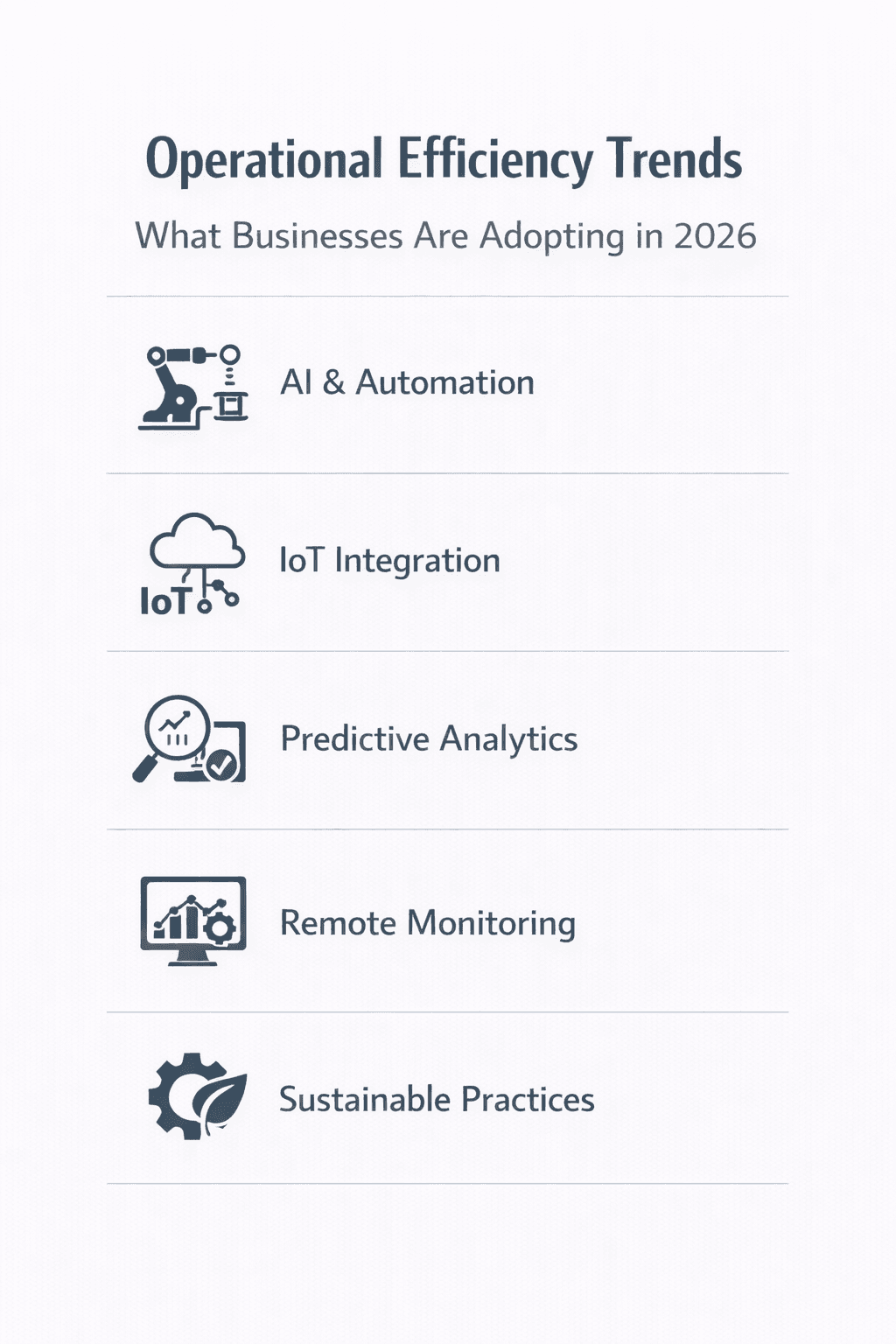
Top Operational Efficiency Trends in 2026
Below is a structured overview of what leading organizations are adopting.
| Trend | What It Means | Why It Matters | Real-World Insight | Business Impact |
| 1. Data-Driven Operational Optimization | Real-time KPI tracking & analytics | Faster decisions, reduced downtime | We helped a plant reduce idle time by 18% by identifying hidden bottlenecks through structured KPI dashboards | Higher throughput, lower waste |
| 2. Lean Management Reinvented | Modern lean integrated with digital tools | Eliminates process waste systematically | Applying Kaizen methodology in a packaging unit cut material movement distance by 32% | Improved cost efficiency |
| 3. Automation with ROI Discipline | Targeted automation, not blind digitization | Avoids overinvestment | Automation improved cycle time by 22% when applied only to high-frequency processes | Measurable productivity improvement |
| 4. Supply Chain Efficiency Focus | End-to-end visibility & flow alignment | Reduces working capital stress | Layout redesign aligned with supply flow reduced WIP inventory by 27% | Better cash flow |
| 5. Workforce Productivity Engineering | Structured time & motion studies | Maximizes manpower output | Manpower productivity improved 15% after role rebalancing | Stronger organizational efficiency |
| 6. Energy & Cost Efficiency Integration | Energy use tied to operational KPIs | Reduces hidden costs | Energy audits reduced per-unit power cost by 9% | Sustainable cost reduction |
- Data-Driven Operational Optimization
Companies are moving beyond dashboards to predictive performance systems.
Instead of asking “What went wrong?”, leaders now ask:
- Which parameter predicts downtime?
- What threshold signals performance decline?
According to Deloitte, advanced analytics in manufacturing can improve asset utilization by up to 20%.
Experience Insight:
In one FMCG facility, our team identified that micro-stoppages—ignored for years—were costing 11% capacity loss. Structured monitoring improved operational excellence within three months.
- Lean Management, Reimagined for 2026
Lean management is not new. But its application is evolving.
Modern process efficiency improvement combines:
- Kaizen methodology
- Digital monitoring
- Flow-based factory layouts
- Structured daily management systems
Research from Boston Consulting Group suggests lean-led transformations can reduce conversion costs by 15–25%.
What’s different in 2026?
- Lean is integrated with automation.
- Decisions are data-backed.
- Continuous improvement culture is measurable.
- Automation with Strategic Precision
The impact of automation on operational performance is significant—but only when applied correctly.
Blind automation often increases complexity and capital burden.
Smart organizations focus on:
- High-frequency repetitive tasks
- Safety-risk operations
- Bottleneck areas
According to International Federation of Robotics, global industrial robot installations continue to grow annually, reflecting automation’s increasing role in operational optimization.
Case Example:
In a precision manufacturing unit, automating only the final inspection stage reduced defect escape rate by 40%—without automating the entire line.
- Supply Chain Efficiency as a Competitive Advantage
Post-pandemic volatility reshaped priorities. Now, supply chain efficiency directly influences profitability.
Businesses are:
- Reducing supplier complexity
- Improving layout-to-flow alignment
- Digitizing inventory tracking
According to Gartner, organizations with advanced supply chain visibility experience 2x faster disruption recovery.
At Faber Infinite Consulting, aligning factory layout with material flow often delivers immediate operational excellence improvements without heavy capital investment.
- Workforce Productivity Engineering
Manpower cost remains a major component of operating expenses.
Companies are investing in:
- Time & motion studies
- Role clarity frameworks
- Performance-linked productivity metrics
Real Experience:
A packaging company improved manpower productivity by 15% after redistributing responsibilities and eliminating redundant approvals.
This is not about layoffs—it’s about business process optimization.
- Cost Reduction Through Operational Efficiency Strategies
In 2026, cost efficiency is no longer achieved by cutting budgets—it is achieved by redesigning systems.
Effective strategies include:
- Layout optimization
- Setup time reduction
- Inventory rationalization
- Energy monitoring systems
According to PwC, companies that adopt structured operational efficiency strategies achieve sustainable margin expansion compared to reactive cost cutting.
How to Improve Operational Efficiency in a Business
Below is a structured roadmap:
| Step | Action | Expected Outcome |
| 1 | Map current processes | Identify bottlenecks |
| 2 | Measure KPIs | Quantify performance gaps |
| 3 | Apply lean techniques | Reduce waste |
| 4 | Introduce selective automation | Improve cycle time |
| 5 | Align workforce roles | Boost productivity |
| 6 | Monitor continuously | Sustain gains |
Operational Efficiency Strategies for Manufacturing Companies
Manufacturers in 2026 focus on:
- Flow-driven layout design
- Lean techniques to increase operational efficiency
- Real-time performance visibility
- Cross-functional accountability
- Continuous process improvement culture
At Faber Infinite Consulting, our 15-step framework integrates lean management, workforce productivity engineering, and operational optimization to deliver measurable results.
Conclusion: The 2026 Competitive Divider
Operational efficiency is not a project. It is a leadership discipline.
Businesses that:
- Measure deeply
- Optimize structurally
- Automate intelligently
- Improve continuously
will lead their markets.
Actionable Takeaways:
- Start with data—not assumptions.
- Measure your biggest capacity losses.
- Redesign flow before buying technology.
- Align manpower to value creation.
- Commit to continuous operational excellence.
If you’re looking to improve operational efficiency in your organization, structured intervention—not isolated initiatives—is the 2026 advantage.
FAQs
- How to improve operational efficiency in a business?
Start by mapping processes, identifying bottlenecks, applying lean management, and introducing targeted automation supported by measurable KPIs.
- What are lean techniques to increase operational efficiency?
Value stream mapping, Kaizen methodology, 5S implementation, setup time reduction, and flow optimization are proven lean approaches.
- What is the impact of automation on operational performance?
When strategically applied, automation can improve cycle time, reduce defects, and increase productivity without unnecessary capital expenditure.
- How does operational efficiency reduce costs?
It eliminates waste, reduces idle time, improves workforce productivity, and optimizes resource utilization—leading to sustainable cost efficiency.
- What are operational efficiency strategies for manufacturing companies?
Layout redesign, manpower productivity engineering, supply chain optimization, and structured KPI monitoring are key strategies.