
“Six Sigma” is often spoken about in boardrooms, but rarely understood on the shop floor. In 2026, the role of a Six Sigma Consultant in India has evolved far beyond statistical tools and certification jargon. Today, it sits at the intersection of data, technology, and human behavior—driving measurable business transformation.
At Faber Infinite Consulting, we’ve seen firsthand how organizations move from firefighting daily inefficiencies to building systems that prevent problems altogether. The difference? A well-executed Lean Six Sigma consulting approach that focuses not just on improvement—but on sustainability.
What Does a Six Sigma Consultant Actually Do?
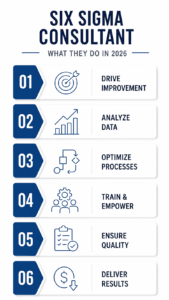
At its core, a Six Sigma Consultant helps organizations reduce variation, eliminate waste, and improve process efficiency using structured methodologies like DMAIC (Define, Measure, Analyze, Improve, Control).
But in 2026, the role has expanded into five key dimensions:
-
Diagnosing Process Inefficiencies
A Lean Six Sigma Consultant begins by identifying hidden inefficiencies across operations—whether in manufacturing lines, supply chains, or service workflows.
-
Applying Structured Methodologies (DMAIC)
The backbone of Six Sigma consulting services remains the DMAIC methodology, which ensures problem-solving is data-driven—not assumption-based.
Example Framework:
- Define: Identify the problem and business impact
- Measure: Collect baseline data
- Analyze: Find root causes using tools like Fishbone Diagram & Pareto Analysis
- Improve: Implement targeted solutions
- Control: Sustain results with monitoring systems
This structured approach differentiates Six Sigma from traditional consulting—it’s not just advice; it’s execution with accountability.
-
Driving Cost Reduction and Efficiency
One of the most searched queries today is:
“How Six Sigma Lean consulting reduces operational cost”
Here’s the reality:
- Reduces defects → lowers rework cost
- Improves cycle time → increases throughput
- Optimizes resources → reduces waste
This is why process excellence consulting is no longer optional—it’s a competitive necessity.
-
Enabling Continuous Improvement Culture
A major shift in 2026 is the focus on people, not just processes.
A Six Sigma Consultant:
- Trains teams on Kaizen implementation
- Builds internal problem-solving capability
- Creates a culture of continuous improvement
Insight:
Companies that sustain Six Sigma results are not the ones with the best tools—they are the ones with the most engaged teams.
-
Integrating Technology with Lean Thinking
Modern Six Sigma Consultants now work with:
- Real-time dashboards
- AI-driven predictive analytics
However, technology alone doesn’t solve inefficiency. Consultants ensure that digital tools align with process logic, not complicate it.
Six Sigma Consultant vs Traditional Management Consultant
This is a critical distinction businesses often miss.
| Aspect | Six Sigma Consultant | Traditional Management Consultant |
| Approach | Data-driven, process-focused | Strategy-driven |
| Execution | Hands-on implementation | Advisory-heavy |
| Tools | DMAIC, Lean tools | Market analysis, frameworks |
| Outcome | Measurable operational gains | Strategic direction |
Bottom Line:
A Six Sigma consultant in India doesn’t just tell you what to do—they work with your teams to make it happen.
The Growing Demand for Six Sigma Consulting in India
India’s manufacturing and service sectors are rapidly evolving with:
- Global competition
- Cost pressures
- Demand for quality consistency
According to industry reports (e.g., ASQ – American Society for Quality and McKinsey insights on operational excellence):
- Companies adopting Lean Six Sigma see 20–30% efficiency gains
- Defect reduction can exceed 50% in optimized processes
This has fueled demand for:
- Lean Six Sigma Consultant roles
- Business Transformation Consulting
- Operational excellence experts
Case Studies: Lean Six Sigma in Indian Manufacturing
Case 1: Textile Manufacturing Unit
Problem: High rejection rates due to inconsistent dyeing
Solution: DMAIC-based root cause analysis
Result:
- Defects reduced by 35%
- Customer complaints dropped significantly
Case 2: FMCG Supply Chain Optimization
Problem: Delayed dispatch and inventory pile-up
Solution: Value Stream Mapping + Kaizen
Result:
- Lead time reduced by 28%
- Inventory carrying cost reduced
These examples highlight how process improvement methodology delivers real, measurable outcomes.
Key Skills of a Modern Six Sigma Consultant (2026)
A successful Lean Six Sigma Consultant today combines:
Technical Skills
- Statistical analysis
- Process mapping
- Root cause analysis
Business Skills
- Financial impact assessment
- Stakeholder management
- Change leadership
Digital Skills
- Data visualization tools
- Automation integration
- AI-based insights
Why Businesses Choose Faber Infinite Consulting
At Faber Infinite Consulting, our approach to Six Sigma consulting services goes beyond frameworks:
- Hands-on execution, not just strategy
- Industry-specific expertise across 40+ sectors
- Focus on sustainable operational excellence
- Strong emphasis on people development and culture
We don’t just improve processes—we build systems that continue improving long after the engagement ends.
Conclusion: The Real Value of a Six Sigma Consultant
In 2026, a Six Sigma Consultant is not just a problem-solver—they are a transformation partner.
They:
- Turn data into decisions
- Convert inefficiencies into opportunities
- Build cultures that sustain growth
Actionable Takeaways:
- Start with one high-impact process—don’t try to fix everything at once
- Focus on root causes, not symptoms
- Invest in team capability alongside tools
- Measure everything—what gets measured improves
If your business is still relying on reactive problem-solving, it’s time to rethink your approach.
FAQs
-
What does a Six Sigma consultant do in simple terms?
A Six Sigma consultant identifies inefficiencies, reduces defects, and improves processes using data-driven methods like DMAIC.
-
How is a Lean Six Sigma Consultant different from a regular consultant?
They focus on execution and measurable results, not just strategy or recommendations.
-
Is Six Sigma still relevant in 2026?
Yes—more than ever. With increasing competition and cost pressure, businesses rely on Six Sigma for efficiency and quality improvement.
-
How long does it take to see results from Six Sigma consulting?
Initial improvements can be seen within 3–6 months, depending on the project scope.
-
Which industries benefit most from Six Sigma consulting services?
Manufacturing, FMCG, logistics, healthcare, and service industries see significant gains from Lean Six Sigma implementation.
Start Your Six Sigma Journey