Most businesses chase ROI through sales, pricing, or expansion. But seasoned consultants know the truth—real ROI is built on the shop floor.
Machines that stop unexpectedly, operators waiting for instructions, quality defects, and inefficient processes silently drain profits every day. This is where Total Productive Maintenance Consulting and structured frameworks like TPM (Total Productive Maintenance) step in.
At Faber Infinite Consulting, we’ve seen firsthand how applying the 8 Pillars of TPM transforms operations from reactive firefighting to predictable, high-performing systems. This blog breaks down these pillars into actionable insights that directly impact ROI.
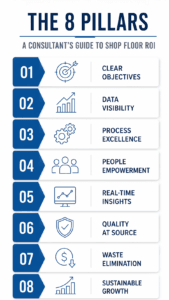
What Are the 8 Pillars of TPM? (Quick View)
| Pillar | Focus Area | ROI Impact |
| Autonomous Maintenance | Operator-led maintenance | Reduced downtime |
| Planned Maintenance | Preventive strategies | Cost control |
| Quality Maintenance | Defect prevention | Lower rework |
| Focused Improvement | Loss elimination | Productivity boost |
| Early Equipment Management | Design efficiency | Faster ROI on assets |
| Training & Education | Skill building | Higher efficiency |
| Safety, Health & Environment | Risk reduction | Compliance & savings |
| Office TPM | Administrative efficiency | End-to-end optimization |
-
Autonomous Maintenance: Ownership at the Source
What it means
Operators take responsibility for basic maintenance—cleaning, inspection, lubrication.
Real Insight
In one FMCG plant we worked with, operators initially resisted this shift. Within 3 months, minor stoppages dropped by 28% because issues were caught early.
ROI Outcome
- Reduced dependency on maintenance teams
- Faster issue resolution
- Increased machine uptime
-
Planned Maintenance: From Reactive to Predictive
What it means
Scheduling maintenance based on data rather than breakdowns.
Industry Insight
According to industry benchmarks (like JIPM TPM guidelines), planned maintenance can reduce breakdowns by up to 50%.
ROI Outcome
- Lower emergency repair costs
- Extended equipment life
- Better production planning
-
Quality Maintenance: Right First Time
What it means
Focus on preventing defects rather than detecting them later.
Case Example
A packaging client reduced rejection rates from 6.5% to 2.1% by identifying root causes at the machine level.
ROI Outcome
- Lower material wastage
- Improved customer satisfaction
- Reduced inspection costs
-
Focused Improvement (Kaizen): Small Changes, Big Gains
What it means
Cross-functional teams identify and eliminate losses.
Real Experience
In a textile unit, a simple change in material flow reduced idle time by 18%, without any capital investment.
ROI Outcome
- Continuous productivity improvement
- Employee engagement
- Quick wins without heavy investment
-
Early Equipment Management: Design for Performance
What it means
Incorporating maintenance learnings into new equipment design.
Expert Insight
Companies that integrate TPM early see 30–40% faster stabilization of new machines.
ROI Outcome
- Reduced startup losses
- Lower lifecycle costs
- Faster return on capital investment
-
Training & Education: Building Capability
What it means
Upskilling employees across functions.
Ground Reality
A common issue we see is “skill dependency”—only one person knows how to fix a machine. Training eliminates this bottleneck.
ROI Outcome
- Reduced human errors
- Improved flexibility
- Higher productivity per employee
-
Safety, Health & Environment: Protection Drives Profit
What it means
Creating a safe and compliant workplace.
Data Insight
According to global safety studies, unsafe workplaces can increase operational costs by 15–20% due to disruptions and liabilities.
ROI Outcome
- Fewer accidents
- Lower legal and compliance costs
- Improved workforce morale
-
Office TPM: Extending Efficiency Beyond the Floor
What it means
Applying TPM principles to administrative functions.
Example
Reducing procurement delays improved production continuity in one plant by 12%.
ROI Outcome
- Faster decision-making
- Reduced administrative waste
- Better coordination across departments
How TPM Improves Overall Equipment Effectiveness (OEE)
Overall Equipment Effectiveness (OEE) is the ultimate KPI for shop floor ROI.
TPM impacts all three OEE components:
| OEE Component | TPM Impact |
| Availability | Reduced breakdowns |
| Performance | Optimized speed |
| Quality | Fewer defects |
Result: Higher output without additional investment.
Integrating Lean and TPM for Operational Excellence
The most successful Manufacturing Excellence Strategies combine Lean and TPM:
- Lean removes process waste
- TPM ensures machine reliability
Together, they create a system where:
- Machines run efficiently
- Processes flow smoothly
- People work proactively
This integration is a core part of Operational Excellence Consulting.
Role of Management in TPM Success
TPM is not just a shop floor initiative—it’s a leadership commitment.
What works in reality:
- Clear KPIs linked to ROI
- Regular reviews by leadership
- Investment in training and systems
Without management involvement, TPM becomes a checklist—not a transformation.
Common Challenges in TPM Implementation
| Challenge | Reality | Solution |
| Resistance to change | Operators see extra work | Build ownership gradually |
| Lack of data | Decisions based on assumptions | Implement tracking systems |
| Inconsistent follow-up | Initial enthusiasm fades | Structured review system |
Why TPM Consulting Matters
Implementing TPM internally often fails due to lack of structure and experience.
TPM Consultants bring:
- Proven frameworks
- Industry benchmarks
- Faster implementation cycles
This is where TPM Consulting Services India play a critical role in accelerating results.
Actionable Takeaways
- Start with a pilot area, not the entire plant
- Track OEE as a core KPI
- Focus on behavior change, not just tools
- Integrate TPM with Lean practices
- Ensure top management involvement
Conclusion: ROI Is Built, Not Bought
The 8 pillars of TPM are not theoretical concepts—they are practical levers that directly impact profitability.
From reducing downtime to improving quality and building workforce capability, TPM creates a system where efficiency becomes a habit.
At Faber Infinite Consulting, we’ve seen businesses transform not by adding resources, but by optimizing what they already have.
FAQs
-
What are the benefits of Total Productive Maintenance in India?
TPM helps Indian manufacturers reduce downtime, improve OEE, lower costs, and enhance workforce productivity—leading to better global competitiveness.
-
How does TPM consulting improve manufacturing OEE?
TPM consulting focuses on reducing losses across availability, performance, and quality—directly improving OEE through structured implementation.
-
What are the best strategies for reducing machine downtime in plants?
Key strategies include planned maintenance, autonomous maintenance, real-time monitoring, and root cause analysis.
-
How can Lean and TPM be integrated for operational excellence?
Lean removes process inefficiencies, while TPM ensures equipment reliability—together creating a high-performance manufacturing system.
-
What is the role of management in Total Productive Maintenance?
Management drives TPM success by setting goals, allocating resources, and ensuring consistent execution across all levels.
Start Your TPM ROI Journey