
As a dedicated business management consultant focusing on the East African industrial landscape, I have observed that the manufacturing sector in Kenya is standing at a critical crossroads. With the Manufacturing sector now identified as a primary driver of automation, accounting for nearly 19% of digital transformation efforts according to recent 2026 economic data, the pressure to modernize is no longer theoretical. It is a survival imperative.
To thrive in this environment, industrial leaders must look beyond just buying new machinery; they must rethink the very bones of their operations: the layout.
Is your factory layout design Kenya-ready for the demands of 2026?
The foundation of any high-performing industrial unit is its plant layout. In Kenya’s current economic climate, where the manufacturing sector is projected to grow at 4.9%, a poorly conceived layout acts as a silent tax on your profits. Factory layout design in Kenya is increasingly focusing on the transition from traditional, “siloed” departments to integrated, flow-based systems.
Research indicates that strategic layout decisions can influence up to 30% of a factory’s total operational costs. When we analyze modern industrial facilities, those that prioritize a seamless flow of materials, from raw receipt to final dispatch, typically see a 42% increase in productivity. This is achieved by ensuring that every square meter is productive, flexible, and capable of supporting future scalability without requiring a total overhaul.
Why are factory planning consultants in Kenya becoming essential for sustainable growth?
The complexity of setting up or optimizing a facility in hubs like Nairobi, Mombasa, or Thika often requires specialized expertise. Factory planning consultants in Kenya provide the technical bridge between a visionary business goal and a functioning, profitable floor. Consultants specialize in more than just drawing blueprints; they conduct deep-dive time-motion studies and capacity planning to uncover hidden inefficiencies.
By engaging experts in the field, local manufacturers can move from reactive troubleshooting to proactive excellence. For instance, recent implementations of specialized facility design have helped regional players achieve:
- 36% reduction in production time by eliminating redundant movement.
- 34% lower inventory holding costs through the integration of FIFO-based storage systems.
- 20% improvement in manpower efficiency by aligning human effort with machine cycles.
Can industrial planning consultants in Kenya help you navigate the Industry 4.0 transition?
As Kenya positions itself as a regional technology hub, the “Smart Factory” is no longer a luxury. Industrial planning consultants in Kenya are now integrating Digital Twin technology and IoT sensors directly into the initial planning stages. Industry 4.0 isn’t just about robots; it’s about data-driven transparency.
When a facility is designed with “smart” intentions, the layout becomes a living organism. Data-driven visual management allows supervisors to see bottlenecks in real-time. By integrating automation and process digitization, firms can achieve a 28% increase in throughput, ensuring they can meet the rising demand of the East African Community (EAC) markets with precision and speed.
What makes a smart factory layout in Kenya the gold standard for modern manufacturing?
A smart factory layout in Kenya isn’t just about high-tech gadgets; it’s about the intelligent arrangement of resources. In a smart environment, the physical distance between high-interaction workstations is minimized through Systematic Layout Planning (SLP).
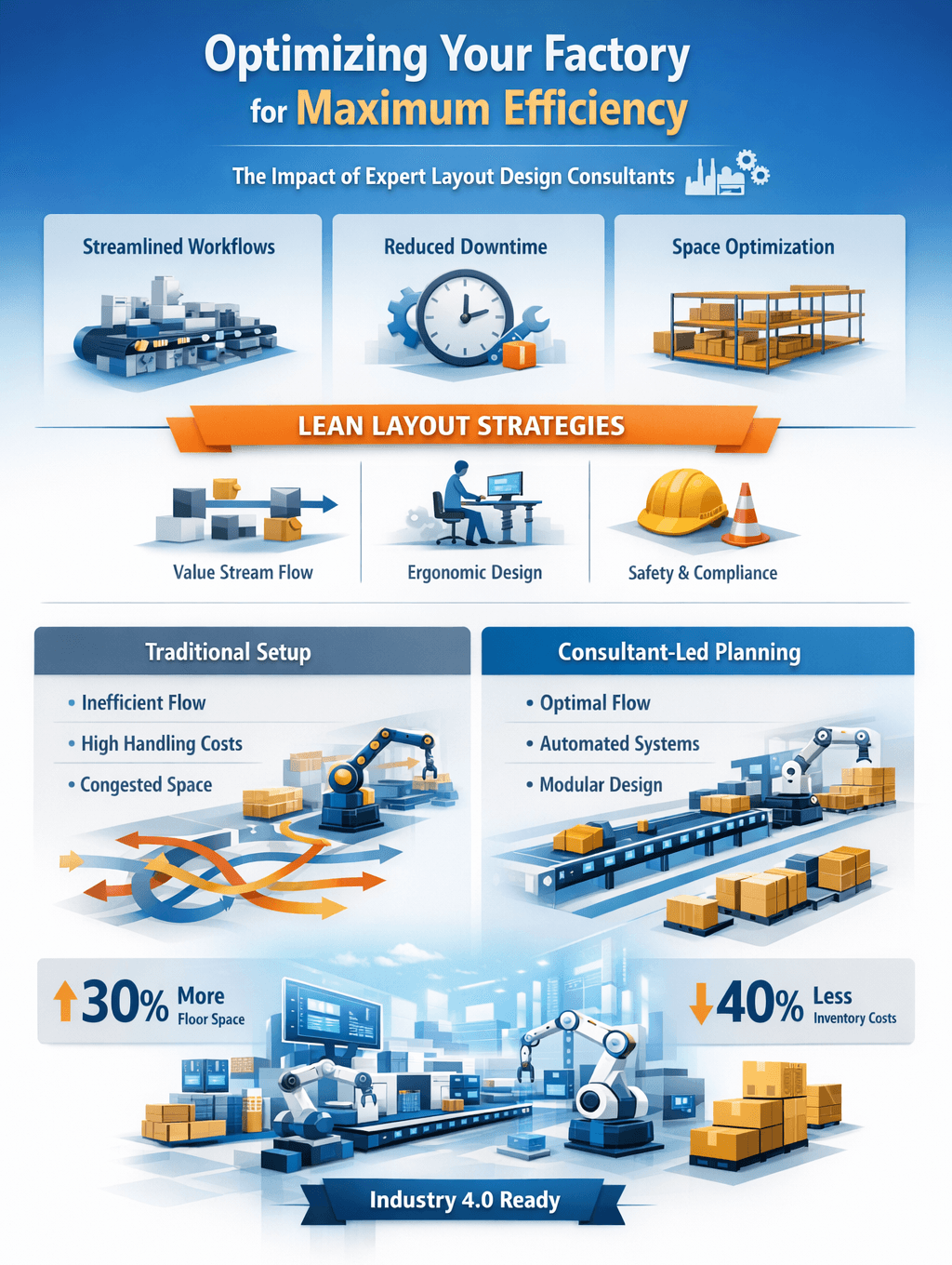
For example, by redesigning production zones to facilitate smooth material flow, companies have successfully reduced material transfer distances by over 40%. This drastic reduction in travel not only speeds up the value stream mapping process but also significantly lowers the risk of material damage and worker fatigue, leading to a much safer and more ergonomic environment.
How does a lean factory layout in Kenya eliminate hidden waste in your production line?
Adopting a lean factory layout in Kenya is perhaps the most cost-effective way to boost manufacturing efficiency. The core philosophy of a lean layout is “flow where you can, pull where you must.” This means arranging the shop floor so that work-in-progress (WIP) never sits idle.
By applying lean manufacturing layout principles, factories can move away from large, messy batches toward “one-piece flow” or “cellular manufacturing.” In these cells, all the equipment and people needed for a specific product family are grouped. This minimizes “transportation” and “waiting,” two of the most common forms of waste, and has been shown to improve labor productivity by as much as 54% in specific regional contexts.
Why is a lean manufacturing layout in Kenya the secret to drastic operational cost reduction?
The primary goal of a lean manufacturing layout in Kenya is operational cost reduction. When you reduce the physical footprint of your manufacturing process, you reduce the cost of utilities, maintenance, and rent.
Consider these benefits of a lean-optimized floor:
- Waste Reduction: By visualizing the entire value stream, you can eliminate “islands of automation” that create inventory piles.
- Productivity Improvement: Streamlined workflows ensure that workers spend more time adding value and less time walking or searching for tools.
- Cost Savings: Lower material handling efforts and optimized space utilization directly translate to a better bottom line.
Through the implementation of lean principles like the 5S methodology (Sort, Set in order, Shine, Standardize, Sustain), local firms have been able to eliminate dozens of unnecessary elements from their workstations, creating an orderly environment that fosters a culture of operational excellence.
FAQs
How does factory layout improve productivity in Kenyan factories?
A well-designed layout improves productivity by minimizing the distance materials and workers must travel. In the Kenyan context, where energy and labor costs can fluctuate, optimizing the physical flow reduces the “total travel distance of goods” and eliminates bottlenecks. This ensures that the manufacturing efficiency remains high even during peak demand periods.
What is the role of factory planning consultants in Kenya?
Factory planning consultants in Kenya act as strategic partners who manage the complexity of facility design. They assist with everything from site selection and land acquisition to detailed CAD fine layouts and equipment sourcing. Their role is to ensure that the final plant structure is flexible, sustainable, and capable of a rapid production ramp-up.
Why hire industrial planning consultants in Kenya for new projects?
Consultants provide evidence-based insights that prevent costly mistakes during the construction phase. By using simulation techniques and cost-benefit analyses, they help investors determine the most economically optimal operating point for their new factory, ensuring a faster return on investment.
Who are the top Industry 4.0 factory planning consultants in Kenya?
Leading consultants are those who integrate process modeling, automation, and infrastructure expertise. They help transition traditional factories into “future-ready” facilities by embedding digital infrastructure, such as IoT-enabled workstations and automated logistics systems, into the master plan.
Can reducing production cost through factory layout design in Kenya be achieved quickly?
Yes. Relayout projects using Systematic Layout Planning (SLP) have shown that even without purchasing new machinery, simply rearranging existing assets can reduce material handling costs by over 23%. This is one of the fastest ways to achieve cost savings and improve KPIs.
Are there specialized lean factory layout design consultants in Kenya?
Yes, several firms now offer proprietary methodologies that combine lean management with industrial engineering. These consultants focus on value stream mapping to identify and eliminate non-value-adding activities, often more than halving the manufacturing footprint while doubling output.
How did Kenyan factories improve productivity through layout design?
By shifting from traditional batch processing to cellular manufacturing and implementing 5S, many Kenyan firms have seen productivity improvements exceeding 30%. These changes facilitate a smoother flow, reduce “lost time” due to equipment setup, and create a more disciplined, high-performance work culture.
Conclusion
The evolution of the Kenyan manufacturing sector toward Industry 4.0 is an exciting journey, but it requires a solid foundation. Whether you are building a greenfield site or retrofitting an existing plant, the layout of your facility will determine your competitive edge for the next decade.