Manufacturing organizations often invest in improvement programs such as Lean, Total Productive Maintenance (TPM), and continuous improvement initiatives. However, many struggle with sustaining results over time. Processes drift, performance becomes inconsistent, and teams revert to firefighting.
The missing link in many cases is not strategy, it is execution discipline at the daily level.
This is where Daily Work Management (DWM) becomes critical.
A well-designed Daily Work Management framework ensures that operational standards are maintained, performance is visible, and issues are addressed quickly. Instead of relying on periodic reviews, DWM creates a structured system for managing work every day.
This article outlines 7 key elements of Daily Work Management that manufacturers can use to build stability, improve accountability, and strengthen operational performance.
1. Standard Work as the Foundation
The foundation of any Lean Daily Work Management system is standard work.
Standard work defines the best-known method for performing tasks consistently. It ensures that processes are not dependent on individual preference or experience alone.
In manufacturing environments, standard work helps:
- Reduce variation in execution
- Improve process predictability
- Ensure consistent quality output
- Create a baseline for improvement
Without standard work, Daily Work Management becomes reactive rather than controlled. Stability must exist before improvement can be sustained.
2. Visual Management Systems
A key component of DWM in manufacturing excellence is visibility.
Visual Daily Work Management boards make performance visible at the point of work. These boards typically display key operational metrics such as:
- Production output
- Quality performance
- Downtime
- Safety indicators
- Overall Equipment Effectiveness (OEE)
Visual management helps teams quickly identify whether operations are on or off target. When abnormalities are visible in real time, response becomes faster and more effective.
The goal is not reporting; it is immediate understanding of performance.
3. Daily Huddles with Discipline
Daily communication is essential for operational alignment.
A structured Daily Work Management huddle agenda ensures that teams focus on what matters most:
- Performance review (KPIs)
- Identification of issues
- Assignment of actions
- Follow-up on previous commitments
These short, focused meetings create rhythm and accountability. However, their effectiveness depends on discipline. Without consistency, huddles become routine discussions rather than performance-driving mechanisms.
4. Tiered Communication System
Manufacturing operations require multiple levels of coordination.
Daily Work Management tiered meetings connect frontline teams, supervisors, managers, and leadership through a structured escalation system.
This ensures that:
- Issues are raised at the right level
- Problems are not delayed or ignored
- Leadership stays connected to operational reality
- Decisions are made closer to the source of work
Tiered meetings are not just communication forums, they are escalation pathways that support faster problem resolution.
5. KPI-Driven Performance Management
Key Performance Indicators (KPIs) are central to any DWM system.
They provide measurable insight into whether operational goals are being achieved. Common manufacturing KPIs include:
- Production output
- Defect rates
- Downtime
- Delivery performance
- OEE
In a structured Daily Work Management system, KPIs are reviewed daily, not monthly, so that deviations can be addressed immediately.
This shift from lagging review to real-time management significantly improves responsiveness.
6. Standardize–Do–Check–Act (SDCA)–Based Stability Control
Sustaining performance requires stability, not just improvement.
The SDCA cycle plays a critical role in Daily Work Management. It ensures that processes are consistently followed and deviations are corrected quickly.
- Standardize: Define the best known method
- Do: Execute according to standard
- Check: Monitor performance against expectations
- Act: Correct deviations and update standards if needed
Unlike PDCA, which focuses on improvement, SDCA focuses on maintaining stability. Both are important, but SDCA is essential for daily control.
7. Leadership Gemba and Accountability
Sustainable Daily Work Management requires leadership involvement.
Gemba (going to the actual place of work) ensures leaders understand real operational conditions rather than relying solely on reports.
Leadership participation in DWM helps:
- Reinforce accountability
- Identify systemic issues
- Support frontline problem-solving
- Strengthen execution discipline
When leaders consistently engage with operations, DWM becomes part of the culture rather than a reporting exercise.
How These 7 Keys Work Together
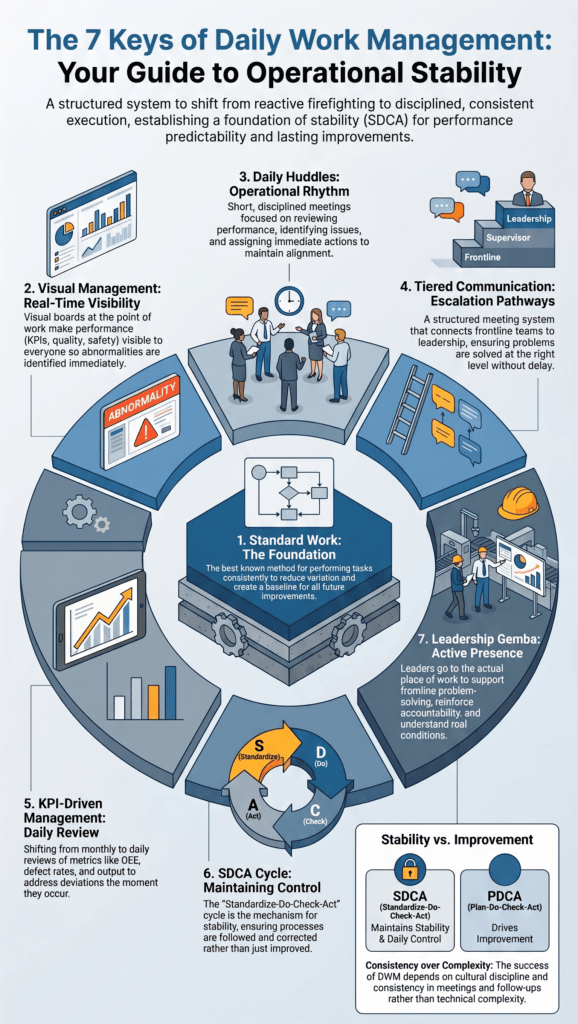
These seven elements are not independent tools; they function as a connected system.
- Standard work creates stability
- Visual management makes performance visible
- Huddles ensure daily alignment
- Tiered meetings enable escalation
- KPIs measure performance
- SDCA maintains control
- Leadership ensures discipline and accountability
Together, they form a complete Daily Work Management framework that supports Operational Excellence.
Implementation Approach for Manufacturers
Organizations can begin implementing DWM in a structured way:
- Define critical KPIs
- Establish standard work
- Introduce visual management boards
- Launch daily huddles
- Set up tiered meetings
- Apply SDCA for stability
- Strengthen leadership engagement
The key is not complexity, but consistency. Even simple systems can deliver strong results when applied discipline is maintained.
Common Challenges in DWM Implementation
Manufacturers often face challenges such as:
- Inconsistent meeting discipline
- Too many KPIs with no focus
- Lack of follow-up on actions
- Weak escalation mechanisms
- Limited leadership involvement
Addressing these requires cultural discipline rather than technical complexity.
Conclusion
Daily Work Management is not a reporting tool; it is an operational system that drives stability, accountability, and performance.
By implementing these 7 key elements, manufacturers can build a structured approach to managing daily operations, improving visibility, and sustaining Operational Excellence over time.
When properly designed and consistently applied, Daily Work Management becomes the backbone of manufacturing performance management.
FAQs
What are the key elements of Daily Work Management?
The key elements include standard work, visual management, daily huddles, tiered meetings, KPIs, SDCA, and leadership engagement.
How does Daily Work Management improve manufacturing performance?
It improves visibility, strengthens accountability, reduces delays in problem-solving, and ensures consistent execution of standards.
What is the role of visual management in DWM?
Visual management provides real-time visibility of performance, helping teams quickly identify deviations from targets.
What is the difference between Daily Work Management and continuous improvement systems like Lean or Kaizen?
Daily Work Management (DWM) focuses on maintaining operational stability through daily routines, standard work, and performance tracking. Lean and Kaizen focus on improving processes by removing waste and making incremental improvements.
In simple terms, DWM ensures stability, while Lean/Kaizen drive improvement. Both work together, but DWM forms the foundation for sustained improvement.
What is SDCA in Daily Work Management?
SDCA is a cycle used to maintain process stability through Standardize, Do, Check, and Act steps.
How can SMEs implement Daily Work Management?
SMEs can start with simple KPIs, standard work, visual boards, and daily huddles before scaling to tiered meetings and advanced systems.