
Choosing the right productivity consultants in Kenya can determine whether a manufacturing business achieves marginal operational gains or undergoes sustained, measurable performance transformation. In a competitive industrial environment shaped by rising input costs, supply chain instability, and increasing pressure for efficiency, selecting a consulting partner is a strategic decision rather than a procurement exercise.
Productivity improvement in manufacturing requires structured diagnostics, practical implementation capability, and proven industrial methodologies tailored to real factory conditions in Kenya. The right consultant directly impacts production output, cost efficiency, quality consistency, and overall operational stability.
This guide explains how to evaluate productivity consultants in Kenya, what capabilities matter most, and what manufacturers should expect from a structured manufacturing productivity improvement engagement in Kenya.
Why Choosing the Right Productivity Consultants Matters
Manufacturing performance is strongly influenced by how effectively production systems are designed, measured, and improved. A weak consulting engagement typically results in theoretical recommendations with limited execution impact. A strong one delivers measurable operational change.
Well-executed manufacturing productivity improvement initiatives typically influence:
- Production output per shift
- Machine utilization and uptime
- Labor productivity and role efficiency
- Waste reduction across processes
- Cost per unit of production
Because of these outcomes, selecting experienced factory productivity consultants is essential for sustainable competitiveness for Kenya’s industrial sector.
What Do Productivity Consultants Do for Manufacturers in Kenya?
Productivity consultants analyze, redesign, and improve manufacturing systems using structured, data-driven methodologies that target efficiency, cost, and output performance.
Some of their core responsibilities include:
- Conducting productivity assessment for manufacturers
- Identifying bottlenecks in production flow
- Reducing machine downtime and idle time
- Improving workforce productivity and task allocation
- Eliminating waste in materials, labor, and time
- Implementing structured improvement systems
- Establishing performance tracking systems
In Kenya’s manufacturing sector, consultants also address systemic constraints such as energy inefficiency, process variability, skills gaps, and fragmented operational data.
Key Criteria for Choosing Productivity Consultants in Kenya
Selecting the right consulting partner requires a structured evaluation approach focused on capability, not presentation.
1. Industry-Specific Manufacturing Experience
The consultant must understand real production environments, not just theory. Relevant sectors include:
- FMCG manufacturing
- Food processing
- Packaging and printing
- Textiles and garments
- Construction materials and light engineering
This ensures that all manufacturing productivity optimization strategies are practical and implementable for the Kenyan market.
2. Strong Diagnostic Capability
A credible engagement always begins with structured analysis. Without this, improvement efforts lack direction.
Key diagnostic tools include:
- Time and Motion Studies (TMS)
- Workflow mapping
- Machine utilization analysis
- Material flow assessment
- Quality rejection and defect tracking
This forms the foundation of any effective productivity assessment for manufacturers.
3. Mastery of Industrial Productivity Improvement Methods
Effective consultants apply globally recognized frameworks adapted to local factory conditions.
Key methods include:
- Lean manufacturing principles
- 5S workplace organization
- Total Productive Maintenance (TPM)
- Overall Equipment Effectiveness (OEE) tracking
- Bottleneck and constraint analysis
- Value Stream Mapping (VSM)
These industrial productivity improvement methods ensure inefficiencies are systematically identified and eliminated.
4. Lean Productivity Consulting Capability
Lean systems remain central to modern manufacturing improvement.
Lean productivity consulting for factories focuses on eliminating the seven wastes:
- Overproduction
- Waiting time
- Excess inventory
- Unnecessary motion
- Transportation inefficiencies
- Defects
- Overprocessing
This directly improves flow efficiency and supports manufacturing productivity improvement objectives.
5. Implementation Capability
A key differentiator is whether consultants can implement, not just recommend.
Strong productivity consultants in Kenya typically:
- Support process implementation on the shop floor
- Train teams on new operating systems
- Introduce KPI dashboards and performance routines
- Support change management and adoption
- Track improvement outcomes over time
This ensures real operational productivity enhancements for Kenya rather than static reporting.
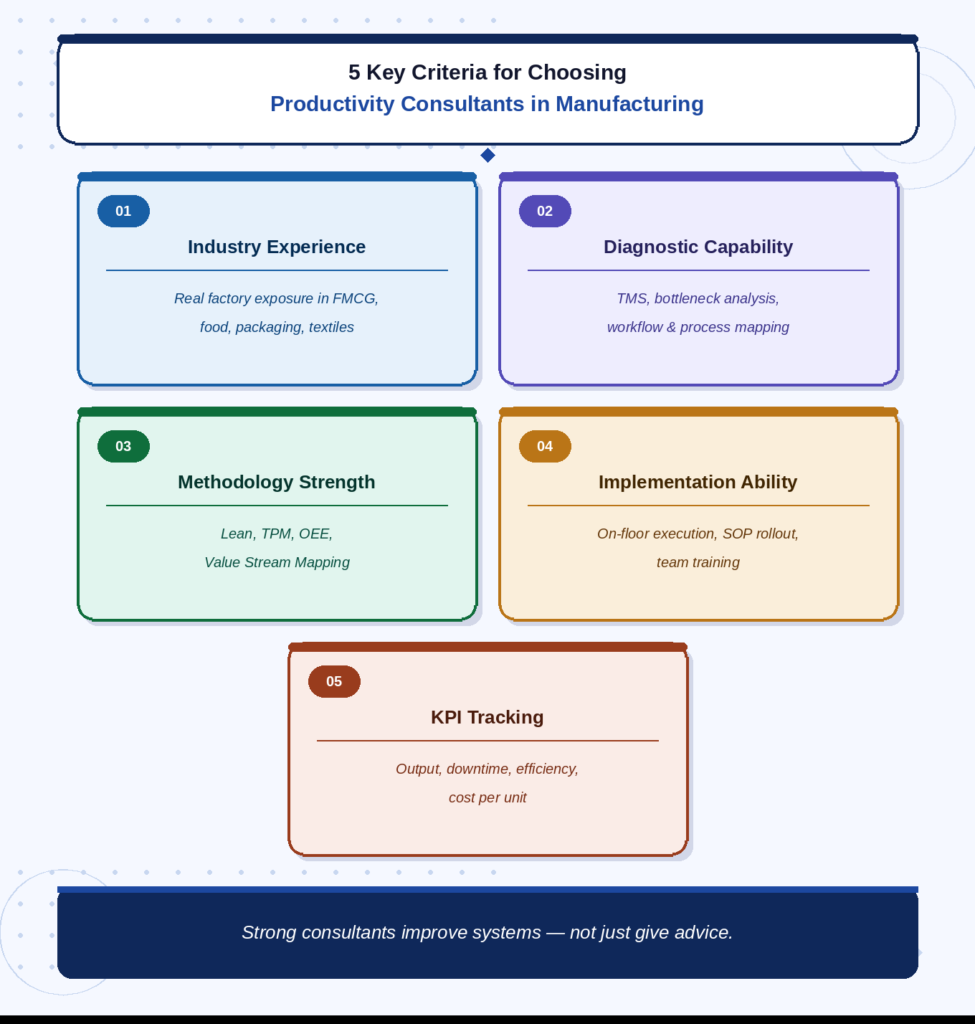
Manufacturing Productivity Improvement Kenya: What to Expect
A structured consulting engagement typically follows a clear improvement cycle:
Phase 1: Diagnostic Review
Assessment of current production systems and identification of inefficiencies.
Phase 2: Root Cause Analysis
Identification of underlying causes of inefficiency rather than symptoms.
Phase 3: Solution Design
Development of Lean-based operational improvement strategies.
Phase 4: Implementation
Execution of process improvements and workforce alignment.
Phase 5: Monitoring and Control
Performance tracking using KPIs and continuous improvement systems.
This structured approach ensures consistent delivery outcomes from manufacturing productivity services.
Red Flags When Selecting Productivity Consultants in Manufacturing
In many failed engagements, the consultant delivers a report but no structured implementation mechanism, which limits real operational impact.
Poor consulting engagements often show predictable warning signs:
- No manufacturing-specific experience
- Overly theoretical recommendations
- Lack of clear implementation roadmap
- No measurable KPIs or performance tracking
- One-size-fits-all methodologies
- Weak focus on workforce involvement
To be effective, productivity improvement consulting must always be practical, measurable, and operationally grounded.
Manufacturing Productivity Optimization in Kenya: Strategic Value
When correctly implemented, consulting-driven improvements lead to measurable operational gains:
- Higher production efficiency without capital expansion
- Reduced operational and unit costs
- Improved product quality consistency
- Faster production and delivery cycles
- Better utilization of existing assets
In many Kenyan manufacturing environments, even small efficiency improvements significantly impact competitiveness and profitability.
Why Hire Productivity Improvement Consultants in Kenya?
Experienced factory productivity consultants can help Kenyan organizations transition from reactive operations to structured performance systems.
Some of the key reasons to hire a consultant include:
- Faster identification of operational inefficiencies
- Access to proven global manufacturing best practices
- Objective external evaluation of performance gaps
- Structured and measurable improvement roadmaps
- Reduced trial-and-error in decision-making
Operational Productivity Enhancement in Kenya: Beyond Production Lines
Operational improvement extends beyond the factory floor into the broader operational system.
Some key areas where its impact can be seen include:
- Supply chain optimization
- Inventory and warehouse management
- Maintenance planning systems
- Procurement efficiency
- Data-driven operational decision-making
This ensures improvements are sustained across the entire manufacturing value chain.
Manufacturing Productivity Services Kenya: What Good Looks Like
High-quality manufacturing productivity services in Kenya should consistently deliver:
- Clear baseline performance assessment
- Structured improvement roadmap
- Hands-on implementation support
- Workforce training and engagement
- KPI-based performance monitoring
- Measurable and sustained productivity gains
These elements ensure transformation is embedded, not temporary.
Lean Productivity Consulting for Factories: Competitive Impact
Lean-driven consulting creates structural efficiency improvements across manufacturing systems.
Key outcomes include:
- Faster production cycles
- Reduced operational waste
- Improved process stability
- Better use of factory space and resources
- Improved responsiveness to demand changes
This is a core driver of manufacturing productivity improvement across industrial sectors in Kenya.
Conclusion
Choosing the right productivity consultants in Kenya is a strategic decision that directly influences manufacturing performance, cost efficiency, and long-term competitiveness.
The most effective consultants combine manufacturing expertise, structured diagnostic capability, Lean methodology application, and strong implementation discipline. Their role is not limited to analysis; they actively support operational transformation.
By applying structured industrial productivity improvement methods, conducting accurate productivity assessment for manufacturers, and ensuring execution discipline, manufacturers can achieve sustained operational excellence and performance improvement.
FAQs
What do productivity consultants do for manufacturers in Kenya?
They assess factory performance, identify inefficiencies, and implement structured systems that improve productivity, reduce waste, and enhance operational efficiency.
How do I choose the right productivity consultants in Kenya?
Look for manufacturing experience, Lean expertise, strong diagnostic capability, implementation support, and measurable KPI-driven delivery.
Why is Lean manufacturing important for Kenyan factories?
Lean systems reduce waste, improve production flow, and increase efficiency without requiring major capital investment.
How does productivity consulting benefit manufacturing in Kenya?
It improves efficiency, reduces costs, enhances quality consistency, and strengthens overall operational performance.
What are the key productivity improvement methods used in factories?
Lean manufacturing, 5S, TPM, OEE tracking, bottleneck analysis, and value stream mapping are the most widely used methods.