Manufacturing in Kenya is undergoing a structural shift driven by rising production costs, energy price volatility, import competition, and increasing demand for consistent quality in both local and export markets.
In this environment, the gap between high-performing and underperforming factories is no longer about capacity; it is about productivity discipline and operational execution.
This is why productivity consultants in Kenya are increasingly being engaged to help manufacturers replace reactive problem-solving with structured, data-driven production systems that improve efficiency, reduce waste, and increase output.
This article explains how productivity improvement transforms Kenyan factories, the methods used in real industrial environments, and the systems that consistently deliver measurable performance gains.
The State of Manufacturing Productivity in Kenya
While Kenya’s manufacturing sector contributes significantly to GDP and employment, many factories still operate below optimal efficiency levels due to structural and operational constraints.
Common realities in production environments include:
- Frequent machine stoppages and unplanned downtime
- Inconsistent production scheduling across shifts
- High rework rates
- Manual reporting systems with delayed decision-making
- Uneven workforce productivity across teams
- Poor alignment between maintenance and production planning
In many factories, 15–35% of potential output is typically lost through preventable inefficiencies rather than capacity limitations.
This is where manufacturing productivity improvement programs in Kenya become essential for helping factories eliminate inefficiencies and improve long-term operational performance.
What Productivity Improvement Really Means
Productivity improvement in manufacturing is not simply about increasing speed or pushing workers harder.
It is the systematic improvement of:
- Output per machine hour
- Output per labor hour
- Material yield efficiency
- Energy utilization per unit produced
- Process stability and predictability
In practical terms, it means:
Producing more consistent output using the same or fewer resources, without compromising quality.
The real goal is stable, repeatable efficiency, not short-term output spikes.
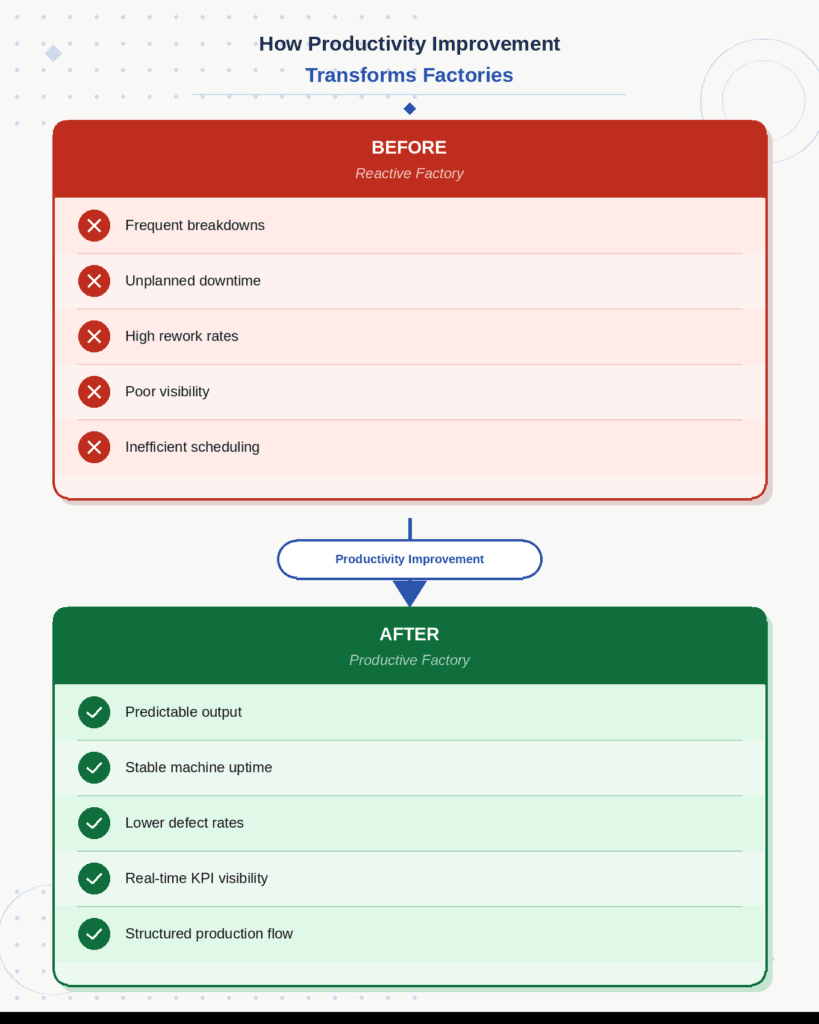
How Productivity Improvement Transforms Kenyan Factories
In many factories, meaningful productivity gains come from improving existing systems rather than investing immediately in additional equipment or production lines. It happens through structured operational shifts that change how factories think, measure, and execute work.
1. From Reactive Operations to Data-Driven Management
Many factories in Kenya still operate reactively; problems are solved only after they occur.
Through manufacturing productivity services, consultants help factories shift from reactive decision-making to real-time operational management using KPIs such as:
- Overall Equipment Effectiveness (OEE)
- Downtime frequency and classification
- Cycle time per process stage
- First-pass yield and defect rates
This shift alone often improves decision-making speed and reduces recurring failures.
2. Systematic Waste Elimination Across Production
A large portion of inefficiency in factories comes from hidden waste, not obvious failures.
Common forms include:
- Waiting time between processes
- Excess movement of materials
- Overproduction in batching systems
- Rework due to inconsistent quality control
- Unnecessary approvals and manual handling
Using structured industrial productivity improvement methods, these losses are systematically removed rather than temporarily reduced.
3. Machine Utilization and Uptime Optimization
Many factories invest heavily in equipment but fail to maximize its operational time.
Productivity consultants focus on:
- Reducing unplanned downtime
- Improving preventive maintenance systems
- Optimizing changeover time between batches
- Aligning production scheduling with machine capacity
Even a 10–15% improvement in uptime can significantly increase total output without additional capital investment.
Many manufacturers assume that purchasing additional equipment will solve production constraints. In reality, consultants frequently discover that existing machines spend more time waiting for materials, operators, or maintenance support than actually producing. Improving equipment availability and scheduling frequently delivers higher output without increasing capital expenditure.
4. Workforce Productivity and Standardization
Human performance variability is a major driver of inefficiency.
Improving operational productivity requires manufacturers to focus on:
- Standard operating procedures (SOPs)
- Task balancing across shifts
- Skills alignment and targeted training
- Reduction of unnecessary motion and manual effort
This creates consistency in output regardless of shift or operator.
5. Factory Layout and Flow Optimization
Poor plant layout is one of the most overlooked causes of inefficiency.
Through Lean productivity consulting, manufacturers often:
- Reduce material travel distance
- Eliminate bottlenecks in process flow
- Reorganize workstations for sequence alignment
- Minimize handling and waiting time
This often delivers immediate productivity gains without new equipment.
What Productivity Consultants in Kenya Actually Do
Productivity consultants in Kenya function as structured problem-solvers who diagnose, redesign, and improve manufacturing systems.
Their core responsibilities include:
- Conducting operational diagnostics and audits
- Mapping production workflows end-to-end
- Identifying bottlenecks and loss points
- Designing improvement roadmaps
- Supporting implementation on the shop floor
- Establishing measurable performance tracking systems
Their value lies in combining external objectivity with proven industrial methodologies, allowing manufacturers to identify operational constraints that internal teams may overlook.
Core Industrial Productivity Improvement Methods
Most successful transformation programs rely on globally proven systems adapted to local manufacturing conditions.
Lean Manufacturing
Focuses on eliminating non-value-adding activities and improving flow efficiency.
Kaizen (Continuous Improvement)
Encourages small, incremental improvements driven by employees at all levels.
5S Workplace Organization
Improves discipline, safety, and efficiency on the shop floor.
Total Productive Maintenance (TPM)
Reduces breakdowns by integrating operators into maintenance systems.
Value Stream Mapping (VSM)
Visualizes production flow to identify inefficiencies and delays.
These methods form the foundation of manufacturing productivity optimization initiatives across Kenya’s industrial sector.
When these methods are implemented together rather than as isolated projects, manufacturers create production systems that are more predictable, efficient, and easier to scale as demand grows.
Productivity Assessment for Manufacturers
Every effective transformation begins with a structured productivity assessment.
This typically evaluates:
- Machine utilization rates
- Labor productivity per shift
- Downtime patterns and causes
- Material yield and waste levels
- Quality rejection rates
The result is a clear baseline of operational performance and improvement priorities.
Without this step, improvement programs often lack direction and measurable impact.
Why Productivity Consulting Matters in Kenya
Productivity improvement consulting gives manufacturers access to proven industrial methodologies and an objective assessment of factory performance. It provides them with:
- External benchmarking perspective
- Dedicated improvement bandwidth
- Exposure to cross-industry best practices
- Structured implementation frameworks
Consulting introduces speed, structure, and objectivity into improvement efforts.
Business Impact of Productivity Improvement
The value of productivity improvement extends beyond higher production volumes. Manufacturers often experience operational, financial, and strategic benefits that strengthen long-term competitiveness.
When implemented correctly, productivity improvement delivers measurable outcomes across three levels:
Operational Impact
- Higher output per shift
- Reduced downtime
- Improved process stability
Financial Impact
- Lower cost per unit
- Reduced waste and rework
- Improved profit margins
Strategic Impact
- Stronger market competitiveness
- Scalable production systems
- Improved delivery reliability
How to Improve Productivity in Kenyan Manufacturing
Sustainable improvement follows a structured sequence:
- Conduct a full productivity audit
- Map and analyze production workflows
- Identify bottlenecks and waste points
- Implement lean-based improvements
- Strengthen maintenance systems
- Train workforce for standard execution
- Introduce real-time performance tracking
Improvement is continuous; not a one-time intervention.
Which Methods Work Best in Kenyan Factories
The most effective approaches include:
- Lean manufacturing systems
- 5S workplace organization
- TPM maintenance systems
- OEE-based performance tracking
- Process standardization frameworks
Why Productivity Improvement Is a Strategic Priority
Kenyan manufacturers are increasingly competing not only locally but also within regional and global supply chains.
Without structured productivity systems, companies face:
- Higher cost per unit
- Lower responsiveness to demand
- Reduced competitiveness in export markets
Productivity improvement is therefore not just operational; it is strategic.
Conclusion
Productivity improvement is the foundation of modern manufacturing competitiveness in Kenya.
Factories that adopt structured improvement systems move from reactive firefighting to predictable, data-driven performance management.
Through manufacturing productivity improvement programs in Kenya, supported by structured consulting and continuous improvement practices, manufacturers can significantly improve efficiency, reduce waste, and strengthen long-term profitability.
The key difference is simple:
High-performing factories do not work harder; they operate more intelligently through structured systems.
FAQs
What do productivity consultants do for manufacturers in Kenya?
They analyze factory operations, identify inefficiencies, and implement structured improvement systems that increase output, reduce waste, and improve efficiency.
How does productivity improvement transform factories?
It improves machine utilization, reduces downtime, stabilizes workflows, and increases output without requiring major capital investment.
Which methods are most effective in Kenyan manufacturing?
Lean manufacturing, 5S, TPM, OEE tracking, and continuous improvement systems are the most widely used and effective.
Why is productivity consulting important?
It provides structured frameworks, external expertise, and faster implementation of proven industrial improvement systems.
What is the first step in productivity improvement?
A structured productivity assessment that measures current performance and identifies bottlenecks and inefficiencies.