
Environmental, Social, and Governance (ESG) considerations are becoming increasingly important for organizations operating in Kenya. While ESG compliance is still evolving and not yet uniformly mandated across all sectors, expectations around sustainability reporting, transparency, and responsible business practices are steadily increasing. This is where an ESG consultant plays a critical role, helping organisations understand what is expected and how to respond.
Organizations are now being influenced by a combination of investor expectations, financial sector requirements, global supply chain standards, and emerging regulatory guidance. As a result, ESG is shifting from a voluntary sustainability initiative to a core business expectation.
At Faber Infinite, we see ESG reporting not as a compliance burden, but as a structured way for organizations to understand their risks, improve transparency, and strengthen long-term decision-making.
Key Takeaways
- ESG compliance in Kenya is evolving, with increasing expectations from investors, regulators, and global markets.
- Sustainability reporting is becoming more important for listed companies, financial institutions, and export-oriented businesses.
- ESG reporting helps organizations improve transparency, governance, and risk awareness.
- There is no single unified ESG law in Kenya, but multiple frameworks and guidance systems influence reporting expectations.
- ESG consultants help organizations build structured reporting and governance frameworks aligned with global standards.
Understanding ESG in the Kenyan Context
ESG refers to the environmental, social, and governance factors that influence how an organization operates and creates long-term value.
In Kenya, ESG is not defined by a single regulatory framework. Instead, it is shaped by a combination of:
- Market expectations
- Industry-specific guidelines
- Investor requirements
- International sustainability standards
- Emerging regulatory initiatives
This means ESG adoption is often driven by business necessity rather than strict legal enforcement.
Environmental, Social, and Governance Factors
Environmental Factors
Environmental considerations relate to how organizations manage their impact on natural systems, including:
- Energy use and efficiency
- Carbon emissions
- Waste management
- Water usage
- Climate-related risks
Social Factors
Social elements focus on how organizations impact people and communities, including:
- Employee health and safety
- Labor practices
- Diversity and inclusion
- Community engagement
- Human rights considerations
Governance Factors
Governance refers to how organizations are directed and controlled, including:
- Board oversight
- Ethical conduct
- Transparency and accountability
- Risk management systems
- Anti-corruption practices
Together, these factors form the foundation of environmental social governance practices.
Is ESG Compliance Mandatory in Kenya?
One of the most common questions businesses ask is whether ESG compliance is legally mandatory in Kenya.
At present, there is no single unified ESG law that requires all organizations to publish standardized sustainability reports. However, ESG-related expectations are increasingly emerging through:
- Sector-specific regulatory guidance
- Financial institution requirements
- Stock exchange disclosure expectations
- International reporting frameworks (used by Kenyan companies)
For example, listed companies and financial institutions are increasingly expected to provide greater transparency on sustainability-related risks and governance practices.
While Kenya does not yet have a single comprehensive ESG law, organizations increasingly monitor guidance and evolving market expectations from institutions such as the Capital Markets Authority (CMA) and the Nairobi Securities Exchange (NSE), particularly regarding corporate governance, sustainability disclosures, and risk management practices.
As a result, ESG compliance in Kenya is best understood as an evolving set of expectations rather than a fixed legal requirement.
ESG Reporting Requirements and Emerging Expectations
Although ESG reporting is not uniformly mandated, organizations in Kenya are increasingly expected to disclose sustainability-related information in structured ways.
These expectations are particularly relevant for:
- Listed companies
- Financial institutions
- Multinational suppliers
- Export-oriented businesses
- Organizations seeking external investment
Reporting expectations often relate to:
- Environmental impact disclosures
- Social responsibility practices
- Governance structures and policies
- Risk management approaches
- Sustainability performance indicators
As global standards evolve, Kenyan organizations are increasingly aligning with internationally recognized frameworks.
Common ESG Reporting Frameworks Used in Kenya
Organizations typically rely on global sustainability frameworks to guide ESG reporting practices.
Global Reporting Initiative (GRI)
The GRI framework is widely used for sustainability reporting and helps organizations disclose their environmental, social, and governance impacts in a structured way.
IFRS Sustainability Disclosure Standards
Developed to improve consistency in sustainability-related financial disclosures, the IFRS Sustainability Disclosure Standards are increasingly influencing global ESG reporting practices.
Task Force on Climate-related Financial Disclosures (TCFD)
TCFD focuses on climate-related risks and opportunities and is widely used to assess how climate factors may affect business performance.
These frameworks are not always legally required in Kenya, but they are increasingly used as reference points for credible ESG reporting.
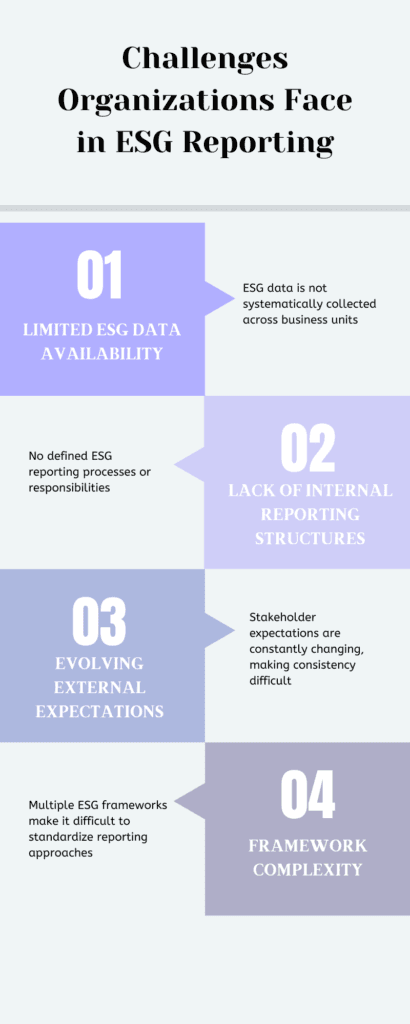
Challenges Organizations Face in ESG Reporting
Many organizations in Kenya are still developing their ESG reporting capabilities and face several common challenges.
Limited ESG Data Availability
Data required for ESG reporting is often not systematically collected across business units.
Lack of Internal Reporting Structures
Many organizations do not yet have defined ESG reporting processes or responsibilities.
Evolving External Expectations
Stakeholder expectations continue to change, making it difficult for organizations to keep reporting approaches consistent.
Framework Complexity
Multiple ESG frameworks exist, making it challenging to determine which is most relevant.
These challenges highlight the need for structured ESG consultant advisory support.
How ESG Consultants Support Compliance and Reporting
An ESG consultant in Kenya helps organizations navigate the evolving ESG landscape by building structured approaches to reporting and sustainability management.
At Faber Infinite, this support is focused on clarity, alignment, and practical integration into business operations.
Materiality Assessments
An ESG consultant conducts materiality assessments to help organizations identify the ESG issues that matter most to their business and stakeholders.
This ensures reporting efforts are focused and relevant.
ESG Reporting Framework Alignment
ESG consultants help organizations align reporting practices with recognized frameworks such as GRI and ISSB, depending on business needs and stakeholder expectations.
ESG Data Structuring
A key challenge in ESG reporting is organizing relevant data.
Consultants help organizations identify what data is needed and how it can be systematically collected and managed.
Governance and Accountability Structures
Strong governance is essential for effective ESG reporting, and an ESG consultant helps define the structures that make it work.
Consultants support organizations in defining responsibilities and improving oversight structures.
Stakeholder Expectation Alignment
Understanding stakeholder expectations helps organizations ensure that ESG disclosures are meaningful and decision-useful.
The Business Value of ESG Reporting
Beyond compliance expectations, ESG reporting provides several strategic benefits for organizations.
Improved Transparency
Clear reporting helps stakeholders understand how an organization manages sustainability risks and opportunities.
Stronger Risk Awareness
ESG reporting helps organizations identify potential risks earlier and respond proactively.
Enhanced Investor Confidence
Investors increasingly consider ESG performance when making long-term investment decisions.
Better Strategic Decision-Making
ESG reporting provides structured insights that support business planning and governance.
The Evolving ESG Landscape in Kenya
The ESG landscape in Kenya is still developing, but expectations are clearly increasing.
Rather than being driven by strict regulation alone, ESG adoption is being shaped by market forces, global standards, and stakeholder expectations.
Organizations that begin building ESG reporting capabilities early are better positioned to adapt as expectations continue to evolve.
At Faber Infinite, we believe that ESG reporting should ultimately support better decision-making, stronger governance, and long-term resilience, not just compliance with external expectations.
Frequently Asked Questions
Is ESG compliance mandatory in Kenya?
There is currently no single mandatory ESG law for all organizations in Kenya. However, ESG reporting expectations are increasing through investors, financial institutions, and international standards.
What are ESG reporting requirements in Kenya?
ESG reporting requirements are not fully standardized but are influenced by global frameworks such as GRI, IFRS Sustainability Standards, and TCFD, as well as sector-specific expectations.
What is ESG reporting?
ESG reporting is the process of disclosing information related to an organization’s environmental, social, and governance performance.
How do ESG consultant help with reporting?
ESG consultants help organizations identify material issues, align with reporting frameworks, structure ESG data, and develop governance processes to support sustainability disclosures.
Contact us