Operating a profitable industrial plant requires keeping machine availability at its absolute peak. As manufacturing sectors expand to meet both domestic demands and export opportunities, local companies in Egypt face severe macroeconomic pressures. Rising asset replacement costs, localized supply chain disruptions, and strict foreign currency regularizations make importing heavy industrial components highly challenging. Under these conditions, relying on reactive, “run-to-failure” maintenance habits is a direct threat to a company’s bottom line.
When a critical production line stops unexpectedly, the financial damage extends far beyond repair costs. It ruins production schedules, creates idle labor overhead, and delays customer shipments. To shield operations from these vulnerabilities and dramatically increase productivity in manufacturing, forward-thinking industrial leaders are shifting from emergency repairs to a structured Total Productive Maintenance (TPM) framework.
By changing how equipment care is handled, moving it from an isolated cost center to a core driver of Operational Excellence, factories can unlock significant hidden capacity from their existing machinery.
The Hidden Drain: How Breakdown Cultures Hurt Factory Efficiency in Egypt
In many conventional manufacturing plants across the country, a distinct wall exists between the teams that run the machinery and the teams that fix it. Operators focus exclusively on output volumes, frequently overlooking early warning signs like subtle vibrations, minor oil leaks, or unusual acoustic signatures. Meanwhile, the maintenance team operates in a perpetual state of crisis management, rushing from one major breakdown to another.
This reactive loop severely damages factory efficiency in Egypt due to several specific operational challenges:
- Extended Spare Parts Lead Times: Because specialized mechanical and electronic components often must be sourced internationally, import clearance delays can turn a minor machine fault into days or weeks of costly, unplanned downtime.
- Accelerated Asset Depreciation: Pushing legacy machinery to its absolute limits without routine, systematic care causes premature wear, driving up long-term capital expenditure (CapEx) needs.
- Compounded Process Waste: Sudden machine stoppages cause massive material waste, particularly in continuous-process industries like plastics, chemicals, and food processing, where material inside the line spoils during a halt.
To build sustainable manufacturing productivity improvement strategies for Egypt, organizations must transition away from crisis management. Sustainable operational improvement requires an integrated approach where asset reliability becomes everyone’s daily responsibility.
Reactive maintenance often begins with minor equipment abnormalities; such as unusual vibrations, small oil leaks, or abnormal machine noise; that go unnoticed or unaddressed. Over time, these seemingly insignificant issues can develop into major equipment failures, resulting in costly unplanned downtime and production disruptions. Total Productive Maintenance (TPM) breaks this reactive cycle through autonomous inspections, early fault detection, and continuous equipment care. This proactive approach improves asset reliability, prevents breakdowns before they occur, and maximizes equipment availability.
The 3 High-Impact Pillars of TPM for Industrial Plants
Total Productive Maintenance is a comprehensive optimization methodology built upon eight foundational pillars designed to maximize Overall Equipment Effectiveness (OEE). For facilities seeking rapid, measurable factory productivity improvement methods in Egypt, focusing resources on three core pillars provides the fastest return on investment.
1. Autonomous Maintenance (Jishu Hozen)
Autonomous maintenance eliminates the traditional divide between operations and maintenance. Under this framework, shop floor operators are thoroughly trained to take direct ownership of the basic daily upkeep of their specific workstations.
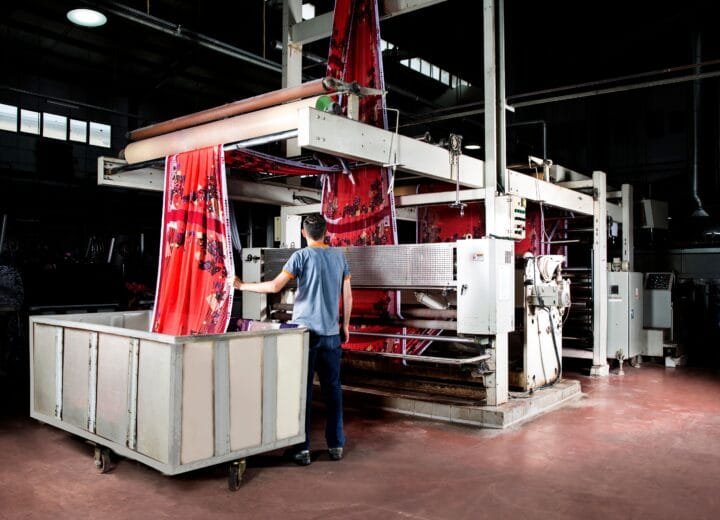
Instead of waiting for a technician, operators perform routine cleaning, precise lubrication, visual inspections, and minor bolt tightening. This ensures that minor deviations are caught and corrected before they evolve into major failures. For instance, in a large-scale textile plant, daily autonomous cleaning of dust and lint accumulation from high-speed loom sensors can reduce micro-stoppages by more than 20% within the first two months.
2. Planned Maintenance
Planned maintenance moves the facility from a reactive state to a data-driven, preventative, and predictive posture. By analyzing historical breakdown data, wear patterns, and manufacturer recommendations, the engineering team establishes highly accurate maintenance schedules.
This allows the factory to execute complex servicing during planned, off-peak windows rather than suffering random shutdowns during high-priority production runs. This structured approach is essential for reducing downtime to improve manufacturing productivity in Egypt, keeping production steady, and systematically extending the operational lifecycle of legacy plant machinery.
3. Focused Improvement (Kobetsu Kaizen)
Focused improvement involves forming cross-functional teams: comprising operators, maintenance engineers, and quality specialists; to permanently resolve recurring bottlenecks on the production floor.
Instead of repeatedly applying temporary fixes to chronic equipment issues, these teams utilize structured root-cause analysis tools like the 5 Whys and Fishbone (Ishikawa) diagrams. This systematic methodology isolates and designs out chronic faults, serving as a powerful engine for continuous process optimization and structural cost reduction.
TPM Pillar Implementation Matrix
| TPM Pillar | Core Daily Action | Operational Impact |
| Autonomous Maintenance | Operators conduct daily cleaning, lubrication, and visual safety checks. | Eliminates micro-stoppages; fosters deep workforce ownership. |
| Planned Maintenance | Engineering schedules data-driven preventive maintenance interventions. | Lowers emergency repair costs; reduces dependency on rushed spare parts. |
| Focused Improvement | Cross-functional teams resolve root causes of chronic machinery faults. | Boosts OEE; drives long-term production efficiency gains. |
Integrating TPM with Industry 4.0 Manufacturing in Egypt
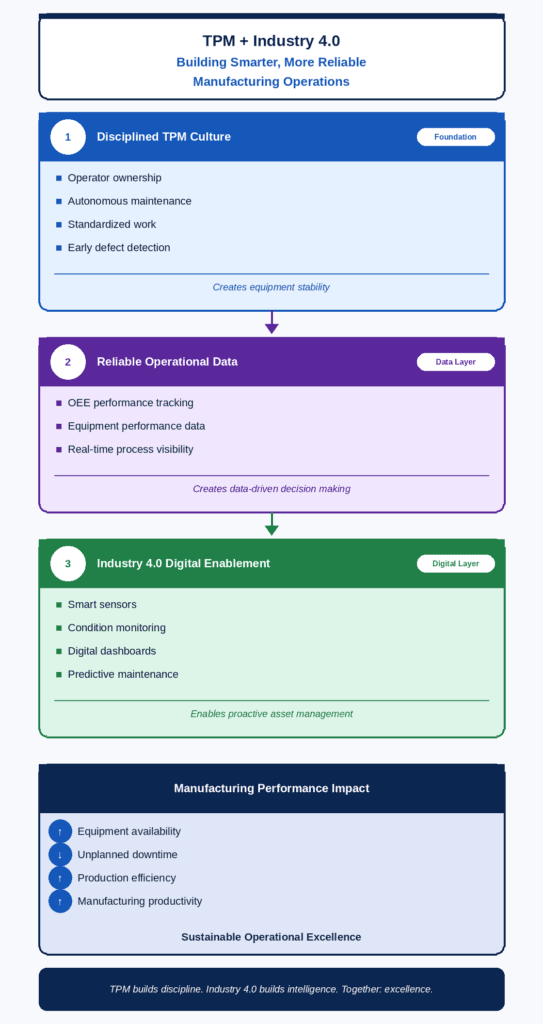
Implementing advanced digital technologies on top of a disorganized, unstable maintenance process simply automates existing inefficiencies. However, when modern digital tools are integrated into an already disciplined TPM culture, the resulting combination accelerates manufacturing productivity across Egypt to international standards.
A disciplined TPM culture provides the operational foundation needed to successfully adopt Industry 4.0 technologies. When operators consistently perform standardized inspections and maintenance activities, they generate reliable operational data that enhances Overall Equipment Effectiveness (OEE) monitoring. This data can then be leveraged through digital tools, real-time dashboards, and connected sensors to enable condition monitoring, predictive maintenance, and more informed maintenance planning. Together, TPM and Industry 4.0 create a scalable approach to improving equipment reliability and manufacturing productivity.
Through a phased deployment of Industry 4.0 manufacturing in Egypt, factories can upgrade from standard time-based maintenance intervals to real-time, condition-based monitoring.
By implementing real-time equipment monitoring and data-driven maintenance practices on critical production assets, factories can gain continuous visibility into machine performance and operating conditions. Early signs of equipment degradation can be identified before they develop into major failures, allowing maintenance teams to plan interventions, optimize spare parts management, and schedule repairs with minimal disruption. This improved visibility strengthens operations management by enabling faster, more informed decision-making, helping organizations reduce unplanned downtime, improve production efficiency, and maximize overall equipment performance.
A Practical Blueprint for Implementing TPM Successfully
Transforming a factory’s maintenance culture requires a practical, step-by-step roadmap to ensure new habits stick long-term.
Step 1: Conduct a Cleanliness and Condition Audit
Begin by restoring selected pilot machinery to an “as-new” baseline condition. Clean the equipment thoroughly to expose hidden defects such as cracks, oil leaks, or loose wiring. Document all findings to establish an accurate equipment health baseline.
Step 2: Establish Visual Standards and SOPs
Create highly visual Standard Operating Procedures (SOPs) right at the workstation. Use color-coded lubrication points, clear pressure-gauge boundary markers, and simple photo checklists. This visual management ensures that autonomous maintenance tasks are performed consistently across all shifts, regardless of individual operator experience levels.
Step 3: Run a Strategic Time and Motion Study
Incorporate a targeted Time and Motion Study to increase productivity in Egypt during changeovers and routine maintenance tasks. Analyzing how tools are retrieved and how machine components are adjusted helps teams streamline maintenance workflows. This minimizes setup times and shortens the Mean Time to Repair (MTTR).
Step 4: Implement Short Interval Control
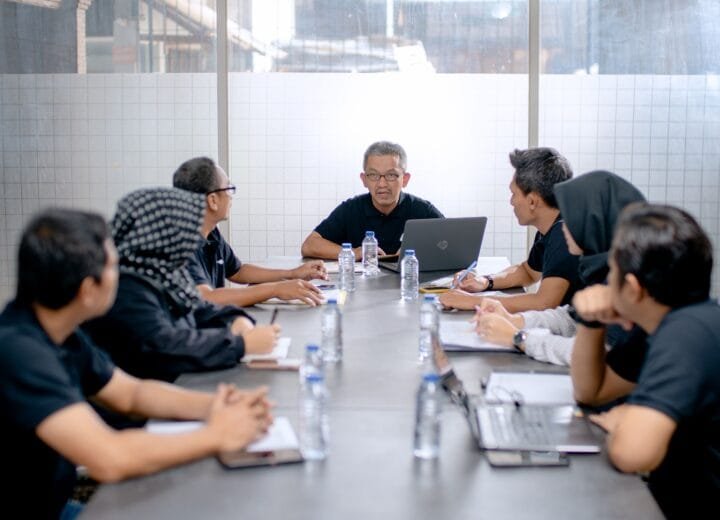
Track OEE, availability, and quality metrics daily through brief, cross-functional floor meetings. Reviewing machine performance data every shift allows teams to spot negative trends early, keeping the entire facility aligned around a shared goal of continuous improvement.
Expert Strategic Insight: TPM is not a temporary maintenance initiative; it is a fundamental shift in operational culture. Long-term success requires leadership commitment to providing operators with the training, tools, and dedicated time needed to care for their equipment properly.
Frequently Asked Questions (FAQs)
How does TPM directly help increase productivity in manufacturing?
TPM drives productivity by eliminating the primary sources of equipment loss, such as unplanned breakdowns, slow cycle speeds, and startup defects. By maximizing machine availability and performance efficiency, factories can complete higher production volumes using their existing assets.
Can Lean Manufacturing and TPM be implemented together?
Yes, TPM is a vital component of the broader Lean Manufacturing framework. While Lean focuses on identifying and eliminating waste across the entire value stream, TPM stabilizes the underlying equipment. This ensures production processes run reliably without sudden breakdowns disrupting the flow.
How can factories reduce the impact of long spare parts lead times?
By moving from reactive maintenance to a data-driven planned maintenance strategy, factories can identify component wear weeks before a potential failure occurs. This gives procurement teams the necessary lead time to handle import regulations and maintain lean, cost-effective backup inventory.
Is a major technology investment required to start with TPM?
No, TPM focuses primarily on operational discipline, behavioral shifts, and process standardization. While utilizing digital solutions for manufacturing productivity in Egypt helps scale and sustain results, the foundation relies entirely on practical shop floor habits like autonomous cleaning, visual inspections, and standardized lubrication routines.
How can we encourage operators to take ownership of machine maintenance?
Begin by providing comprehensive, practical training to build their technical confidence. In addition, ensure management actively supports the transition by recognizing operator achievements and providing dedicated time during each shift for autonomous maintenance tasks.